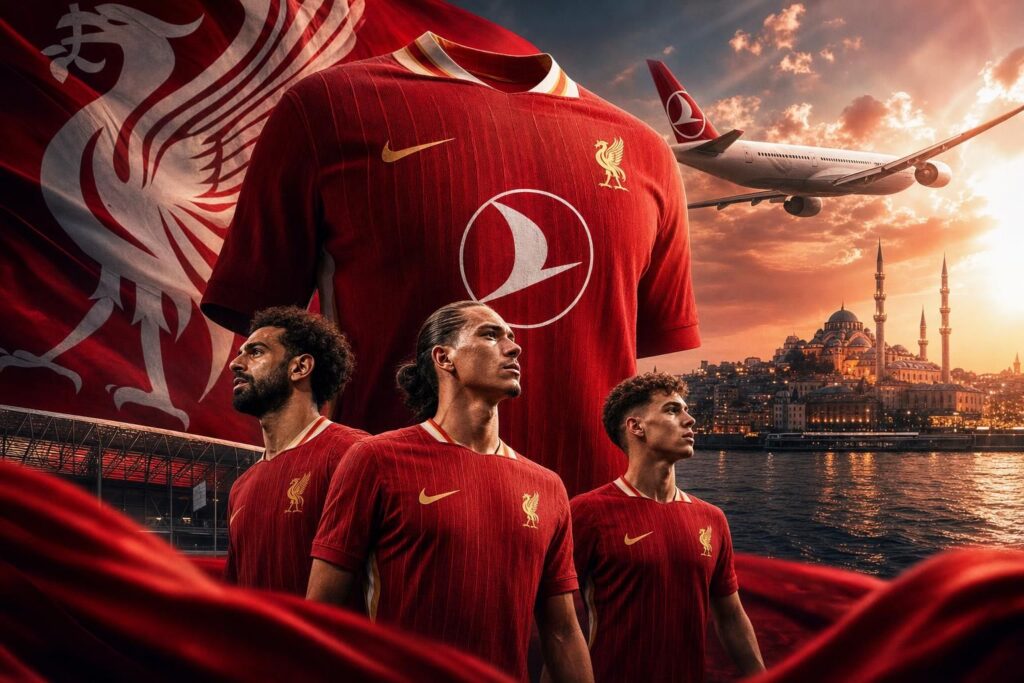
Liverpool confirm £60m-plus annual Turkish Airlines sponsorship from 2027, replacing Standard Chartered and setting new Premier League commercial benchmark.
Liverpool’s Turkish Airlines sponsorship deal is reportedly worth more than £300m across five years, with the airline becoming the club’s main partner from June 1, 2027. The agreement will put Turkish Airlines on the front of Liverpool’s men’s, women’s and Academy match shirts and represents the club’s first change of main partner in 17 years.
Turkish Airlines will replace Standard Chartered, whose current front-of-shirt agreement is understood to be worth around £50m per season. The new deal is reported to exceed £60m annually, while Standard Chartered will remain associated with Liverpool as a global partner from 2027-28.
Liverpool Turkish Airlines Sponsorship Deal Explained
The Liverpool Turkish Airlines sponsorship deal puts the club at the very top end of Premier League commercial partnerships. The financial terms were not disclosed by Liverpool itself, but the agreement is widely reported to be worth more than £300m across five years, broadly comparable with Manchester United’s Snapdragon arrangement. Liverpool’s ability to command that valuation reflects a commercial operation that generated £323m of revenue in the year ending May 2025, within total club revenue of £703m.
The timing is significant because Liverpool are also entering a new ownership phase. In August, FSG entered into a definitive agreement to sell a minority equity stake in the club to 1892 Holdings, a consortium led by Amit Bhatia and including investment connected to the Mittal family, K5 Sports and Eduardo Saverin’s family office. The sponsorship deal does not fund that transaction, but both developments underline how valuable Liverpool has become as a global sports business.
Turkish Airlines’ appointment also carries symbolic weight for Liverpool supporters. The club’s commercial chief Ben Latty referenced “those special memories back in 2005 in Istanbul,” pointing to Liverpool’s Champions League victory against AC Milan at Ataturk Olympic Stadium. The connection between the airline and that iconic European success provides narrative continuity for a club that has long understood the power of commercial storytelling.
What Premium Sponsorship Actually Buys
The most useful way to understand the deal is as a recurring revenue uplift. Standard Chartered’s current agreement is reported at roughly £50m a season, while Turkish Airlines is expected to pay more than £60m annually. That additional commercial income gives Liverpool more financial flexibility across recruitment, infrastructure and operating costs without depending entirely on broadcasting or player sales.
Arsenal’s recent commercial negotiations illustrate the competitive pressure. The Gunners are understood to have targeted sponsorship deals worth £50m plus annually as part of their commercial growth strategy, though Arsenal’s current Emirates arrangement remains their primary revenue source. Manchester City, despite their dominance on the pitch, have not secured a comparable shirt deal, partly because of sponsor complications and partly because City’s commercial operations follow a different model centred on parent company City Football Group.
The new Liverpool deal is also notably broader in scope than some historical sponsorships. Turkish Airlines will appear on the front of the men’s shirts, women’s shirts and academy match shirts, reflecting modern commercial reality where club sponsorships increasingly encompass entire organisational structures rather than solely the first-team men’s operation. This multi-platform approach increases the sponsorship’s tangible value.
The Broader Commercial Context
Liverpool’s ability to secure such a substantial deal speaks to several wider trends in football commerce. First, the global reach of elite English clubs means premium international brands like Turkish Airlines see genuine value in association with Liverpool’s fanbase and global platform. Second, Premier League clubs collectively command higher sponsorship valuations than their European counterparts, a reflection of the league’s broadcasting revenue and commercial infrastructure. Third, the willingness of companies like Turkish Airlines to commit substantial sums reflects confidence in the sponsorship’s commercial return, whether through brand exposure or hospitality arrangements.
The size of the deal also shows how sophisticated elite football sponsorship has become. Front-of-shirt inventory is scarce, global exposure is enormous and clubs with genuinely international audiences can create competition among major brands for one of the most visible positions in sport.
Standard Chartered’s transition from primary sponsor to global partner is tactically valuable for Liverpool. The bank’s 17-year association with the club has been commercially successful and loyal, and converting that relationship into a different structure maintains brand continuity while enabling the new Turkish Airlines partnership. For Standard Chartered, remaining connected to Liverpool without the front-of-shirt obligation provides ongoing brand association at reduced cost.
What This Means for the Rest
Liverpool’s Turkish Airlines sponsorship will inevitably reset expectations across the Premier League. Clubs currently in sponsorship negotiations will use £60m-plus as a benchmark, creating either upward pressure on existing deals or forcing clubs to justify why their valuations differ from Liverpool’s premium positioning. Arsenal, Tottenham and Manchester United will all likely reference the new deal in their own sponsorship conversations, whether to argue for premium valuations or to explain why their current arrangements remain optimally structured.
The deal also underscores Liverpool’s continued ability to command premium valuations despite Manchester City’s recent on-pitch dominance. City’s commercial appeal has grown substantially, but City’s parent company structure complicates traditional shirt sponsorship arrangements in ways that do not affect Liverpool’s straightforward corporate structure. This is a reminder that commercial success in football does not automatically follow playing success, and long-established brands like Liverpool retain distinct advantages in sponsorship negotiations.
For Liverpool, the deal is less about celebrating a new logo on the shirt and more about what the number behind it represents. More than £300m across five years gives the club another major recurring revenue stream and reinforces its position among football’s strongest commercial brands. On the pitch, that does not guarantee trophies. Off it, Liverpool have just secured another advantage in the increasingly expensive business of staying at Europe’s top table.