
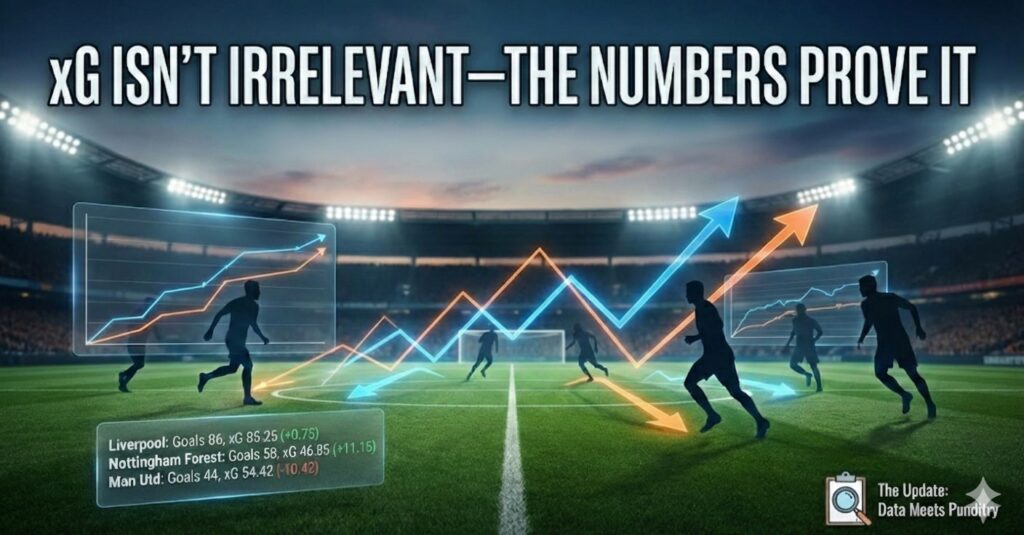
Premier League 2024/25 goals closely matched expected goals (xG), most teams stayed on target, proving xG is a reliable metric
Wayne Rooney recently dismissed expected goals (xG) as “irrelevant.” Which, frankly, tells you more about the state of football punditry than it does about data. At المستجدات, we are not pretending xG is flawless. It isn’t. Football will always be too chaotic, emotional and human to be reduced to a single number. But writing it off completely is classic ex-footballer logic. Loud. Confident. And mostly wrong. Football may be played with heart, but it is governed by probability.
We have worked in analytics before. No, we are not saying where. And the first thing you learn is this: metrics are not truth, they are indicators. xG does not tell you what will happen. It tells you what usually happens over time.
And last season, the Premier League behaved exactly as expected.
Most Teams Finished Where Probability Predicted
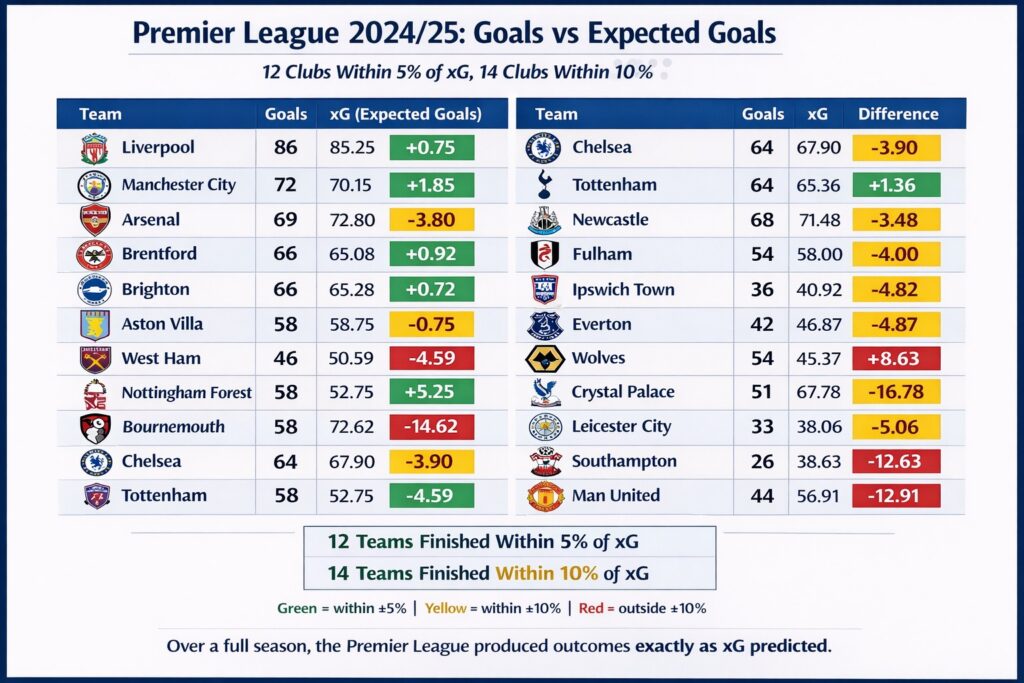
Compare goals scored to expected goals across all 20 Premier League clubs, and the picture is strikingly consistent. 12 teams finished within 5% of their xG. 14 teams finished within 10% of their xG. Liverpool scored 86 goals from 85.25 xG. Brentford, Brighton, Arsenal, and Chelsea all landed comfortably within normal variance. Few teams deviated wildly, which is exactly what xG predicts: most outcomes cluster near the mean, with outliers being the exception.
Even when teams did swing above or below expectations, the gaps were rarely shocking. Arsenal finished slightly under xG, Chelsea slightly over. This is football, not a flaw in the model.
The Outliers Pundits Love to Obsess Over
There were, of course, a few standout cases. Wolves (+8.63) and Nottingham Forest (+5.25) comfortably beat their xG, while Crystal Palace (−16.78) and Manchester United (−12.91) underperformed by a wide margin. These kinds of outliers always make headlines, but they don’t invalidate xG; every season has its streaks and slumps, and across 38 matches results usually settle closer to the expected baseline.
Why Regression to the Mean Isn’t Theory – It’s Gravity
xG isn’t about calling every match correctly; it’s about identifying long‑term trends. Teams that reliably produce good chances usually end up with goal totals that mirror the underlying numbers. Over a full 38‑game season, the league tends to snap back to what probability has been signalling all along.
The headline‑grabbers are the ones who break the pattern, Chris Wood last season, Morgan Rogers this one – but they’re the outliers. Most attackers settle back toward their expected output sooner or later, which is precisely why xG remains such a powerful indicator.
A Simple Analogy Rooney Might Understand
Think of xG like odds in poker. You can play a perfect hand and still lose, that doesn’t make probability meaningless. It’s the long-term patterns that matter. Teams making good decisions consistently see their results align with expectations.
Final Word
xG is not perfect. It cannot account for context, pressure, or luck. But over a full Premier League season, it’s one of the clearest ways to measure whether teams scored in line with their opportunities.
Last season, most clubs did exactly that, a reality inconvenient for pundits who prefer stories over systems.
Expected goals isn’t irrelevant. It’s just often misunderstood.
Stay secure and flexible while following the Premier League with Surfshark VPN – protect your privacy and access streaming services safely.
Some links in this article may be affiliate links. If you click through and make a purchase, we may earn a commission at no extra cost to you.