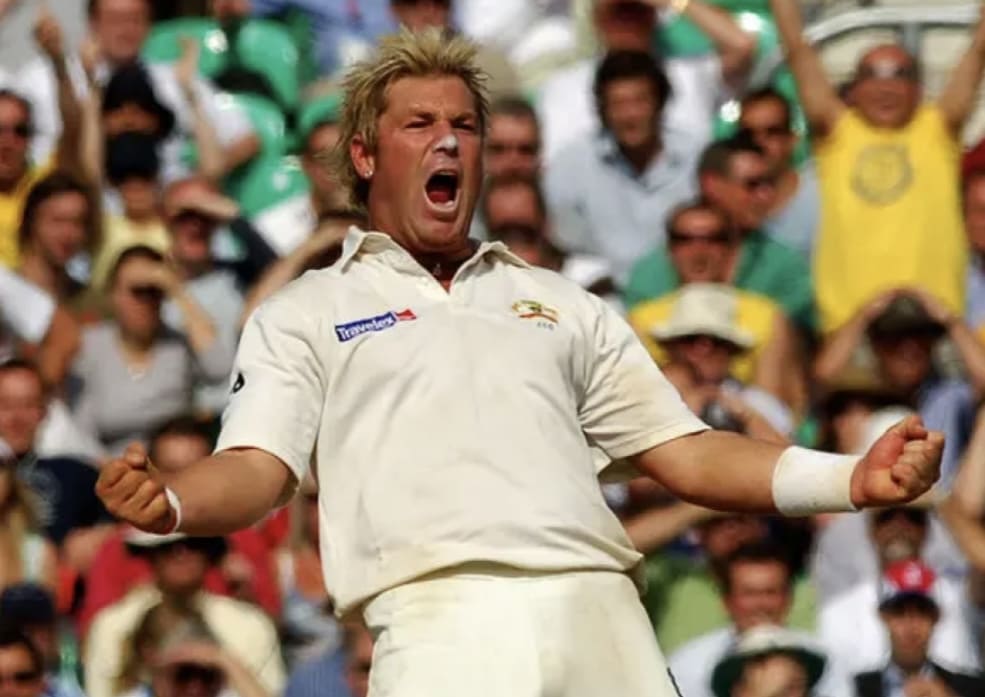
بواسطة التحديث - If cricket had a rockstar who could spin a ball sideways, sledge a batsman into submission, and still somehow charm your grandmother, it was Shane Warne.
The bleached hair, the earring, the swagger – Warnie turned spin bowling into pure theatre. And when he gripped that red ball with his meaty fingers, batsmen around the world collectively clenched.
Shane Warne’s career stats tell one story: 708 Test wickets, the second-highest in history at the time of his retirement. But stats don’t capture the way he did it. The drift, the dip, the rip. The mental warfare. The ability to bowl Australia to victory when no one else could. From the Ball of the Century at Old Trafford to his farewell masterclass at the SCG, Warne didn’t just take wickets, he created moments that transcended cricket.
In this article, we’re breaking down Shane Warne’s top 5 performances for Australia, across Tests and ODIs. These aren’t just good spells. These are the performances that made grown men gasp, made commentators lose their minds, and cemented Warne’s legacy as the greatest spin bowler cricket has ever seen.
Let’s relive the magic.
Shane Warne Career Stats at a Glance
Before we relive the magic, here’s a snapshot of Warnie’s legendary career:
- Test Matches: 145 matches, 708 wickets, average of 25.41
- ODI Matches: 194 matches, 293 wickets, average of 25.73
- Strike Rate (Bowling): 57.4 (Test), 36.2 (ODI)
- Best Test Figures: 8/71 vs England, Brisbane, 1994
- Best ODI Figures: 5/33 vs South Africa, World Cup Semi-Final, 1999
- Career Span: 1992 – 2007
- Major Achievements: 1999 Cricket World Cup winner, Wisden Leading Cricketer in the World (5 times), highest Test wicket-taker for a spinner until 2004
Now, let’s get into the performances that made these numbers legendary.
#5: 7/56 vs England, The Gabba (1994–95 Ashes)
Format: Test Match
The first Test of the 1994-95 Ashes at The Gabba. England arrived in Australia with hope. Mike Atherton’s side had drawn the previous series 1-1, and they fancied their chances. Then Shane Warne walked out on Day 1 and reminded them exactly what Australian dominance looked like.
Why It Slapped
Warne’s 7/56 in England’s first innings wasn’t just about the raw numbers, it was about how he did it. The Gabba isn’t known as a spinner’s paradise. It’s fast, bouncy, and batsman-friendly. Fast bowlers thrive here. Spinners? They usually just hold an end while the quicks do the damage.
But Warnie turned it square. Literally. He pitched the ball in line, spun it past helpless England bats, and left batsmen looking like they were swinging at ghosts.
Mike Atherton, Graeme Hick, Graham Thorpe, all Test-class players, all made to look like club cricketers facing their first leg-spinner. England were bowled out for 167, and Australia never looked back. The spell set the tone for the entire series. By the time the Ashes were done, Australia had won 3-1, and Warne had taken 27 wickets at an average of 20.33.
This wasn’t just a great spell. It was a statement. Warnie was 25 years old and already bowling like a man possessed. The drift, the dip, the rip, all on full display. England’s batsmen didn’t just lose their wickets, they lost their confidence.
What made it even more impressive was the pitch. First-day Brisbane wickets are green, seam-friendly, and hostile. Spinners usually don’t come into the game until Day 3 or 4. Warne? He ripped through England on Day 1. That’s not just skill, that’s genius.
حكم التحديث
This is when England collectively realized: Shane Warne wasn’t just a good spinner, he was their lifelong tormentor. Australia went 1-0 up. Warnie? Already living rent-free in English nightmares. If you want to understand why the Ashes became Warne’s personal highlight reel, start here. The Gabba 1994 was where the legend truly began.
#4: 5/33 vs South Africa, World Cup Semi-Final (1999)
Format: ODI
Edgbaston, Birmingham. World Cup semi-final. Australia vs South Africa. Pressure doesn’t get heavier than this. South Africa, the tournament’s most dangerous team, needed to chase down 214 to reach their first-ever World Cup final. On paper, it was gettable. But they hadn’t accounted for one thing: Warnie in full flight.
Why It Slapped
Shane Warne’s 5/33 in the 1999 World Cup semi-final is one of the greatest ODI spells ever bowled. Not just because of the wickets, but because of when he took them. South Africa’s top order featured Herschelle Gibbs, Hansie Cronje, and Jacques Kallis—three of the best batsmen in the world. Warne demolished all three.
Gibbs? Bowled through the gate. Cronje? Caught at slip trying to cut. Kallis? Stumped after being beaten in flight. Every wicket was a masterclass in spin bowling. The drift. The dip. The turn. Warnie had all of it working.
But it wasn’t just the skill, it was the mental game. Warne sledged, he stared, he celebrated like he’d just won the lottery. He got inside the batsmen’s heads. By the time South Africa’s middle order arrived, they were already beaten mentally.
The match famously ended in a tie, but Australia progressed to the final on net run rate. South Africa were heartbroken. Warne? He’d just bowled one of the most iconic spells in World Cup history.
His figures of 10-4-33-5 in a knockout game under immense pressure is stuff of legend. Four maidens. Five wickets. Thirty-three runs. On a batting-friendly Edgbaston pitch. Ridiculous.
حكم التحديث
Spin. Sledge. Swagger. This was peak Warne. When cricket needed its Michael Jordan moment, he spun it in from another postcode. South Africa’s batsmen walked off shell-shocked. Australia walked into the final. And Warnie? He walked off like he owned the place. Because, in that moment, he absolutely did.
#3: 12/128 vs South Africa, Sydney Test (2006)
Format: Test Match
The SCG, January 2006. Shane Warne’s final Test match on Australian soil. The stage was set for a fairy-tale farewell. Australia vs South Africa in the New Year’s Test. The script practically wrote itself. And Warnie? He delivered the performance of a lifetime.
Why It Slapped
Twelve wickets. In one Test match. On a crumbling SCG pitch that was tailor-made for spin. Warnie took 6/161 in the first innings and 6/67 in the second. He ripped through South Africa twice, dismantling a batting lineup that included Graeme Smith, Jacques Kallis, and AB de Villiers.
The second innings was pure art. South Africa needed to bat out the final day to save the Test. Warne had other ideas. He bowled 29.5 overs of relentless leg-spin, taking 6/67 and bowling Australia to a 2-0 series lead. Every ball was a test of patience. Every over was a chess match.
He dismissed Kallis twice, caught behind and LBW. He got Graeme Smith stumped. He had AB de Villiers caught at slip. He made the ball talk, and the SCG crowd roared with every wicket.
This wasn’t just a farewell, it was a masterclass. At 36 years old, with over 700 Test wickets already in the bank, Warne bowled like a man in his prime. The flight was still there. The rip was still there. The sledging? Definitely still there.
The SCG erupted when he took his 12th wicket. The crowd gave him a standing ovation that lasted minutes. Teammates mobbed him. Commentators lost their voices. It was the perfect send-off on home soil.
حكم التحديث
The SCG became the Church of Warne. Every delivery was a sermon. The farewell wasn’t quiet, it was a statement. Warnie didn’t just leave the Australian cricket stage; he torched it on his way out. Twelve wickets. One stadium. One legend saying goodbye in the most Warnie way possible: by obliterating the opposition.
#2: ‘Ball of the Century’ – 1/51 vs England, Old Trafford (1993 Ashes)
Format: Test Match
First ball of his Ashes career. First delivery to Mike Gatting. June 4, 1993. Old Trafford, Manchester. No one could have predicted what was about to happen. Not the English batsmen. Not the commentators. Not even Warne himself.
Why It Slapped
You know it. We know it. Cricket fans who weren’t even born in 1993 know it. The Ball of the Century.
Shane Warne’s first delivery in Ashes cricket defied physics. It pitched a foot outside leg stump. Drifted in the air. Dipped viciously. Then spun sideways across Mike Gatting’s pad, past his defensive bat, and clipped the top of off stump. Gatting stood there, frozen. His face was a mixture of confusion, disbelief, and existential dread.
Richie Benaud, commentating, could barely contain himself: “He’s done it! Gatting has absolutely no idea what has happened to him!”
The ball spun so much that it defied logic. Gatting was a world-class batsman, one of England’s best players of spin. He’d faced Warne before in Australia. He knew what to expect. Except, he didn’t. Because no one had ever bowled أن ball before.
It wasn’t just a great delivery, it was a cultural moment. The footage has been replayed millions of times. It’s in cricket documentaries, highlight reels, and montages. It’s the delivery every young leg-spinner tries to replicate in the backyard. It’s the delivery that made the cricketing world sit up and realize: Australia had found something special.
Warne only took 1/51 in that innings, but it didn’t matter. The damage was done. England were rattled. The psychological warfare had begun. By the end of the series, Warne had taken 34 wickets, and England had lost 4-1.
حكم التحديث
You don’t need seven wickets when one delivery changes history. It was less “cricket ball” and more “religious experience.” Gatting’s bewildered face became a meme before memes existed. That ball announced Warne to the world. It said: “This guy is different. This guy is dangerous. This guy is going to haunt England for 15 years.” And he absolutely did.
#1: 40 Wickets in the 2005 Ashes Series
Format: Test Series
England won the 2005 Ashes. They reclaimed the urn for the first time in 18 years. The nation celebrated. Andrew Flintoff became a hero. Kevin Pietersen smashed hundreds. It was England’s summer. But here’s the truth: Shane Warne won the cricket.
Why It Slapped
Forty wickets. In a single Ashes series. While playing for a losing side. With Australia’s batting collapsing around him. That’s not just a performance, that’s carrying an entire team on your shoulders and still falling just short.
Warne took 4/116 at Lord’s. 6/122 and 4/64 at Edgbaston. 4/99 and 6/46 at Old Trafford. 4/100 at Trent Bridge. 6/124 and 6/46 at The Oval. Every single Test, he was Australia’s best bowler. Every single innings, he gave them a chance to win.
England’s batsmen feared him. Kevin Pietersen famously used an ultra-aggressive approach against Warne because he knew playing defensively was suicide. Flintoff later admitted Warne was the hardest bowler he ever faced. Even in defeat, Warnie commanded respect.
The stats are absurd. He bowled 250.3 overs, more than any other bowler in the series. His average was 27.57. His strike rate was 37.6. He did all of this at 35 years old, on turning English pitches, with relentless pressure.
He dismissed Michael Vaughan, Marcus Trescothick, Andrew Strauss, Ian Bell, Kevin Pietersen -basically everyone who mattered. He bowled marathon spells when Australia needed him. He took wickets when no one else could. He fought until the very last ball at The Oval.
Australia lost the series 2-1. But Warne’s 40 wickets remain an Ashes record for a single series by an Australian bowler. It’s a record that may never be broken.
حكم التحديث
The only man who could lose a series and still come out with a statue. Every wicket was war. Every over was art. Even English fans stood and applauded him at The Oval. That’s not just respect, that’s reverence. Warne didn’t win the Ashes in 2005, but he won something bigger: immortality. Australia lost. Warnie became eternal.
Honorable Mentions: Other Warnie Masterclasses
These didn’t crack the top 5, but they’re still legendary:
- 6/46 vs West Indies, MCG (1992): Warnie’s breakout Test performance. Destroyed the mighty Windies batting lineup and announced himself to the world. This was the spell that made selectors believe he was the real deal.
- 4/33 vs Pakistan, World Cup Final (1999): Another World Cup heroic moment. Warnie strangled Pakistan’s chase in the final at Lord’s and helped Australia lift the trophy. His spell in the middle overs broke Pakistan’s momentum.
- 5/113 vs India, Chennai (2004): Bowling to Sachin Tendulkar, Rahul Dravid, and VVS Laxman on a flat Chennai pitch? Warnie still took 5 wickets. Unreal skill against the best players of spin in world cricket.
- 8/71 vs England, Brisbane (1994): His best-ever Test figures. Demolished England at The Gabba with a spell of sustained brilliance. This remains his best numerical performance in Test cricket.
Frequently Asked Questions About Shane Warne
What was Shane Warne’s best bowling performance?
Shane Warne’s best Test bowling figures were 8/71 against England at The Gabba in November 1994. However, many consider his 12-wicket haul (6/161 and 6/67) in the 2006 Sydney Test against South Africa as his greatest overall performance, as it came in his final Test on home soil and helped Australia secure a series victory.
How many Test wickets did Shane Warne take?
Shane Warne took 708 Test wickets in 145 matches between 1992 and 2007, making him the second-highest wicket-taker in Test cricket history at the time of his retirement (only behind Muttiah Muralitharan). He also took 293 ODI wickets in 194 matches, giving him over 1,000 international wickets across formats.
What made Shane Warne the greatest leg-spinner ever?
Warne combined unmatched skill with psychological warfare. His leg-spin had ridiculous revolutions, drift, and dip that made batsmen misjudge length and line. But it was his cricket IQ, sledging ability, and capacity to bowl Australia to victory in impossible situations that set him apart. He turned spin bowling from a defensive holding tactic into an attacking weapon that could win matches on any surface.
Did Shane Warne ever win a World Cup?
Yes. Shane Warne won the 1999 Cricket World Cup with Australia, taking crucial wickets in both the semi-final (5/33 vs South Africa) and final (4/33 vs Pakistan). He was a key part of Australia’s dominant era in limited-overs cricket and helped Australia become the most feared ODI team in the world.
How did Shane Warne compare to Muttiah Muralitharan?
While Muttiah Muralitharan ended his career with more Test wickets (800), many cricket experts consider Warne the greater bowler due to the variety in his game, his success in all conditions (especially in Australia and England), and his impact on the art of leg-spin bowling. Warne’s battles with the best batsmen in the world, Tendulkar, Lara, Kallis – defined an era.
الكلمة الأخيرة للتحديث
Shane Warne didn’t just take wickets, he made cricket feel alive. Whether it was the Gabba, Lord’s, or the MCG, Warnie turned every spell into an event. The drift that hypnotized batsmen. The sledges that lived in their heads rent-free. The celebrations that made you believe cricket was supposed to be fun.
He wasn’t perfect. The scandals, the controversies, the off-field chaos, it was all part of the Warnie package. But when he had the ball in hand, none of that mattered. He was a once-in-a-generation talent who turned leg-spin from a dying art into a lethal weapon.
Even his rivals respected him. England hated facing him, but they still gave him a standing ovation at The Oval in 2005. That tells you everything.
Shane Warne passed away on March 4, 2022, at the age of 52. The cricketing world mourned. Tributes poured in from every corner of the globe. Because Warnie wasn’t just Australia’s, he belonged to cricket. He was the rockstar who made spin bowling cool, who made leg-breaks dangerous, and who made every Test match feel like theatre.
وداعاً وارني. قد يتلاشى الملعب، لكن الأسطورة لن تتلاشى أبداً.