بواسطة التحديث
شاهد كأس العالم في أي مكان - ثبّته مع سيرف شارك
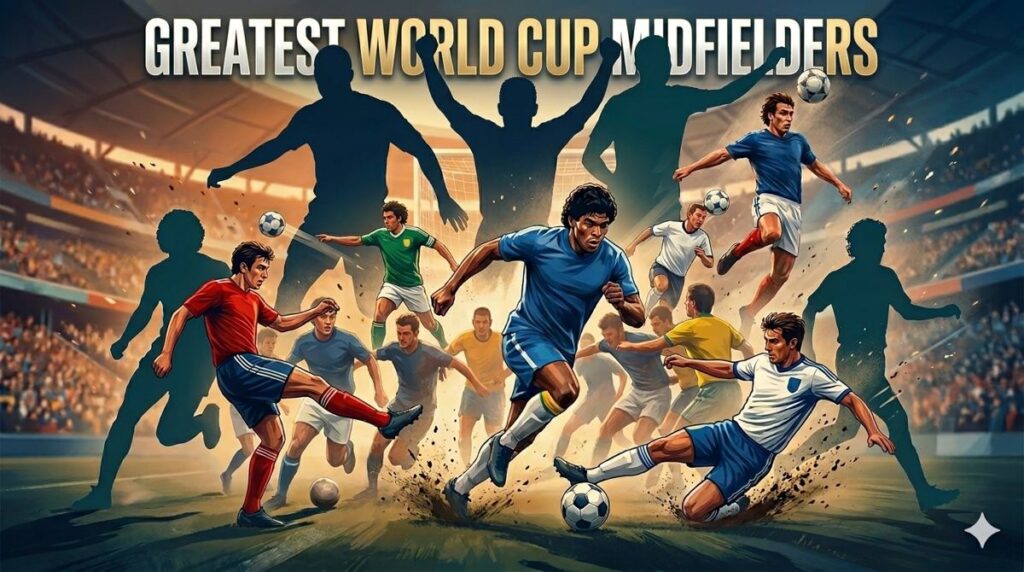
ملخص. The greatest world cup midfielders ever? Good luck surviving that argument. Some controlled matches like chess grandmasters, others played football as if basic tactical structure was a personal insult. Zidane takes top spot ahead of Iniesta and Xavi, though leaving out names like Michel Platini will absolutely cause outrage somewhere in France within the next five minutes.
Midfield is football’s most impossible role to rank properly because midfielders are asked to do everything. Defend, create, control, dictate tempo, score and assist goals, rescue managers from their own terrible tactical ideas and occasionally cover for a right back who’s wandered off spiritually sometime around the 60th minute.
Unlike forwards, midfielders rarely get the luxury of simplicity. If strikers are judged on moments, midfielders are judged on whether they can quietly control entire matches without most people fully noticing until years later when everyone suddenly starts saying things like “to be fair actually, he ran the game.” Which usually means they’ve watched three YouTube compilations and become emotionally unstable.
This list is not about statistics because midfield is where statistics go to die a slow confusing death. It’s about influence, style, dominance, longevity and the strange ability certain players possessed to make elite footballers around them look like they’d accidentally won a raffle to be there.
You will absolutely disagree with parts of this. That is healthy. Football lists are supposed to irritate people. If nobody threatens to stop speaking to you over a ranking, you’ve probably made the list too sensible.
Zinedine Zidane
Some footballers dominate games physically. Zinedine Zidane dominated them spiritually. At his peak, time itself seemed to bend in his favour, matches slowing to accommodate his laconic style. Carlo Ancelotti believed him to be the most technically able footballer of all time. Players closed him down in desperation only to discover they had been pursuing a ghost, while Zidane moved on, carrying with him an ethereal air of quiet, almost weary superiority.
The obvious comparison here is Michel Platini, who absolutely has a claim to inclusion among the greatest midfielders ever. Euro 84 in particular remains one of the most absurd peaks any midfielder has produced. But Platini’s international dominance burned brightest over a shorter period, whereas Zidane sustained greatness across club football and international tournaments with a broader body of work.
“Sometimes I don’t know what takes me over during a game. Sometimes I just feel I have moved to a different place and I can make the pass, score the goal or go past my marker at will” – Nowhere was that clearer than the 2006 World Cup quarter-final against Brazil, a side boasting not only Ronaldo but Ronaldinho and Kaká at their very peak. And yet it is a game remembered solely for Zizou operating on a different plane entirely.
The 1998 World Cup final, Euro 2000, the volley against Leverkusen, it’s one endless collection of mystical moments that feel preserved in football’s memory permanently. Even the headbutt somehow became mythological because normal players get sent off, whereas Zidane managed to exit football like a Shakespearean emperor collapsing dramatically in front of billions.
And honestly, if you’re talented enough, mildly terrifying behaviour occasionally becomes part of the brand.
Xavi
There are midfielders who controlled games, and then there was Xavi, who controlled football itself like a man quietly editing reality in real time. A player so good he’s elevated to one name status, a badge usually reserved for Brazilians and footballing deities. Watching peak Barcelona and Spain often felt less like sport and more like a hostage situation involving possession. And not one where one had any real hope the hostages would ever be released.
The absurd thing was how simple he made everything look. No needless drama, no Hollywood nonsense, no stepovers that achieved absolutely nothing except exhausting the knees of children attempting them in parks. Just angles, timing and a brain operating about four business days ahead of everyone else on the pitch. Pass, pass and pass again. And…pass. Into the goal.
Spain winning Euro 2008, the 2010 World Cup and Euro 2012 owed an enormous amount to Xavi turning midfield into his own private laboratory. By the 2012 final, he was dictating play so completely it felt borderline impolite, and the final itself was a straight-up violation.
And yet because he lacked the explosive glamour of forwards, there are still people who underestimate him. Which is a bit like underestimating oxygen because it doesn’t score enough goals.
Andres Iniesta
There has probably never been a midfielder more universally adored by neutral fans because watching this little fella play football felt strangely therapeutic. Even opposing supporters often sounded reluctant to criticise him, like booing him might somehow lower property values nearby.
The defining image remains the 2010 World Cup final winner, that glorious strike against the Netherlands that instantly elevated him from genius to national treasure. But reducing Iniesta to one goal feels wildly unfair, although we’ll use that for the clip, because of course we will. This was a player who could escape pressure in spaces so small they barely appeared physically legal. Three defenders around him? Fine. Four? At that point it felt like a mild irritation. There’s an iconic image of Iniesta encircled by five Italian players, intruding on his space like paparazzi surrounding a peak‑noughties pop princess, and yet he remains the calmest figure in the scene. Which, really, says it all.
What separated Iniesta was the humanity in his football. Everything looked graceful without ever becoming soft. He could destroy a midfield while appearing polite enough to apologise afterwards. There was no vanity to him, none of the exhausting “look at me” energy modern football increasingly encourages. Watching Iniesta casually pirouette away from defenders while they slid into advertising boards at dangerous speeds will never go out of style.
Rivelino
Before modern football became obsessed with systems, pressing triggers and managers drawing geometric art on whiteboards, there was Rivelino. This is the man who popularised the flip flap before Ronaldinho turned it into football’s equivalent of jazz improvisation, casually playing like a street football deity who’d wandered accidentally into professional football. Everything about him felt gloriously rebellious. The moustache alone looked capable of nutmegging someone.
Part creator, part destroyer, part chaos merchant, Rivelino played midfield with the sort of swagger modern academies would probably try to coach out of players by age fourteen. He hit passes nobody else saw, scored goals that looked faintly unreasonable and carried himself with the confidence of a man who knew defenders were fundamentally temporary obstacles.
His role in Brazil’s 1970 side often gets overshadowed because that team contained approximately every footballing genius alive at the time, which is deeply inconvenient historically. But Rivelino was central to it all, providing invention and brutality in equal measure. The left foot alone should probably have received diplomatic immunity. His role in أن goal, will be played on an endless loop for as long as human’s have eyes. And a wi-fi connection
Andrea Pirlo
Pirlo looked less like a footballer and more like a man who owned an extremely successful vineyard and had reluctantly agreed to play football in between tasting sessions. Everything about him radiated elegance. The beard, the passing, the free kicks, the permanent expression of someone mildly inconvenienced by having to run at all, even if it was running away from Park Ji Sung. We’ll leave it to the great man to explain how he felt about that.
“Even Sir Alex Ferguson, the purple-nosed manager who turned Manchester United into a fearsome battleship, couldn’t resist the temptation. He’s a man without blemish, but he ruined that purity just for a moment when it came to me. A fleeting shabbiness came over the legend that night.
At Milan, he unleashed Park Ji-sung to shadow me. He rushed about at the speed of an electron. He’d fling himself at me, his hands all over my back, trying to intimidate me. He’d look at the ball and not know what it was for.
They’d programmed him to stop me. His devotion to the task was almost touching. Even though he was a famous player, he consented to being used as a guard dog.”
Touche.
What made Pirlo extraordinary was the complete absence of panic in his game. Press him aggressively and he’d simply use your momentum against you, usually with a pass so perfect it felt borderline passive aggressive.
Italy’s 2006 World Cup win contains some of the finest midfield orchestration ever seen. Pirlo controlled matches with the calm of an orchestra conductor who knew the ending already. Then came Euro 2012, where he spent the tournament humiliating younger, more athletic midfielders by proving football intelligence is often far crueller than physical dominance.
And then there was the Panenka against England. A penalty so disrespectful to Joe Hart it probably should have required formal diplomatic consequences afterwards.
N’Golo Kante
At his peak, Kanté covered so much ground it occasionally felt like France had illegally fielded two midfielders wearing the same shirt. In fact during the 2018 World Cup it often looked like there was one Kanté either side of Paul Pogba at all times, cleaning up danger with such terrifying efficiency that opposing attacks started feeling emotionally pointless.
The remarkable thing about Kanté was that he achieved total midfield domination without any visible ego whatsoever. No dramatic pointing, no performative screaming, no pretending every tackle was a war crime committed against him personally. He just quietly appeared everywhere, won the ball and disappeared again like an extremely polite footballing ghost.
Leicester’s title win remains one of football’s greatest miracles and Kanté somehow followed it by immediately winning the league again with Chelsea because apparently reality had stopped functioning properly by that point.
Lothar Matthäus
If football history had a section titled “Players Who Absolutely Did Not Care Whether You Liked Them,” Lothar Matthäus would have his own wing. Universally respected, frequently disliked and entirely unbothered by either, Matthäus spent two decades dominating midfields with the energy of a man fuelled entirely by competitiveness and mild resentment.
The complete midfielder barely even covers it. He could tackle, dictate, score screamers, surge through midfield and organise entire teams while looking furious that everyone else wasn’t working hard enough. The 1990 World Cup remains his defining masterpiece, a tournament run of total authority where he seemed to operate simultaneously as captain, enforcer and tactical system all by himself.
Then there’s the famous Stefan Effenberg story. Effenberg once included a chapter in his autobiography titled “What Lothar Matthäus knows about football” consisting entirely of a blank page. Which is obviously ridiculous because Matthäus knew an extraordinary amount about football. But the fact people instantly believed the story tells you everything about how deeply chaotic his relationships with teammates could become.
And yet none of it mattered because when the match started, Matthäus was usually the best player on the pitch anyway.
Sócrates
Football has produced intelligent players before, but Sócrates made everyone else look like they’d accidentally forgotten homework. A qualified doctor, political activist and midfield genius, he carried himself with the aura of someone who could dismantle a defence and then calmly explain existential philosophy afterwards over cigarettes and black coffee.
Which, to be fair, he probably could.
Sócrates played football with a strange hypnotic elegance. Tall, languid and effortlessly inventive, he drifted through matches as though ordinary tactical structure bored him slightly. His passing was imaginative without becoming chaotic, his finishing clinical without ever looking rushed. And the backheels. Dear God, the backheels. He treated them less as occasional flourishes and more as a moral obligation.
The great tragedy is that Brazil’s magnificent 1982 side never won the World Cup. They remain football’s favourite beautiful failure, adored precisely because they valued artistry over caution in a sport increasingly obsessed with efficiency. Sócrates embodied all of that romanticism perfectly.
Also, no footballer in history has ever looked more likely to be interrupted mid match because someone needed urgent medical advice nearby.
الفكرة النهائية
Ranking midfielders is fundamentally impossible because midfield itself contains too many different jobs. How exactly are you supposed to compare Pirlo’s elegance to Kanté’s destruction or Zidane’s artistry to Matthäus’ relentless fury?
But certain names keep surviving every generation of debate. Players who shaped matches so completely they ended up shaping eras too.
And eventually you come back to Zidane. Thierry Henry famously said “In France, everyone realised that God exists. And now he is back in the French national team. God is back – and there is little else to say.” So we won’t.
حافظ على أمانك ومرونتك أثناء متابعة كأس العالم 2026 مع Surfshark VPN – احمِ خصوصيتك وادخل خدمات البث بأمان.
قد تكون بعض الروابط في هذه المقالة روابط تابعة. إذا قمت بالنقر عليها وقمت بالشراء، فقد نحصل على عمولة دون أي تكلفة إضافية عليك.