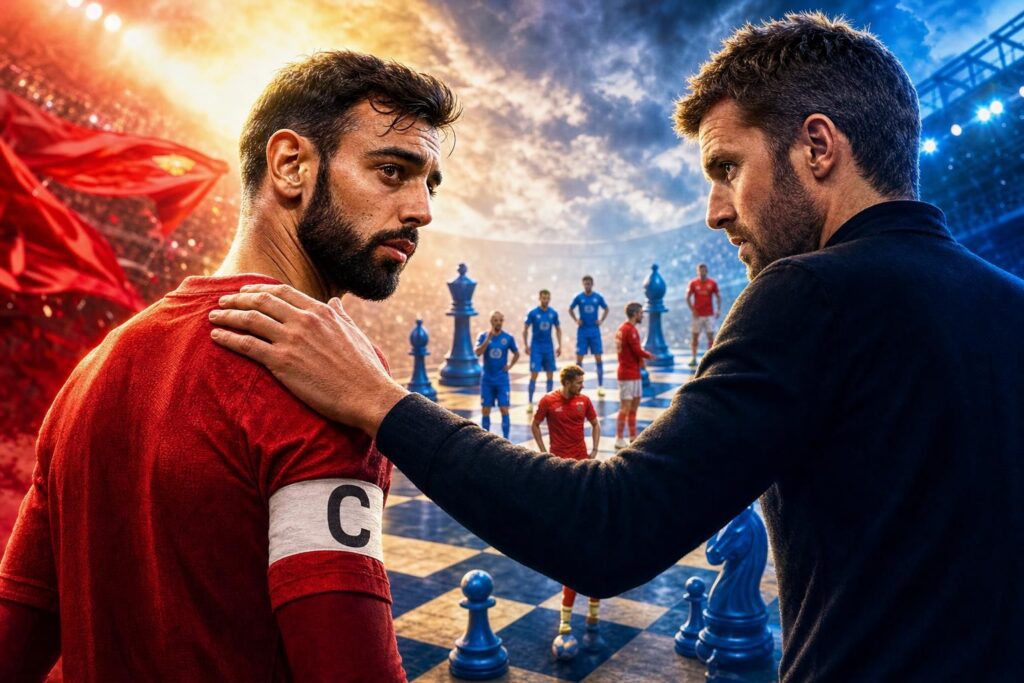

Carrick’s retention settles the Chelsea dugout, not his long-term future, while the coming matches test coaching, selection and the players’ response.
Michael Carrick’s future has acquired one piece of clarity: he will take Manchester United to Chelsea. Anyone reading that as a grand endorsement should resist ordering the commemorative mug.
BBC Sport and Sky Sports reported on 27 October that Carrick would remain in charge for the Chelsea match after United’s 3–0 home defeat by Bournemouth. That establishes who prepares the team for the next game. It establishes no guaranteed longer tenure, no season-long backing and no formal three-match trial.
For those of us watching another United managerial emergency develop, the distinction matters. Keeping the manager in his job today and deciding he is the right man for tomorrow are separate judgements. Only the first is visible here.
With United 16th at BBC Sport’s reporting cut-off on 27 October, the immediate question is what Carrick can change. Chelsea, Roma and Aston Villa offer a chance to examine that, without pretending somebody has handed him a sealed envelope containing a points target.
A place in the dugout is not an assurance
The Bournemouth defeat on 25 October supplied the latest, emphatic reason for scrutiny. United lost 3–0 at Old Trafford. No creative interpretation of the scoreline is required.
According to BBC Sport, some of Carrick’s coaching staff wondered whether they would survive that result. The broadcaster also reported that senior United figures believed the players shared responsibility. Those accounts describe uncertainty and competing responsibilities inside the club; they do not reveal precisely why United retained him.
Sky Sports’ report that Carrick will remain in charge against Chelsea gives supporters something concrete. Everything beyond that needs more care.
After Bournemouth, Carrick told reporters, as quoted by BBC Sport: “I’m not expecting anything in particular, to be honest. I’m carrying on as normal.” That is a description of how he was proceeding, not proof that assurances had arrived. At United, supporters have become unwilling specialists in the distance between a manager taking training and a manager having security.
Chelsea, Roma and Villa can test more than resolve
The forthcoming sequence identified by BBC Sport is Chelsea away, Roma in the Champions League three days later, then Aston Villa. It provides three different opportunities to assess whether United can produce something repeatable.
At Chelsea, the first useful test is whether the team’s decisions look connected. When one player presses, do others support him? When United lose possession, is there protection behind the ball? Can they progress up the pitch without every difficult passage becoming somebody else’s problem?
These are questions to watch, rather than a claim that each failure explains Bournemouth. They are also more revealing than counting clenched fists before kick-off. We have reached the point where a photograph of determined training faces should come with a warning that determination may not survive contact with an opposition midfield.
Roma then tests how much of any response travels into the next match. With only three days between games, Carrick will have limited time to install anything elaborate. Clear roles, sensible selection and adjustments players can actually execute are the practical currency. A tactical revolution requiring six uninterrupted weeks on the training ground is not much use on this timetable.
Villa offers another check on continuity. A good Chelsea result would matter, especially given United’s position, but one afternoon cannot establish that the underlying football is improving. Equally, a defeat should still be examined for what happened within it, rather than treated as permission to stop watching the details.
There is no verified ultimatum attached to this run. Supporters can demand progress without inventing the board’s marking scheme.
Fernandes needs a football answer, not Instagram forensics
The captain’s situation makes Carrick’s selection particularly significant. BBC Sport reports that Bruno Fernandes publicly questioned his tactics after the 4–1 defeat at Como, was benched against Bournemouth and subsequently liked an Instagram post carrying a suggestive caption.
That sequence warrants scrutiny. It does not prove a falling-out, establish Fernandes’ motives or tell us what was said privately. A social-media like remains a remarkably small object on which to balance an entire dressing-room diagnosis.
The useful question is how Carrick intends to use him. If Fernandes returns, what role helps the team function? If he stays out, does the alternative justify the decision? As our earlier examination of Carrick’s comments about Fernandes’ selection explored, selection uncertainty should not automatically become a disciplinary verdict.
Carrick must be able to choose his side. The captain must also be judged on his contribution. Neither principle requires supporters to pretend they have read their WhatsApp messages.
Shared responsibility must include the people upstairs
An unnamed player told BBC Sport: “The feeling is that we all want to put it right. Players, staff, everyone.” The broadcaster explicitly said it did not know whether Fernandes shared that sentiment. One anonymous account cannot settle the mood of an entire squad.
Nor should shared responsibility become a convenient phrase that leaves nobody answerable. Carrick owns coaching and selection decisions. Players own their execution. Broader questions about squad construction and the conditions in which the manager works belong higher up, as our guide to United’s decision-making structure explains.
We should be deeply suspicious of any United diagnosis that ends neatly at the technical area. It is the most televised workplace in the organisation, which does not make it the only one capable of getting things wrong.
The coming matches can show whether Carrick can organise a convincing response and whether his players deliver it. They cannot disclose private assurances, settle every recruitment question or reveal an unannounced decision date. For now, United have chosen who takes the team to Chelsea. They still owe us evidence that the choice leads somewhere.