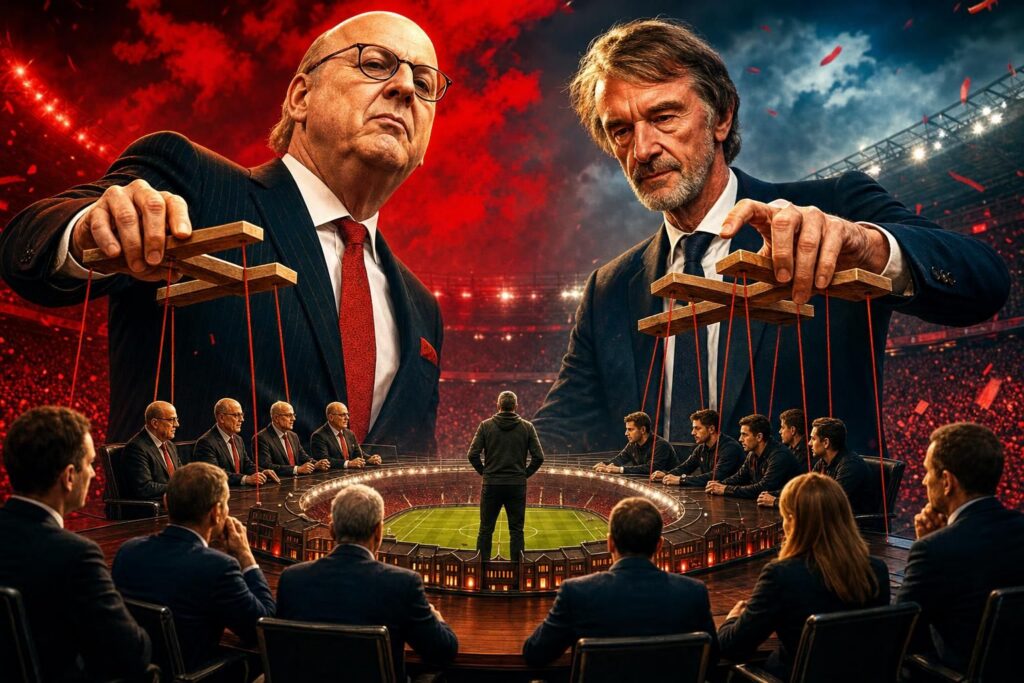
The Glazers retain Manchester United’s formal voting control, while INEOS has governance rights and football influence through the club’s leadership structure.
Manchester United has two answers to the question of who runs the club, and confusing them makes every transfer argument worse. The Glazer family retains formal control through its voting power. INEOS, led by Jim Ratcliffe, is a substantial minority investor with governance rights and a significant role in football operations. Between those positions sits the club’s executive leadership, where strategy has to become decisions somebody can actually carry out.
That distinction matters when a signing fails, a manager leaves or a recruitment plan changes. Supporters understandably want a name on the invoice. United’s public disclosures explain who holds corporate power and how the leadership structure works, but they do not reveal who won every argument in a transfer meeting. Anyone claiming otherwise from the sight of a new player holding a scarf is doing more archaeology than the evidence permits.
The Glazers retain formal control
Manchester United plc is listed on the New York Stock Exchange and has two classes of shares. The important distinction is voting power, not simply how much of the club a shareholder owns economically. The Glazer family’s Class B holdings give it the controlling voting stake, as the club’s filings on ownership and governance set out.
INEOS owns a substantial minority interest, but “minority” is doing real work in that sentence. Manchester United’s investor FAQs put the Glazers’ voting rights at about 67.9% and INEOS’s at about 28.9% as of December 2024. Those figures are a dated snapshot, not a guarantee that the percentages remain unchanged. They establish the essential point: Ratcliffe’s investment did not make him United’s controlling shareholder.
Formal control matters for shareholder votes and the composition of the board. It does not mean a Glazer personally chooses every transfer target, any more than owning a supermarket chain means selecting the biscuits for the Salford branch. Corporate power works through appointments, agreements, budgets and oversight. Its consequences can be significant without its holder appearing in every meeting.
What INEOS gained, and what it did not
The arrangement is more involved than a minority shareholder buying shares and waiting politely for a dividend. A Governance Agreement signed in December 2023 sets out rights between the Glazer parties, identified as the majority holder, and INEOS, the minority holder. It covers voting and director nominations, with INEOS’s nomination rights linked to specified shareholding thresholds.
Those rights give INEOS a formal route into the club’s governance. Its involvement in football operations also makes Ratcliffe’s influence more substantial than the percentage beside his name might suggest. But influence, operational responsibility and ultimate shareholder control are different things. Saying “INEOS runs the football side” may be useful shorthand; treating it as proof that INEOS has unfettered authority over every football decision goes beyond what the public documents establish.
The Premier League confirmed approval of Ratcliffe’s investment in 2024 following its ownership and directors’ processes. That approval concerned the investment and the relevant governance change. It was not a public transfer manual, with a neat box identifying who must authorise the next centre-forward.
The board sets the framework; executives run the operation
The board is where ownership rights become corporate oversight. The Governance Agreement shapes director nominations, while United’s management structure places day-to-day business and football operations within the executive leadership, including the group chief executive. In broad terms, shareholders exercise their formal rights, the board oversees the company, and executives lead its operations.
Recruitment sits inside that chain, not outside it. A sporting plan needs people to identify players, assess their fit, negotiate deals and work within financial limits. Ownership can shape the resources available and the people entrusted with the plan; executive and football leadership have to turn it into action. If you have followed United long enough, you will know that the gap between an organisational chart and a coherent transfer window can accommodate several expensive wingers.
The public record does not provide a complete, deal-by-deal approval chart. It does not specify every spending threshold, every person with a veto or how a disagreement over a particular player would be resolved. Nor should the existence of a group chief executive be mistaken for evidence that one executive personally selects the squad. Responsibility can be delegated, shared and constrained without every conversation appearing in an annual report.
Can you tell who wanted a signing?
Usually, not from the signing alone. A player arriving during INEOS’s involvement is not proof that Ratcliffe picked him. A poor deal under Glazer control is not, by itself, proof that a Glazer demanded it. Both claims skip the inconvenient middle of the story: scouting, coaching preferences, negotiations, finances and compromises made behind closed doors.
That is not an argument for letting ownership off the hook. Owners help choose leadership and set the conditions in which it works. If recruitment repeatedly lacks direction, it is reasonable to scrutinise appointments, the structure and the resources behind them. It is less reasonable to treat every transfer as a private diary entry revealing an owner’s intentions. The shirt presentation tells you who signed; it rarely tells you who first mentioned him in a meeting.
The same caution applies when United change course. A managerial appointment or major shift in recruitment can reveal something about the club’s strategy, particularly alongside attributable statements and documented leadership changes. It does not automatically reveal how every shareholder, director and executive voted or argued. Football clubs can produce a confusing outcome through ordinary collective decision-making. United supporters need no further demonstration of that possibility.
What the structure means for United’s future
United’s arrangement gives supporters two legitimate lines of scrutiny. The Glazers retain the decisive formal voting position and cannot be written out of questions about long-term governance. INEOS has meaningful governance rights and a prominent football role, so its influence on leadership and strategy deserves scrutiny too. The people running the operation must then be judged on whether their choices produce a recognisable plan rather than another costly collection of unrelated ideas.
The clearest way to assess the club is to look for patterns over time: whether appointments give football leaders stable responsibilities, whether recruitment serves a consistent approach, and whether the board provides conditions that allow it to endure. One excellent signing would not settle those questions. Neither would one dreadful Saturday. United have spent enough years treating each new era as the answer printed at the back of the textbook.
For a wider look at how different clubs arrange ownership and control, see our guide to ownership models at Europe’s biggest football clubs. United’s particular structure is a reminder that a large stake in football operations and formal control of a company are not necessarily the same thing.
So who makes the decisions at Manchester United? The Glazers hold ultimate voting control; INEOS has substantial minority rights and football influence; the board and executives turn that framework into strategy and operations. For an individual transfer, the precise division of authority is not fully public. That answer is less satisfying than naming a single man to blame, but it is considerably more useful when the next decision arrives.