
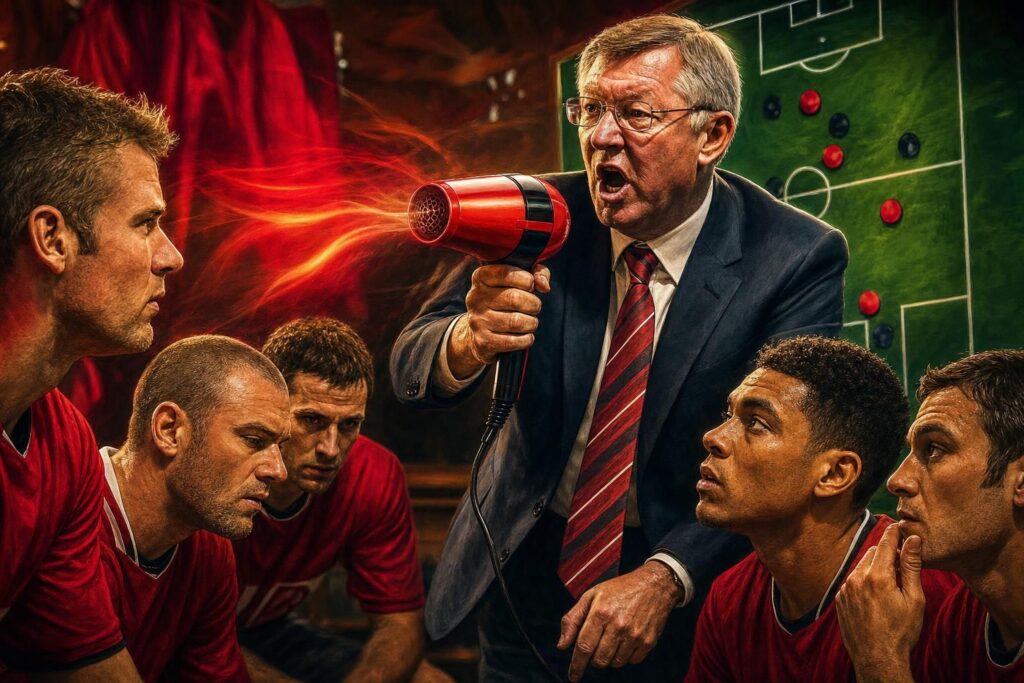
Ferguson’s hairdryer was one part of a broader, player-specific approach built around observation, authority, trust and selective confrontation.
Sir Alex Ferguson’s hairdryer treatment is football’s favourite shorthand for a dressing-room dressing-down: the manager gets close, the volume rises, and a player leaves with his fringe rearranged by pure authority. It is a vivid image. It is not a complete account of how Ferguson managed Manchester United.
From his arrival at Old Trafford in 1986 to his retirement in 2013, Ferguson built a reputation for demanding standards and confronting players when he thought they had fallen short. But accounts from players and Ferguson himself point to something less tidy than the folklore: he watched, judged the person and the moment, and chose from a range of approaches. Sometimes that meant a blast. Sometimes the more important message was that he trusted you.
What the hairdryer meant
In football, “hairdryer” describes a forceful, usually private confrontation, delivered at close range and with enough volume to make the point difficult to miss. The phrase fits Ferguson’s public image so neatly that it can make his temper seem like a management system: identify the mistake, turn up the decibels, wait for improvement.
There were real confrontations behind the shorthand, and former players have recalled Ferguson’s intensity. Wayne Rooney, looking back on his United years, described himself as “not the quickest learner” and expressed faith in Ferguson’s management. Retrospective accounts also point to players such as Ryan Giggs and Roy Keane when discussing how Ferguson’s approach could vary across a dressing room. Those memories matter, but they are not all the same kind of evidence: a vivid anecdote recalled years later is not a complete record of what happened every week.
That distinction is important. The hairdryer became a useful label because it captures a dramatic moment, not because it proves Ferguson managed everyone by shouting. If every story about a manager’s temper becomes the whole story, the quiet work disappears. In Ferguson’s case, that would leave out much of the point.
Different players, different pressure
Ferguson’s approach is commonly described as flexible and player-specific. That does not mean every player received a bespoke motivational speech, or that the manager’s instincts were always right. It means the same intervention was not necessarily suited to every personality, or every stage of a player’s career.
Some players respond to a direct challenge; others need time, guidance or the confidence that a poor performance has not ended the manager’s faith in them. Ferguson’s own reflections, including those collected in his autobiography, put emphasis on observing players and understanding what might move them. The manager’s authority was not in question. The judgement lay in deciding how to use it.
That is where the hairdryer image is both useful and misleading. It captures the force of Ferguson’s authority, but not its calibration. A dressing-down could make expectations unmistakable when a player had let the team down. Applied indiscriminately, it would just be noise. The hard part was knowing which conversation the moment called for, rather than treating every bad pass as a disciplinary hearing.
Players’ recollections of Ferguson’s management include both confrontation and support. Rooney’s later comments show trust in Ferguson even while acknowledging that he could be slow to learn. Other accounts describe a manager who paid attention to individuals and adjusted how he dealt with them. The contrast is not evidence that one side must be false. A player could be challenged in one moment and backed in another; teammates could experience the same manager differently.
Trust was part of the authority
Ferguson’s influence was not built on fear alone. Reports and player accounts describe a broader approach, including individual attention, encouragement and the trust to give players responsibility. That matters because confrontation is most persuasive when the player believes the manager is invested in him, not simply waiting for a reason to explode.
For a young player learning the demands of first-team football, a public blast may be less useful than clear instruction and the chance to recover from an error. For an established player who knows the standards and has fallen short, a sharper challenge may carry more force. These are reasonable ways to understand why players remember different Fergusons. They should not be mistaken for a rulebook Ferguson published, or proof that every confrontation produced the intended result.
The same distinction applies to public discipline and private support. Ferguson could make standards visible, but his leadership was also described in terms of observation and timing. A manager who only shouts eventually becomes background noise. At United, the hairdryer’s reputation was powerful partly because it was not the only setting.
Memory, myth and the manager behind the image
Ferguson’s career at United lasted long enough for stories to pass through several rounds of retelling. Players remember events from their own position; later interviews can sharpen a story into a memorable anecdote. Ferguson’s retrospective descriptions also frame his methods from the perspective of a manager looking back. Those accounts are valuable, but they do not turn every familiar tale into a contemporaneous, fully documented incident.
That is why the hairdryer is best treated as a real element of Ferguson’s management, not a universal explanation for it. The image tells us something about his appetite for confrontation and the authority he commanded. It tells us less about how often he used it, how each player received it, or whether it was the decisive reason a player improved.
United supporters do not need to pretend Ferguson was a gentle coach who occasionally raised an eyebrow. The force was part of the package. But so were his attention to individuals, his willingness to trust players and his ability to choose when to apply pressure. The manager who built a dynasty was not simply a man with a loud voice and a very short distance between himself and the guilty party.
So, was the hairdryer the secret to Ferguson’s man-management? No. It was one tool in a broader approach: sometimes effective, sometimes remembered more vividly than the quieter work, and experienced differently by different players. The folklore survives because the image is irresistible. The more useful truth is that Ferguson’s authority mattered most when he knew whether to use it as a blast, a challenge or a vote of confidence.
That is a less cinematic answer than a manager roaring someone into greatness. It is also closer to the evidence: Ferguson’s success was associated not with one fixed trick, but with a varied approach in which confrontation had its place and trust had one too. The hairdryer made the highlight reel. It was never the whole match.