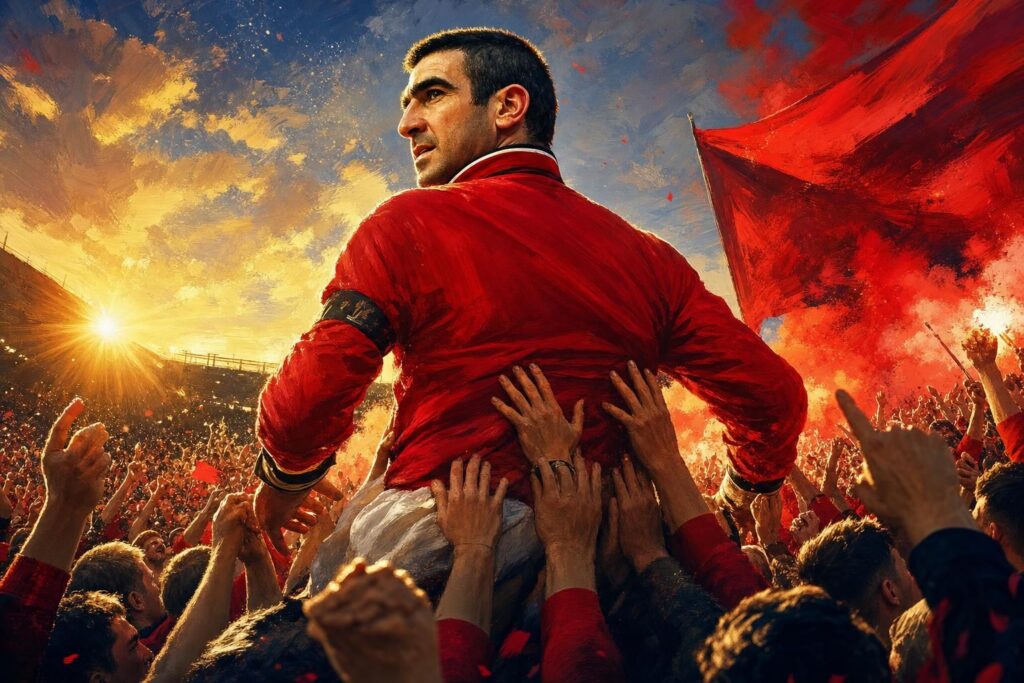
Cantona remains United’s King because transformative football, distinctive charisma and enduring supporter songs turned a successful playing spell into a lasting emotional bond.
Manchester United supporters are perfectly capable of arguing about a substitute’s positioning for three days. Yet call Eric Cantona “the King” and remarkably little constitutional scrutiny follows. No election, no succession plan, no serious appetite for either. The throne remains occupied by a man who left United in 1997.
That ought to require some explaining. Our history hardly suffers from a shortage of extraordinary footballers. Cantona’s United career lasted from 1992 to 1997, not a lifetime. Affection has nevertheless given him something that a longer service record cannot automatically buy: a permanent place in how we imagine the club.
Why is Eric Cantona so loved at Manchester United? Because his influence during a transformative winning period came with a personality supporters could build a world around. The football earned the devotion. The character gave it a face. The songs have kept it alive.
The football has to come before the crown
There is a lazy version of the Cantona story in which charisma does all the work. Mysterious Frenchman arrives, everyone becomes terribly impressed, trophies follow. It makes a lovely legend and a fairly useless explanation of a football team.
Cantona joined United from Leeds in 1992 and became a transformative figure in the club’s early Premier League success. His spell brought multiple league titles. That winning contribution matters because supporter mythology needs something sturdier beneath it than an interesting personality. Without the football, you have a cult figure. With it, you can have a defining one.
The Premier League’s retrospective records 70 goals and 56 assists in 156 league appearances across Leeds and United combined. Those are not United-only totals, but they capture the essential balance: here was a player who could finish attacks and make them happen.
That combination helps explain the particular attachment. A scorer gives you the release of a goal. A creator also gives you anticipation, the sense that an attack might become something better because he is involved. Cantona offered both. We could admire the outcome and enjoy the intelligence behind it.
For all football’s enthusiasm for declaring someone a “winner”, usually while showing footage of them shouting, influence needs to be expressed through actual play. Cantona’s case rests on productive invention within a successful team. The aura was not being asked to cover a shortfall in football.
Nor should affection evict everyone else from the photograph. United’s rise was a collective achievement. Turning Cantona into its sole author would diminish the team that made his influence consequential. He helped change the trajectory; he did not personally perform every job at the club while the others stood about appreciating him.
He made superiority feel like a personality
Winning explains respect. It does not fully explain why one former player becomes a lasting emotional shorthand.
Cantona’s appeal rests partly on the fit between his charismatic, rebellious image and the United we like to believe in: imaginative, assertive, capable of making the opposition feel that something unpleasantly ambitious is about to happen. We are not always that club. Supporting United involves maintaining a strenuous distinction between identity and available evidence.
But Cantona belongs to a period when that self-image had compelling football behind it. His confidence could be read as a promise that the team’s ambition was justified. Supporters responded to more than achievement. They recognised an attitude they wanted their club to possess.
There is vanity in that, obviously. Football support is not a character reference. We enjoy players who make our chosen allegiance feel unusually discerning, as though supporting United were an artistic judgement rather than something often settled before we could reliably tie our shoes.
Cantona gave that vanity unusually good material. His individuality made success feel distinctive. We wanted to win, certainly, but we also wanted something worth describing afterwards beyond the result.
This is where historical achievement and affectionate mythology begin to separate. History asks what he contributed. Mythology asks what he came to represent. The first deserves evidence; the second deserves scrutiny without the joyless assumption that loving a footballer is an accounting error.
The songs are the strongest evidence
If you want proof that Cantona’s status survived his playing career, look beyond another anniversary tribute. Clubs can commission those. Supporter rituals have to be worth repeating.
United’s own feature on player chants documents Cantona’s place in that culture, including “Eric the King” and “12 Cantonas”. The former is also preserved in the FanChants archive. His name has remained something supporters sing together, rather than merely recognise in an old team photograph.
That distinction matters. A tribute tells you a player was important. A chant gives him a continuing job in the life of the crowd.
It also allows affection to travel beyond first-hand experience. You need not have watched Cantona’s United career unfold to learn the song, ask about the player and inherit some of the attachment. Football history passes between generations through repetition and enthusiasm, with considerably less concern for orderly presentation than a museum would prefer. A younger supporter can join the chorus before knowing every detail of the seasons behind it; the song becomes an invitation to find out.
“12 Cantonas” is particularly revealing. As squad construction, the proposition requires further work. As an expression of devotion, it is admirably clear. Supporters are not submitting a balanced recruitment proposal. They are exaggerating affection because exaggeration is part of the pleasure.
The royal nickname works similarly. “The King” does not need to survive a spreadsheet comparison with every United great. It names a relationship. Demanding that it prove an objective ranking misunderstands what the crowd is saying.
A king without a greatest-player argument
We should resist making Cantona’s place dependent on diminishing anybody else. United’s history contains different kinds of greatness, different burdens carried and different teams transformed. Our feature on Wayne Rooney’s role alongside Cristiano Ronaldo explores another way individual brilliance can serve a collective.
Cantona’s exceptional position is the meeting point of impact, individuality and remembrance. He helped United win, embodied an exhilarating version of the club and remained available to supporters through songs and shared mythology after he left.
That mythology simplifies him. Mythology always does. We can acknowledge the editing without pretending there was nothing worth preserving.
He remains our King because the achievement and the affection reinforce each other. The football gives the songs substance; the songs keep the football emotionally present. Nobody needs to declare him United’s greatest player to understand why the crown still fits.