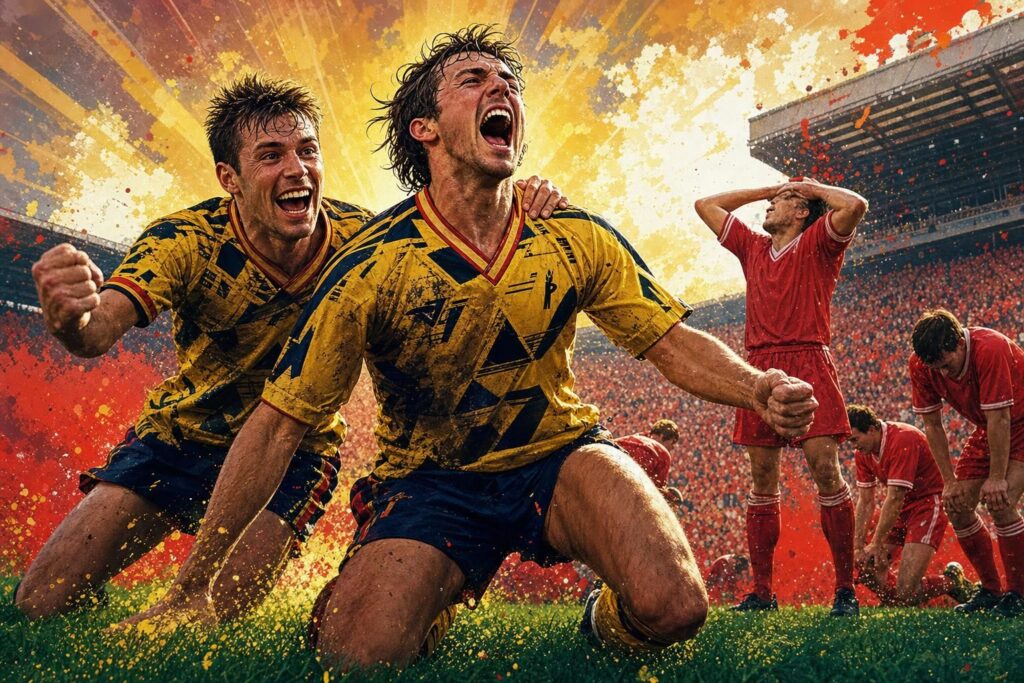
Arsenal beat Liverpool 2–0 through Smith and Thomas, finishing level on points and goal difference but winning the 1989 title on goals scored.
Arsenal needed to win by two goals at Anfield, so George Graham picked five defenders. Even now, knowing how it ends, you can appreciate the potential for a deeply unpleasant journey home.
Yet that apparent contradiction explains the night better than treating it as one glorious Michael Thomas moment. On Friday 26 May 1989, Arsenal beat Liverpool 2–0 to win the First Division on goals scored. Alan Smith supplied the opener; Thomas delivered the second in stoppage time. Before the release came calculation, restraint and enough jeopardy to make subsequent generations of Gooners nervous watching a recording.
Why Arsenal needed two goals, not simply a win
Before kick-off, Liverpool had 76 points and a goal difference of +39. Arsenal had 73 points and +35. Both had played 37 matches, leaving this meeting to settle the championship.
A victory would bring Arsenal level on points, but a one-goal win would leave Liverpool ahead on goal difference. The crucial detail: every Arsenal goal improved our difference by one while reducing Liverpool’s by one. Two goals therefore erased a four-goal gap.
At 2–0, both clubs would finish on 76 points and +37. The next tie-break was goals scored, where Arsenal would lead 73–65. That is exactly how the final table finished.
So Arsenal required a two-goal winning margin, not specifically 2–0. A 3–1 victory would also have worked. Conceding was not fatal, but it would mean needing at least three goals. Graham’s defensive caution starts looking rather less perverse once you stop shouting “attack” long enough to do the sums.
Graham’s gamble was refusing to panic
The fixture had been postponed in the aftermath of Hillsborough. Before kick-off, Arsenal’s players distributed flowers to Liverpool supporters. That gesture belongs in the story: this championship decider took place in the shadow of a disaster, not outside it.
For the football, Graham used David O’Leary as a sweeper alongside Tony Adams and Steve Bould, with Lee Dixon and Nigel Winterburn completing the five-man defensive selection. John Lukic was in goal; Thomas, David Rocastle, Kevin Richardson, Paul Merson and Smith made up the rest of the starting side.
It was an unusually defensive answer to an attacking requirement. But throwing players forward immediately risked making the task harder. Keeping Liverpool out preserved the possibility that two good moments could win the league.
In Sky Sports’ retrospective, Graham recalled saying: “I said ‘no, we’ll try to be cautious’.” He remembered believing that a first goal could unsettle Liverpool and open the way for another. Dixon later described the intended sequence as goalless at half-time, a goal early in the second half, then a late winner.
Those are later recollections, not a transcript smuggled out of the dressing room. Contemporary reporting does, however, corroborate the cautious approach and sweeper system. Graham was managing the requirement rather than performing desperation for the benefit of anxious Arsenal supporters. We are not always grateful for that distinction while a match is happening.
There was a first-half opening when Bould met Thomas’s cross, only for Steve Nicol to clear his header. Liverpool lost Ian Rush after 32 minutes, Peter Beardsley replacing him. At half-time it remained 0–0: useful to Graham, considerably less soothing to anyone whose emotional wellbeing required two Arsenal goals.
Smith opens the door, Thomas leaves us waiting
The first breakthrough arrived in the 52nd minute. Winterburn delivered an indirect free-kick and Smith headed in. Liverpool protested, but referee David Hutchinson consulted his linesman and allowed the goal.
Smith later recalled that the routine had been practised repeatedly without previously coming off in matches. An excellent occasion to stop wasting everybody’s time in training, then. More seriously, it matters that the opener came from preparation: Arsenal had a rehearsed way of creating the chance they desperately needed.
Now the score was 1–0, a particularly cruel arrangement. Arsenal were winning at Anfield and Liverpool were still winning the league. Celebration had to come with a mental asterisk.
Thomas then had the opportunity that makes the eventual ending more remarkable. From Richardson’s pass, he shot straight at Bruce Grobbelaar, an incident placed in the 74th minute by the contemporary match report. For anyone discovering the game through its famous finish, this is essential: Thomas did not glide through an evening of uninterrupted composure.
Graham changed the side too. Martin Hayes replaced Merson after 73 minutes; Perry Groves came on for Bould after 76. The original defensive structure had served its purpose. Arsenal still needed another goal, and time was becoming the opposition’s most reliable player.
Smith deserves more space in our telling than merely being the scorer before the scorer. Having provided the first goal, he would also supply the pass for the second. Thomas owns the immortal finish; Smith helped build both halves of the required margin.
The move that turned 1–0 into a championship
In stoppage time, John Barnes was attacking for Liverpool when Richardson interrupted the move and possession returned to Lukic. Liverpool were not simply standing around waiting for history to happen to them.
Lukic threw to Dixon. Dixon passed forward to Smith, who controlled and sent Thomas through. A ricochet involving Nicol helped Thomas keep possession. Preparation and nerve had brought Arsenal this far; a favourable bounce was welcome to contribute.
Then Thomas lifted the ball over the advancing Grobbelaar. The goal is recorded as 90+2. Arsenal had their two-goal margin.
What still feels outrageous is the composure of that final action after the earlier chance had gone. With the championship requiring an immediate solution, Thomas found a finish delicate enough to make the surrounding panic look faintly embarrassing.
ITV Sport’s archive highlights capture the decisive phases:
Watch Liverpool v Arsenal 1989 highlights.
Liverpool restarted before the final whistle. It was not literally the last kick, although Arsenal hardly needed the extra ordeal. The margin survived, and our first league title since 1971 was secured.
The beauty of Anfield ’89 is that the delirium had a precise foundation. Graham kept the task manageable, Smith supplied the breakthrough and the final pass, and Thomas finished when there was scarcely any match left. Level on points. Level on goal difference. Eight more goals scored. We can reasonably claim that no piece of arithmetic has ever looked better in an Arsenal shirt.