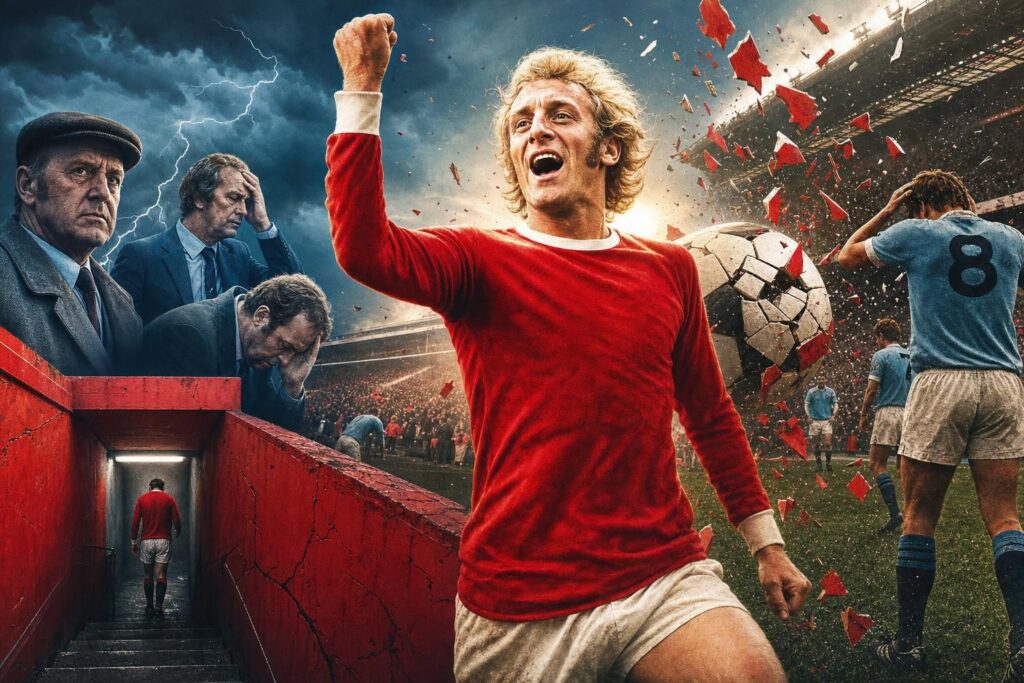
United’s 1974 relegation followed managerial instability and a failing attack; results elsewhere meant Denis Law’s derby winner did not decide their survival.
Denis Law supplied the backheel. Manchester United supplied the months of failure that made it look like a relegation verdict. Somehow, the man who scored one goal against us has ended up carrying more responsibility in the popular telling than the team that managed only 38 all season.
It is a magnificent piece of football shorthand and a rotten explanation. United were relegated in 1974 because an already struggling club failed to replace its great attacking generation, endured managerial upheaval and spent far too much of the season discovering how difficult winning becomes when scoring is an occasional treat.
Law’s goal gave Manchester City a 1–0 derby victory at Old Trafford on 27 April. Results elsewhere meant United would have gone down even if we had won. That distinction matters, unless we are happy to let the most painful image do all our historical thinking.
The decline was already on the team sheet
Tommy Docherty did not inherit a healthy United and suddenly drive it into a ditch. The club’s official history of the 1970s records a succession that makes the instability plain.
Wilf McGuinness was relieved of his duties on 26 December 1970. Matt Busby returned temporarily. Frank O’Farrell took over in June 1971, but the 5–0 defeat at Crystal Palace on 16 December 1972 proved his final match. Docherty was appointed six days later.
There were different managers, different circumstances and different responsibilities. Collectively, though, this was a club struggling to establish what came next. United supporters are entitled to find that sentence unpleasantly familiar without pretending every unhappy period has identical causes.
United finished 1972–73 in 18th place with 37 points. The warning was therefore available in a particularly accessible format: the league table. Relegation the following year was a further deterioration, not an inexplicable trapdoor beneath a successful side.
Meanwhile, the attack’s famous names were disappearing. Bobby Charlton retired from United at the end of 1972–73. Law joined City on a free transfer that summer. George Best remained only briefly as a meaningful part of the league campaign, making 12 appearances and scoring twice. His final United appearance came in the 3–0 defeat at QPR on 1 January 1974.
We rightly cherish those names. But a team sheet cannot collect points by reminding the opposition who used to be on it. Moving beyond Charlton, Law and Best was unavoidable; producing a functioning attack without them was the actual job. In 1973–74, United failed it.
Thirty-eight goals: the number beneath the mythology
The final league record is brutally economical: 42 matches, ten wins, 12 draws and 20 defeats. United finished 21st out of 22 with 32 points, scoring 38 goals and conceding 48. Only Norwich, with 37, scored fewer.
That last comparison should end any temptation to describe this merely as bad luck in a dramatic derby. An attack finishing one goal ahead of the division’s least productive side has spent the season submitting evidence against itself.
The individual returns show how little scoring weight United could muster. Sammy McIlroy scored six in 29 league appearances, Lou Macari five in 35 and Brian Kidd two in 21. Jim McCalliog contributed four in 11. These are not grounds for dismissing every player involved, but they do explain why the departed attacking generation loomed so large.
Martin Buchan and Alex Stepney played all 42 league matches. There was continuity in important positions; this was not simply a team with nobody dependable left. Yet dependable figures elsewhere could not manufacture the goals needed to turn narrow matches into wins.
Away from Old Trafford, the shortage became especially damaging: three wins, five draws and 13 defeats, with just 15 goals scored. United’s first away league victory did not arrive until 2 March, a 1–0 win at Sheffield United. March. By then, calling it an away-day problem rather understates the duration of the experiment.
Home offered insufficient protection: seven wins, seven draws and seven defeats. Our ground, our crowd, perfectly equal opportunities for all three results. There was no dependable source of points to offset the travelling misery.
The recovery that made hope particularly cruel
United did briefly produce something supporters could cling to. From 30 March to 20 April, Docherty’s side went six league games unbeaten, winning four and drawing two.
That brought ten points under the two-points-for-a-win system. It was a substantial recovery, and it deserves recognition. So does the emotional cruelty of a struggling side finally becoming useful just late enough to make you start calculating again.
We know the temptation: identify the remaining fixtures, assume the improved form continues and quietly demote every rival’s next opponent from football club to rescue service. The run gave hope a legitimate foothold. It could not erase everything that preceded it.
United then lost their final three matches, all 1–0, against Everton, City and Stoke. The season ended with three consecutive demonstrations of its central weakness. Whatever else went wrong, a side unable to score had almost no margin for error.
What Law’s backheel actually decided
On 27 April 1974, Law backheeled Francis Lee’s pass past Stepney at Old Trafford. City won 1–0. A former United great scoring the derby winner against a relegation-threatened United was painful enough without making him personally responsible for the entire collapse.
The relegation arithmetic is clear. Before that afternoon, United had 32 points from 40 games. With two matches left and two points available for a win, our maximum was 36.
Birmingham had 35 points before their final game. They beat Norwich 2–1 to finish on 37. West Ham drew 2–2 with Liverpool and also reached 37. Even victories against both City and Stoke could therefore no longer save United.
Remove Law’s goal alone and the derby becomes a draw. Add a hypothetical win at Stoke and United reach 35 points, still insufficient. Relegation became certain that afternoon with one United fixture remaining, but the backheel was not the mathematical cause.
Three clubs went down that season, the first with a third relegation place. Teams level on points were separated by goal average, not modern goal difference. Neither detail offers an escape clause: United finished 21st, five points behind 19th-placed Birmingham.
The backheel survives because it gives a long decline a single, devastating image. But blaming Law lets too much else disappear: the unstable succession, the inadequate attacking renewal, the barren away trips and the recovery that arrived too late.
We can bear to tell our own history properly. Law won City the derby. United’s season-long failures cost us our place in the First Division.