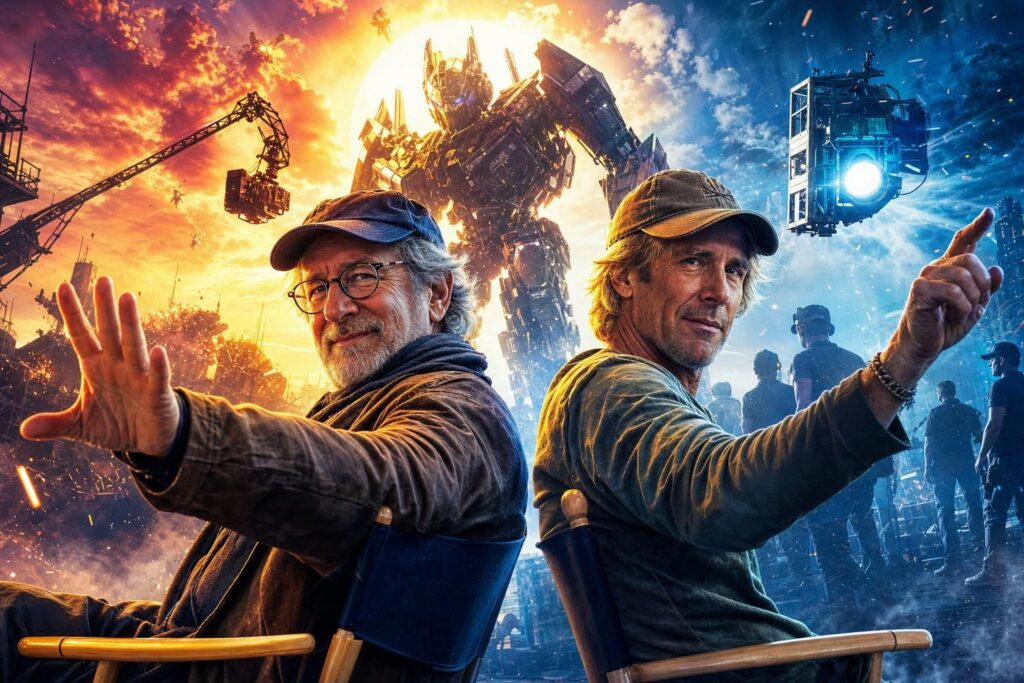
Spielberg producing, Bay in talks to direct the eighth live-action Transformers film. Beyond that, nothing is confirmed.
Steven Spielberg is returning to the Transformers franchise, but not in the way the headlines might suggest. As reported on 6 October 2026, he is not directing the next live-action film. Instead, he will oversee creative aspects and executive produce alongside his production company, having reportedly read and signed off on the script. Michael Bay, the director behind the first five live-action entries, is in talks to direct, but no deal has been confirmed.
This distinction matters because there is a meaningful difference between “Spielberg is involved” and “Spielberg will direct.” The former suggests a guiding hand on a project; the latter would signal a major creative reset. Similarly, Bay’s involvement remains in negotiation. Reporting that a director is “in talks” reflects a project in development, not a green-lit production. Either scenario could still fall apart before any cameras roll.
Where This Film Fits in the Franchise
According to trade reports from The Hollywood Reporter and TheWrap, this would be the eighth live-action Transformers film, though understanding that count requires clarifying what the franchise actually includes. Bay directed the original five films between 2007 and 2017, concluding with The Last Knight. Travis Knight then directed Bumblebee in 2018, followed by Transformers: Rise of the Beasts in 2023. That makes seven live-action entries, though the animated Transformers One released in 2024 sits separately from the live-action timeline.
The significance of this historical context is straightforward: Spielberg’s original involvement with the franchise came through the Bay era. He executive produced the first three films, establishing himself as a franchise stakeholder. Bay’s five consecutive entries created the franchise’s visual and tonal template, even as subsequent films departed from his approach. If Bay does eventually sign on, it represents a return to the filmmaking voice that defined the property for audiences during its peak commercial period.
What the Reported Script Contains – and What It Doesn’t
Jason Fuchs is reported to be writing the film, with the script set in the present day according to The Hollywood Reporter. That detail alone tells us something: rather than jumping forward into speculative futures or backward into period pieces, this project is anchored to contemporary settings. What the reporting does not provide is any information about plot, character focus, scale, tone, or which robots would actually appear.
The cast situation comes with its own clarity. Shia LaBoeuf, who anchored the Bay films as Sam Witwicky, is not expected to return. This signals a fresh protagonist approach, though whether that means the franchise will return to human-centred storytelling or shift focus toward the Transformers themselves remains unspecified. Lorenzo di Bonaventura, who has been involved with the franchise for years, is helping develop the project, providing some continuity in the creative infrastructure.
What Remains Completely Unknown
There is no title. No release date. No confirmed cast beyond LaBoeuf’s absence. No indication of production timeline. No budget information. No trailer, teaser, or promotional imagery. What exists at this stage is a written script that Spielberg has apparently read, the involvement of established franchise personnel, and preliminary negotiations with a director who last worked on a Transformers film nine years ago.
Crucially, Bay’s signature style, maximalist action sequences, satirical humour, destructive set-pieces, military cooperation narratives—is not confirmed as the direction this eighth film would take. The question of whether a Bay return would signal a creative reversion to his earlier approach or something different entirely depends entirely on conversations that apparently have not yet concluded.
Why This Matters, and Why It Doesn’t Yet
The involvement of both Spielberg and Bay matters in franchise terms. Between them, they were responsible for establishing what audiences associated with live-action Transformers over two decades. Spielberg’s executive producer status suggests someone with creative authority watching over the project; Bay’s potential return would connect this film to the template he created.
However, this is development-stage reporting, not a production announcement. Films at this stage routinely change direction, lose their attached directors, acquire new ones, or get shelved altogether. The fact that Fuchs has written a script and Spielberg has read it represents genuine progress, but it does not constitute a commitment to production, a locked director, or a confirmed timeline.
What this announcement actually tells us is that Paramount is actively developing a new live-action Transformers film with established franchise figures involved in advisory and negotiating roles. What it does not tell us is whether that film will actually be made, who will ultimately direct it, what it will contain, or when audiences might see it.
The next meaningful update would be confirmation of Bay’s directorial deal, or announcement of an alternative director if those negotiations fail. Until then, this remains a project on paper with interested parties and reported creative approval, but no certainty beyond that.