
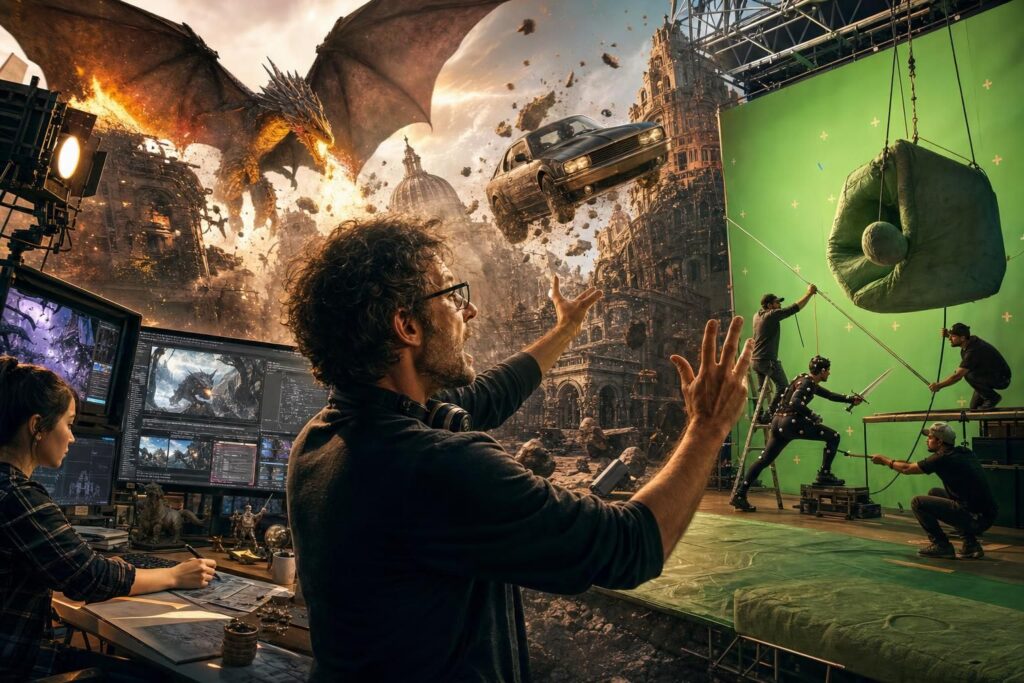
A film’s budget buys possibilities, but convincing visual effects depend on the shots planned, footage captured and time artists have to finish them.
You can spend a fortune putting a creature on screen and still make it look as though it has wandered in from a different film. Meanwhile, a production with considerably less money can make an impossible image feel perfectly at home. The difference is rarely explained by the internet’s favourite diagnosis: “bad CGI”.
Computer-generated imagery is only one part of a visual-effects shot. Someone has to decide what the camera sees, photograph anything that will remain real, design the digital elements, match their lighting and movement, then make the whole thing survive the edit. Money helps at every stage. It cannot travel back in time and make an unplanned shot well planned.
A blockbuster budget is not a CGI budget
A film’s headline budget covers far more than the images people will eventually argue about online. Cast, crew, locations, sets and the rest of production all compete for resources, while visual effects require specialist labour and time in post-production. The Producers Guild of America’s guide to film budgeting makes the useful distinction between different parts of a production budget. A large total tells you surprisingly little about what was available for one troublesome sequence.
It also tells you nothing about how often that sequence changed. A lavishly funded film can ask artists to make more shots, revise them more frequently or finish them against a tighter deadline than a smaller film with a narrower, clearer brief. None of this means expensive productions are doomed. It means a budget is a set of choices, not a magic setting labelled “make realistic”.
That distinction matters because visual-effects costs are tied to the work being asked for, not simply to the size of the film’s overall spend. A sequence with many demanding shots, repeated changes or complex interactions between actors and digital elements needs appropriate time and resources. A smaller budget can encourage sharper priorities, but it cannot make a difficult shot effortless or replace the people doing the work.
The effects shot begins before the effects team finishes it
Consider a person standing beside a digital creature. For the creature to belong in the scene, its scale, position and movement must make sense alongside the actor. The lighting should appear to fall on both of them from the same world. The camera’s perspective and the actor’s eyeline have to cooperate. Get those decisions broadly right during planning and filming, and the digital work has something to build on. Get them wrong, and artists may spend their time rescuing the shot before they can improve it.
This is why previsualisation, often shortened to previs, matters. Filmmakers can work through a sequence before shooting it, testing what needs to be photographed and what will be created later. Previs does not guarantee beautiful results; a carefully planned image can still disappoint. But it can expose expensive surprises while there is still a chance to change the plan, rather than send everyone a politely urgent email in post-production.
The same principle applies on set. In an interview about Welcome to Marwen, visual-effects supervisor Kevin Baillie discusses how on-set motion capture and virtual-production methods informed the work. Those techniques are not a universal answer, but they illustrate a broader point: decisions about performance and the finished image need not wait until filming is over. The earlier filmmakers understand what a shot requires, the fewer fundamental questions remain for artists to settle afterwards.
On-set choices also determine what the effects team has to match. Lighting, camera position, movement and practical elements all contribute to the material that will be combined later. A digital addition can be technically accomplished yet still feel detached if it does not share the scene’s visual logic. The camera does not care how much a production spent; it records the consequences of the choices made in front of it.
Why “just fix it in post” is a terrible plan
Post-production is where an enormous amount of the craft happens. Digital models need surfaces and textures; movement must feel appropriate to the scene; lighting, shadows and colour must sit alongside the photographed material. Compositing brings those elements together. A convincing result often depends less on how much has been added than on whether you notice the join.
That work needs iteration. Artists produce versions, receive notes and refine the image. Sometimes a shot changes because the edit changes. More time and money can help absorb revisions, but neither makes late creative decisions painless. If the shape of a sequence remains unsettled, an effects team can spend valuable effort perfecting images the finished film will not use, then rush to complete their replacements.
Time is not an ornamental extra in this process. It gives artists room to test an idea, see what is not working and refine the result. A rushed schedule can narrow those opportunities, while a clear plan helps direct effort towards the shots that matter most. Neither a generous budget nor clever software removes the need for decisions to arrive early enough to be useful.
Nor is every complaint about “CGI” necessarily a complaint about technical execution. An image may be expertly assembled yet look unpersuasive because the creature’s design feels out of place, the action moves too quickly to read or the camera does something the scene has not earned. Viewers do not separate those decisions into departmental invoices. They see one image and decide whether they believe it.
What smaller productions can teach the giants
Everything Everywhere All at Once is a useful challenge to the idea that visual ambition requires the largest possible spend. In a WIRED discussion of its visual effects, the filmmakers describe work shaped by the production’s constraints. The film’s inventiveness does not prove that small budgets are preferable, or that its approach could be copied wholesale for any franchise spectacle. It shows how a clear idea of what an effect needs to do can matter more than making every shot as elaborate as possible.
The Creator offers a different example. Its large-scale science-fiction imagery prompted attention to the production choices behind it, with TheWrap’s making-of account examining how its team pursued visual ambition without treating maximum spending as the only route. Again, the lesson is not that effects are cheap if you simply try harder. Artists still do the work. The lesson is that where and how a film spends its resources helps determine what those artists can achieve.
These films make a useful contrast, not a universal recipe. Their visual approaches and production needs are not interchangeable, and a successful method in one film will not automatically transfer to another. What they have in common is the more practical lesson: the intended image, the available resources and the production plan need to fit together.
Both examples come with an important warning against romanticising thrift. A tight budget can focus creative decisions, but it can also squeeze the people responsible for delivering them. The clever part is not paying less for an impossible task. It is designing a task that serves the film and can actually be finished well.
The real test is whether the image belongs
There is no single visual-effects recipe. Some shots benefit from practical elements; others need extensive digital creation. Previs, motion capture and virtual production are tools, not quality certificates. What matters is whether filmmakers choose methods that suit the scene, give artists usable material and leave enough room to refine the result.
So why do expensive films sometimes have unconvincing CGI? Because audiences see the outcome of a production process, not the size of its bank transfer. A convincing effect needs good decisions before the camera rolls, attention while it is rolling and time for skilled people after it stops. The spectacular mistake is assuming that the last of those stages can quietly repair anything the first two neglected.