Pakistan’s 1954 Oval win, England’s Karachi triumph and the 2006 forfeiture show how cricket and disputes shaped this enduring Test rivalry.
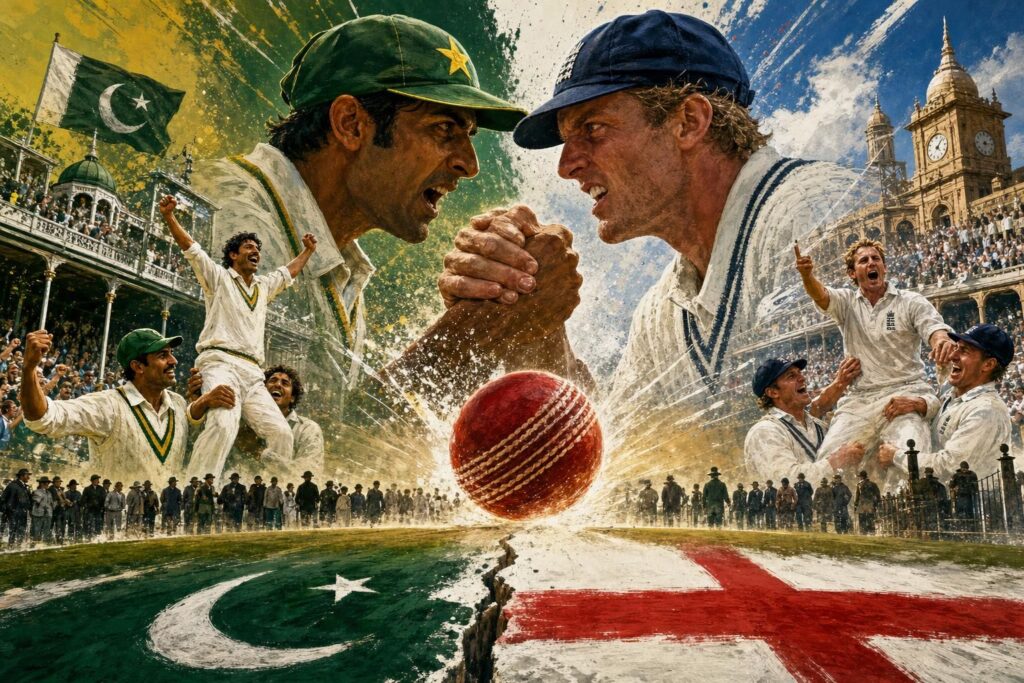
England–Pakistan Test cricket has never needed a tidy scoreline to leave a lasting impression. The rivalry began with a visiting team making history at The Oval, produced a rare English victory in Karachi under fading light, and reached its most notorious impasse at the same London ground. The cricket matters; so do the arguments about who gets to interpret it.
That combination makes this more than a tour-by-tour list of results. The defining moments show Pakistan arriving as a serious opponent, England confronting the difficulty of winning in Pakistan, and disputes over conduct and authority sometimes taking on a life beyond the match. The story is not one uninterrupted feud, though. Treat every meeting as a row in waiting and you miss the sport that made the rivalry worth arguing over in the first place.
1954: Pakistan announces itself at The Oval
Pakistan’s first Test tour of England came in 1954, and it did not end with a polite introduction. Pakistan won a Test at The Oval, an emphatic early marker from a team new to this fixture. England did not have to wait decades to discover that its visitors could beat it on English soil.
The result matters because later accounts can make the rivalry sound as if it was built chiefly on prickly exchanges. Competitive credibility came first. Pakistan did not need a controversy to make England take notice; winning at The Oval was a rather effective way to introduce itself. The series gave the rivalry an immediate sporting foundation, rather than leaving it to be assembled later from disputes and recollections.
It also gives the ground a peculiar place in the story. The Oval would become associated with another defining England–Pakistan Test, but the first memory is one of Pakistan’s achievement. That contrast is more revealing than any neat claim that one side always controlled the terms. The rivalry’s history keeps changing shape, sometimes on the very same patch of London turf.
The late-1970s edge: when conduct became part of the contest
By the late 1970s and into the 1980s, the relationship had acquired a reputation for tension involving players and officials. One episode from the 1978–79 era centred on England fast bowler Bob Willis, whose use of shielded bouncers attracted later censure from Wisden. It is a small detail with a larger point: the debate was not always confined to who had scored more runs.
In Test cricket, fast bowling is supposed to make batters uncomfortable. The arguments begin when players, officials or observers disagree about where the line sits, and how consistently it is being applied. In this rivalry, those questions could linger after the immediate contest was over. They helped establish a combative reputation, but they should not be mistaken for the entire history of the teams’ cricket.
The late-1970s episodes also help explain why later flashpoints were rarely remembered in isolation. An argument about conduct could arrive with an existing history of suspicion and disagreement behind it. That does not prove every side saw every incident in the same way, or that the tension was permanent; it shows why a moment on the field could carry more weight than its immediate sporting consequence.
There is a difference between a rivalry being tense and every match being a diplomatic crisis in whites. The broader relationship between the two countries has often coloured how encounters are understood, but it cannot explain every decision or exchange. Sometimes a disputed moment stays a sporting dispute; sometimes it becomes the story people remember instead of the cricket.
Karachi, 2000: England wins where it had struggled
England’s Test victory in Karachi in 2000 carried particular weight because winning in Pakistan had proved so difficult for touring English sides. The match finished in near-darkness, giving the closing stages an atmosphere few Test finishes can manufacture. England secured a rare result in conditions and circumstances that left little room for complacency.
That is the appeal of the Karachi Test: the light became part of the contest, not just the setting. Every remaining moment mattered, and England found a way to turn a difficult touring challenge into a win. There is no need to dress the finish up with invented heroics. A rare away victory, with darkness closing in, is already a compelling piece of Test cricket.
Set beside 1954, Karachi also shows how the rivalry’s balance shifts with the venue. Pakistan’s win at The Oval and England’s Karachi success were not matching episodes, but each disrupted the comfortable assumption that the home side would dictate the terms. The 2000 result was England’s only Test win in Pakistan at that time, which gives it a place in the story beyond the final moments.
The Oval, 2006: a Test without a normal ending
Six years later, The Oval became the setting for the rivalry’s most infamous rupture. A dispute involving umpire Darrell Hair and the condition of the ball escalated until Pakistan forfeited the Test. The match is remembered less for its cricket than for the fact that the usual route to a result broke down.
That distinction matters. Describing it simply as a bad-tempered afternoon flattens a consequential dispute about officiating, trust and the authority to make decisions on the field. At the same time, reducing it to a single line in a results table leaves the reader wondering how a Test could end that way. It was a major incident in the rivalry, not a shorthand explanation for every England–Pakistan match.
The ground’s double role makes the episode especially striking. In 1954, The Oval had hosted Pakistan’s breakthrough victory in England. In 2006, it was the venue for a Test that ended in forfeiture. One match established Pakistan as a team capable of beating England in England; the other showed how fragile the contest could become when trust in the game’s administration collapsed.
A rivalry that is more than its flashpoints
Later encounters have continued the story, with controversy and calmer periods both part of its modern history. The available landmarks do not justify claiming that every series followed the same script, or that friction was inevitable whenever the teams met. That would turn a complicated sporting relationship into a ready-made headline, and a fairly lazy one at that.
Nor is England–Pakistan simply a rival version of the Ashes, with a familiar ritual waiting to be repeated. Its defining episodes are less easily packaged: a new Test opponent winning at The Oval, an English side prevailing in near-darkness in Karachi, and a match at The Oval ending in forfeiture. The connecting thread is the contest over sporting terms, sometimes played out through cricket and sometimes through arguments about its governance.
That history is worth revisiting whenever the teams meet. Great results alter what each side believes it can achieve; serious disputes reveal how quickly trust can become part of the contest. England and Pakistan have supplied both, and the rivalry is strongest when remembered for the cricket as well as the commotion.