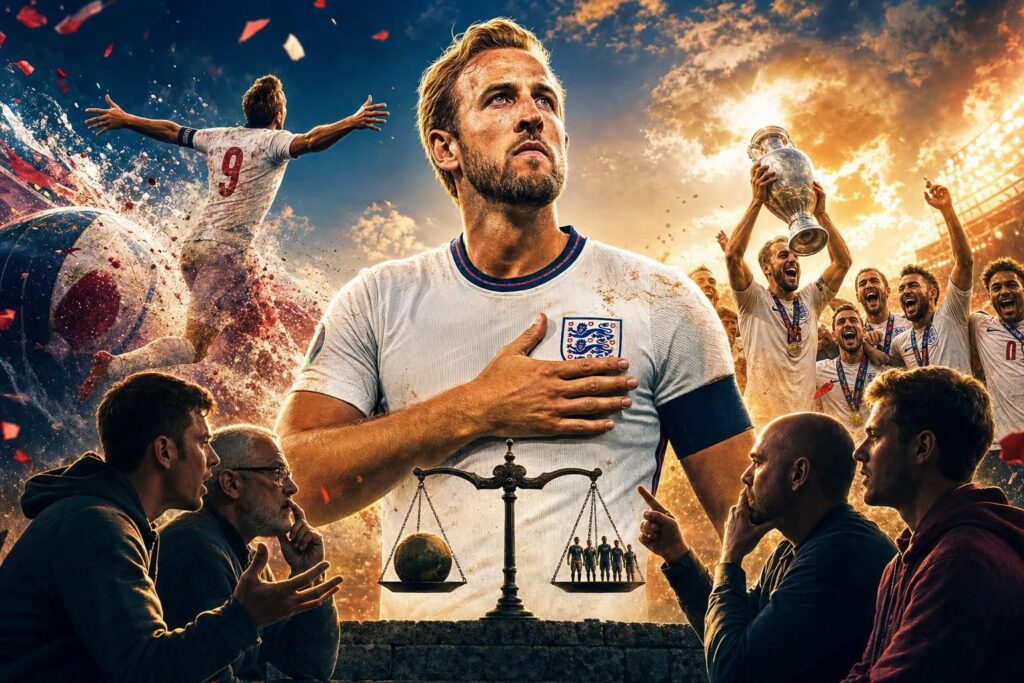
Kane’s goal record is undisputed, but team success matters more than individual output when comparing all-time greatness.
One more appearance, and Harry Kane would equal Peter Shilton’s record of 125 England caps. That milestone matters. Not because it proves anything definitively about greatness, but because it forces a genuine question: does Kane’s scoring and longevity make him a credible candidate for England’s greatest men’s international? The answer requires less certainty than you might think.
Start with the simplest measure: goals. As of 5 October 2026, Kane had scored 89 times in 124 caps. Those are numbers that do not require interpretation. He is indisputably England’s greatest goalscorer. The midfielder or defender who tries to reframe this as debatable is wasting breath.
But longevity, for all its appeal, is not identical to importance. Shilton appeared 125 times for England as a goalkeeper across nearly two decades. Kane will reach that same number far more quickly. The raw cap count reflects durability and selection consistency rather than singular excellence. It is the difference between “I appeared frequently” and “I changed matches when I appeared.”
The Shilton comparison actually undermines rather than supports any claim to being England’s greatest international. Shilton was a consummate professional and served his country with distinction, but nobody seriously argues he was England’s greatest player because he played the most matches. He was a goalkeeper. Kane is a striker. The positions demand entirely different forms of contribution. Goals are Kane’s job. They are part of Shilton’s job, but not the defining measure of it.
The 1966 Counterargument
This is where the 1966 argument enters, and it is a legitimate one. Bobby Moore captained England’s 1966 World Cup winners. Sir Bobby Charlton was part of the same side. Neither player appears in modern goal-scoring rankings because their central contribution operated within a different context entirely. Moore’s distribution, positioning, and leadership created the platform for England to win a World Cup. Charlton’s all-around skill, intelligence, and decision-making made him indispensable to a team that won the sport’s defining prize.
Kane has not won a major tournament with England. That is not a minor point. It is a material distinction. When England has reached deep in tournaments during Kane’s era, the team has fallen short at crucial moments. The 2018 World Cup semi-final loss to Croatia, the 2020 Euro final loss, the quarter-final exit at the 2022 World Cup: Kane’s personal performance in these moments has often been good rather than defining. That is not a failure of individual ability. It is a recognition that tournament football operates at a different pressure and that team success requires systemic excellence, not individual brilliance.
The Comparison Problem
Comparing Kane to Moore or Charlton directly is therefore flawed. They were players of genuinely equal importance to their teams, operating at genuinely different positions and eras, within genuinely different tactical systems. Kane is a centre-forward in the modern era. Moore was a centre-back in 1966. Charlton was a midfielder-forward hybrid in the same period. Their production looks different because their jobs were different.
What remains true is that Kane’s goal-scoring record and consistency across 124 caps reflects extraordinary individual excellence. He has remained England’s principal attacking threat across four different tournaments spanning eight years. That is not luck or circumstance. That is elite performance sustained across context.
Individual Excellence Versus Team Success
The fairest assessment acknowledges the distinction between individual excellence and team success. Kane reaching Shilton’s cap record represents a credible claim to being England’s most prolific and durable modern international. But prolific and durable are not the same as greatest. The 1966 winners have a stronger claim to that title, not because they were better footballers in some abstract sense, but because they delivered at the moments that mattered most. Kane has not.
This is not criticism of Kane. It is context. A player can be England’s greatest goalscorer and simultaneously not be England’s greatest international player. Those are different questions. One measures individual output. The other measures overall contribution to team success. Kane has achieved the first. The second has eluded him.
The real answer to the question posed by this milestone is therefore: Kane is England’s greatest goalscorer and one of the most important modern-era players to wear the shirt. Whether that makes him England’s greatest international depends entirely on how you weight individual production against team achievement, and that remains a matter of reasonable judgment rather than objective fact.