

FPL prices follow transfer activity, but managers bank only half the profit, making points and reliable information more valuable than speculative rises.
Nothing exposes the peculiar cruelty of Fantasy Premier League quite like buying a player for £7.5m, watching him rise to £7.6m and discovering that selling him still returns £7.5m. The market says you have made a profit. Your bank balance responds with the administrative warmth of a rejected expenses claim.
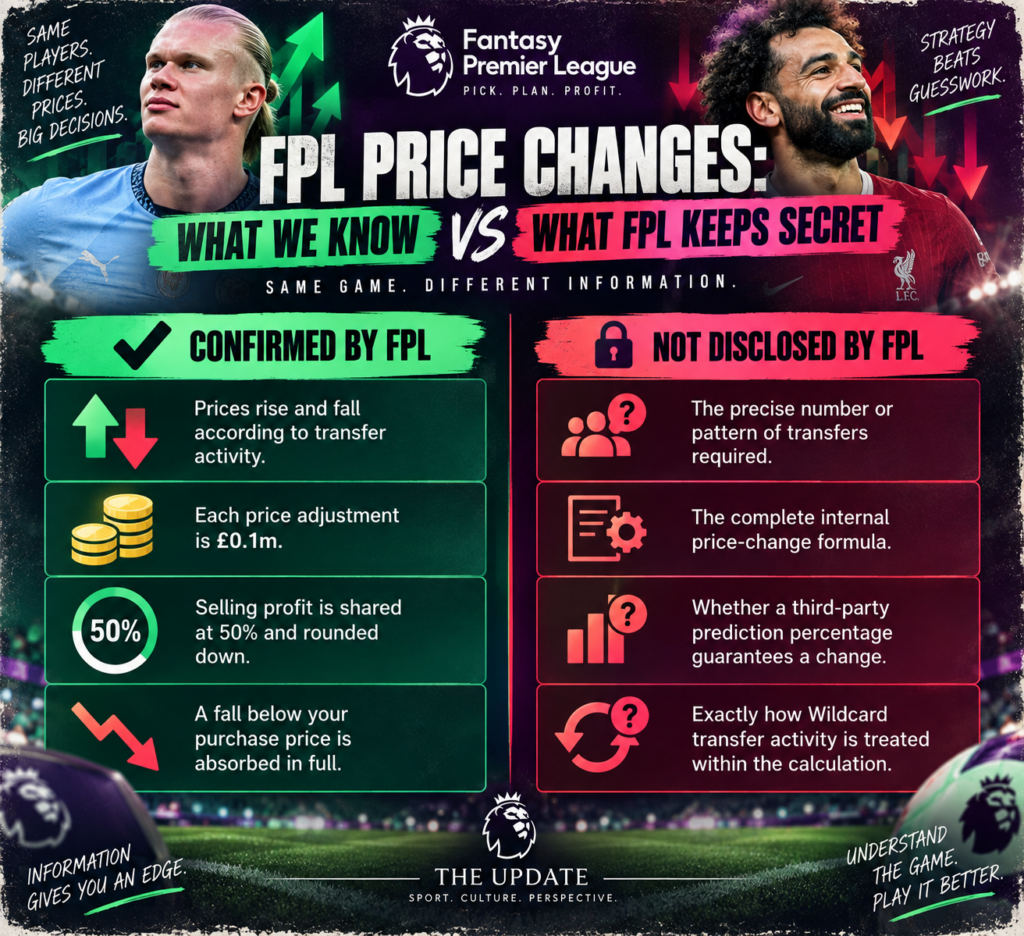
FPL price changes are driven by managers buying and selling players, but the game does not publish the precise formula used to trigger them. What it does confirm is how prices move and how much money you receive when selling. Understanding that distinction is essential because price-prediction websites estimate the hidden part; they do not possess a secret key to the Premier League vault.
The confirmed FPL price-change rules
Player prices can rise or fall throughout the season according to transfer activity, broadly reflecting supply and demand. An influx of purchases can lead to a rise, while sustained sales can produce a fall. Changes happen daily rather than being tied exclusively to the Gameweek deadline, and each individual adjustment is £0.1m.
Three different prices matter. A player’s purchase price is what you paid for him. His current price is the market price displayed in the game. His selling price is what FPL will actually add to your budget if you remove him. Confusing those last two is responsible for a remarkable amount of imaginary wealth.
How FPL selling value is calculated
When a player rises above your purchase price, you receive 50% of the profit if you sell, rounded down to the nearest £0.1m. In practical terms, the player normally needs to rise by £0.2m before your selling price increases by £0.1m.
Suppose you buy a midfielder for £7.5m. If his current price rises to £7.6m, his selling price remains £7.5m because half of the £0.1m gain is £0.05m, which is rounded down. At £7.7m, you can sell for £7.6m. At £7.8m, you still receive £7.6m because half of the £0.3m rise is £0.15m, again rounded down. If he reaches £7.9m, the selling price becomes £7.7m.
The calculation can be expressed simply: take the difference between current price and purchase price, halve it, round that profit down to the nearest £0.1m, then add it to the purchase price.
Price falls are less charitable. If your £7.5m purchase drops to £7.4m, you can sell only for £7.4m. FPL shares your gains but leaves you alone with your losses, an arrangement familiar to anyone who has ever inspected a mobile-phone contract.
Why a £0.1m rise can matter even when you cannot bank it
A first rise may not increase the selling value of a player you already own, but it increases the cost for everyone who does not. That can still affect your plans.
Imagine you own a £6.0m midfielder and want to replace him with a midfielder costing £6.5m. You have exactly £0.5m in the bank. If the target rises overnight, the move becomes unaffordable. Acting early would preserve the route into the player, even though waiting would provide more injury news.
The reverse scenario is equally important. If your outgoing player is about to fall from £6.0m to £5.9m and you bought him at £6.0m, delaying costs £0.1m of usable budget. If the incoming player might also rise, the same transfer can effectively become £0.2m more expensive.
That is the strongest case for an early move: a price change would block a transfer you have already decided is correct. You are protecting a specific plan, not gathering shiny coins because a tracker has turned an alarming shade of red.
When an early FPL transfer is worth the risk
An early transfer is rational when the target is central to your medium-term plan, the outgoing player is clearly unwanted, and an imminent movement would make the deal impossible or damage a tightly allocated budget. The decision becomes stronger when both players have completed their matches and there is little relevant team news still to arrive.
Waiting is usually better when either player has another fixture before the deadline, when European matches are involved, or when press conferences could clarify an injury, suspension or selection issue. Saving £0.1m is not a triumph if your new signing develops a hamstring problem on Wednesday and requires another transfer on Friday.
A four-point hit taken to repair that mistake is especially difficult to justify. Team value can help buy future points, but it does not score any itself. There is no end-of-season parade for finishing 1.8 millionth with a squad worth £106m.
The dangerous obsession with building team value
Extra budget is valuable when it improves the players you can own. Early in the season, price rises can compound and create useful flexibility later. Yet headline team value can exaggerate your spending power because some profit remains locked behind the 50% selling rule.
A player bought at £7.5m and now priced at £7.8m contributes to the displayed value of the squad, but selling him returns only £7.6m. Replace several heavily appreciated players and the supposed fortune shrinks quickly. This is why selling value matters more than admiring the total on the transfers page.
There is another trap. Managers sometimes sell a successful player to capture profit, then discover that buying him back costs substantially more. If that player remains a strong pick, harvesting £0.1m can amount to pawning the television to purchase a slightly nicer remote.
What happens on a Wildcard or Free Hit?
A Wildcard allows unlimited transfers without the usual points deductions, and players can still change price while it is active. This creates opportunities to reshape a squad as market prices move. However, FPL’s published rules do not clearly explain whether Wildcard transfers are treated differently inside the hidden price-change calculation. Claims that they definitely count, or definitely do not, go beyond official confirmation.
The sensible approach is to use prediction tools cautiously and build the Wildcard squad you actually want. Do not repeatedly buy and sell players purely to manufacture profit unless the displayed prices and your own selling values make the benefit real.
A Free Hit is temporary. Your previous squad returns after the Gameweek, so it should be planned primarily around that week’s points rather than as a method of permanently accumulating value.
Use price information without becoming its servant
Before transferring early, ask one practical question: would the expected change prevent or materially weaken my intended move? If yes, acting may be worth the injury and information risk. If no, waiting for press conferences and completed fixtures is generally the stronger percentage play.
Price trackers can sharpen that judgement, but their thresholds are estimates rather than official guarantees. Check your player’s purchase price and selling price inside FPL, calculate what the movement would actually change, and remember that a predicted rise is not automatically money you can spend.
The best FPL managers care about team value without worshipping it. Budget creates options; points create rank. Confusing the two is how perfectly sensible squads end up participating in the annual Saturday-night hamstring lottery for the magnificent prize of £0.1m.