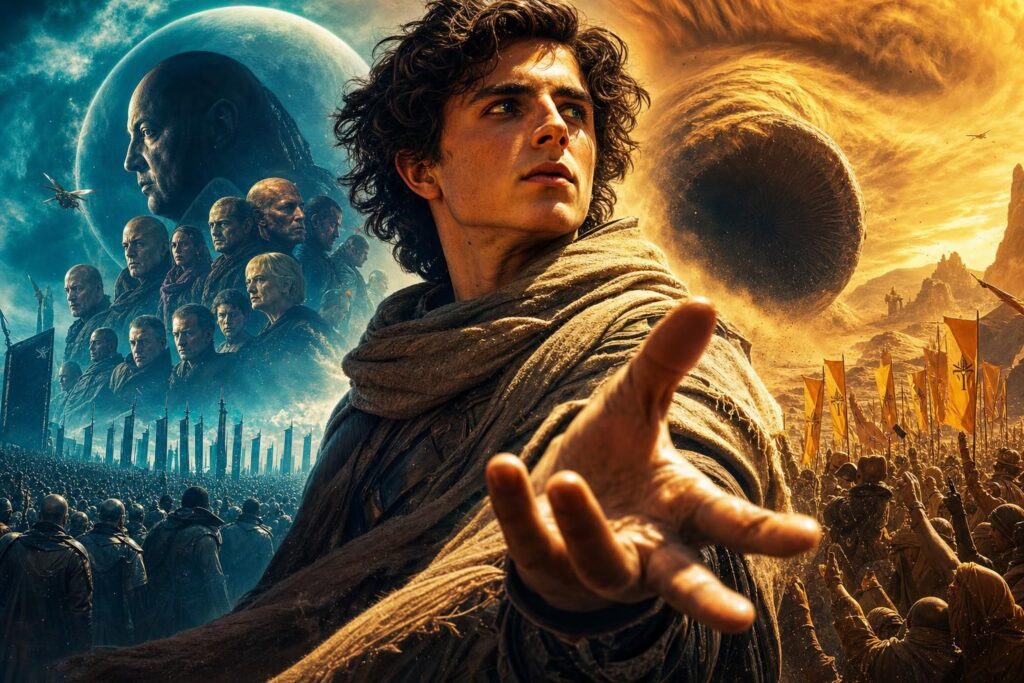
Paul is a tragic protagonist rather than a straightforward villain: his enemies leave him few good choices, but he still claims dangerous power.
Spoilers for Dune and Dune: Part Two follow. This article discusses the two released Denis Villeneuve films only, not events from later novels.
Paul Atreides would be much easier to judge if he were less good at being the main character. He is dispossessed, hunted and played by Timothée Chalamet with precisely the sort of wounded intensity that makes an audience want to hand him the keys to civilisation. Unfortunately, Dune: Part Two asks what happens after somebody does.
So, is Paul Atreides a villain? In Villeneuve’s two released films, the strongest answer is not quite, but he is no conventional hero. His enemies help create the catastrophe he is trying to survive. He nevertheless chooses to turn a manufactured prophecy into political power, knowing that his rise threatens violence far beyond the people immediately fighting him. The tragedy explains his choices. It does not wipe his fingerprints off them.
Being hunted does not make Paul wrong to fight back
The moral case for Paul begins with a fairly important detail: he did not volunteer to have his family destroyed. In the first film, the attack on House Atreides strips him of protection and leaves him and Jessica seeking refuge among the Fremen. Treating his resistance as inherently villainous would require the sort of moral reasoning usually found in a palace occupied by the people who attacked him.
The Fremen, meanwhile, have their own struggle on Arrakis. Paul’s involvement in their fight against the Harkonnens is not merely a disguise for personal ambition. The films give us reasons to sympathise with him and with the people fighting beside him. That matters, because a cautionary story becomes awfully cheap if its central figure never has a defensible reason to act.
But a just cause is not a lifetime exemption from scrutiny. Paul’s position changes as he becomes more than an ally in a resistance movement. The question stops being whether he should defend himself and becomes whether he should accept the extraordinary authority being offered to him, and what he is prepared to do with it. His circumstances explain why he seeks a route to survival; they do not make every route morally equivalent.
The prophecy is where survival becomes power
In Part Two, belief in Paul’s promised role is not presented as harmless local colour. It shapes how people understand him and what they will follow him to do. Paul initially resists the messianic path, which is one reason the eventual turn matters. The film is not showing a man who simply stumbles into leadership while looking for somewhere to park a sandworm.
His knowledge is imperfect, and the films do not give the audience a tidy ledger of every future he can see. They do, however, make his fear of a much wider, prophecy-driven war central to his hesitation. When he embraces the role he had feared, that earlier resistance becomes evidence of his awareness, not proof of his innocence. He understands enough to dread the consequences, even if he cannot control or know every detail of what follows.
This is the distinction between having limited options and having no agency. Paul faces enemies with overwhelming power, and refusing the prophecy carries risks too. Yet he also gains the ability to direct a movement around his claim to lead it. Once people are asked to believe that a political decision has the force of destiny, disagreeing with the leader becomes rather more difficult. Even the most exhausting meeting at your local council remains preferable to that arrangement.
That is where the moral test lies: not in asking whether Paul has a perfectly safe alternative, but whether he can foresee that his chosen path carries grave costs and still chooses it. The films make those costs part of the choice, not an unfortunate footnote added after the victory parade. Constraint matters; so does what he does with the power he acquires.
Winning Arrakis does not settle the moral argument
By the end of Part Two, Paul has won a decisive struggle and consolidated power. In a simpler blockbuster, that would be the cue for cheering, perhaps while somebody brushes sand off an expensive cloak. Villeneuve lets the victory feel consequential without letting it feel safely complete. Paul’s ascent points towards conflict on a far larger scale.
That is why ‘hero’ is too comfortable a label. Paul’s success against brutal opponents does not guarantee that everyone who follows him will benefit from what comes next. Equally, calling him a straightforward villain flattens the story’s pressure points: the attack on his family, the Fremen’s fight and the genuine danger of doing nothing. He is not pursuing power in a world where a peaceful, clearly available alternative sits on a shelf beside the spice.
The distinction is between explanation and absolution. Understanding why Paul takes a dangerous course makes him a compelling protagonist. It cannot make the foreseeable consequences irrelevant. Dune is interested in that uncomfortable interval between ‘I had reasons’ and ‘therefore I was right’.
Why viewers can watch the same ending and disagree
Paul’s story gives viewers the loss and fear that drive him before confronting them with the scale of his ambition. Cinema also makes charisma difficult to resist. Give a gifted young man an immense desert, an impossible enemy and a destiny, and the familiar machinery of the heroic epic starts running almost by itself.
Part Two uses that machinery while asking us to notice it. One viewer sees a leader making a terrible calculation under pressure; another sees a man who recognises the danger and reaches for power anyway. Both are responding to something the films put on screen. The disagreement depends on how much moral weight each viewer places on Paul’s constraints compared with his final choice.
The RogerEbert.com review of Part Two likewise treats his ascent as something more troubling than a simple victory. That tension is the point: the film can make Paul’s triumph thrilling without asking us to mistake the thrill for an ethical verdict.
Adaptations also shape the verdict. David Lynch’s 1984 film presents Paul in a more traditionally triumphant register than Villeneuve’s films, which put greater emphasis on the danger surrounding his rise. The character’s name is the same; the moral frame around him is not. That contrast is a useful reminder that a protagonist can look heroic in one telling and alarming in another.
The verdict: tragic protagonist, dangerous leader
On the evidence of the released Villeneuve films, Paul is best understood as a tragic protagonist whose decisions become increasingly dangerous. ‘Tragic’ recognises the violence that narrows his choices and the future he fears. ‘Protagonist’ tells us whose story we are following. Neither word crowns him a hero.
He fights people who deserve to be opposed, then accepts a form of authority that carries its own frightening consequences. His reasons remain intelligible. That is what makes the question worth asking after the credits, rather than settling it with a label before the sand has stopped blowing.
So, is Paul Atreides a villain? Not in the simple sense of a story’s obvious monster. He is a threatened survivor who becomes a powerful leader, and the films make his awareness of danger part of the moral problem. Calling him a hero ignores the consequences; calling him irredeemably evil ignores the pressures and choices that make the tragedy work. The uncomfortable answer is that Paul can be understandable, compelling and responsible for what he chooses, all at once.