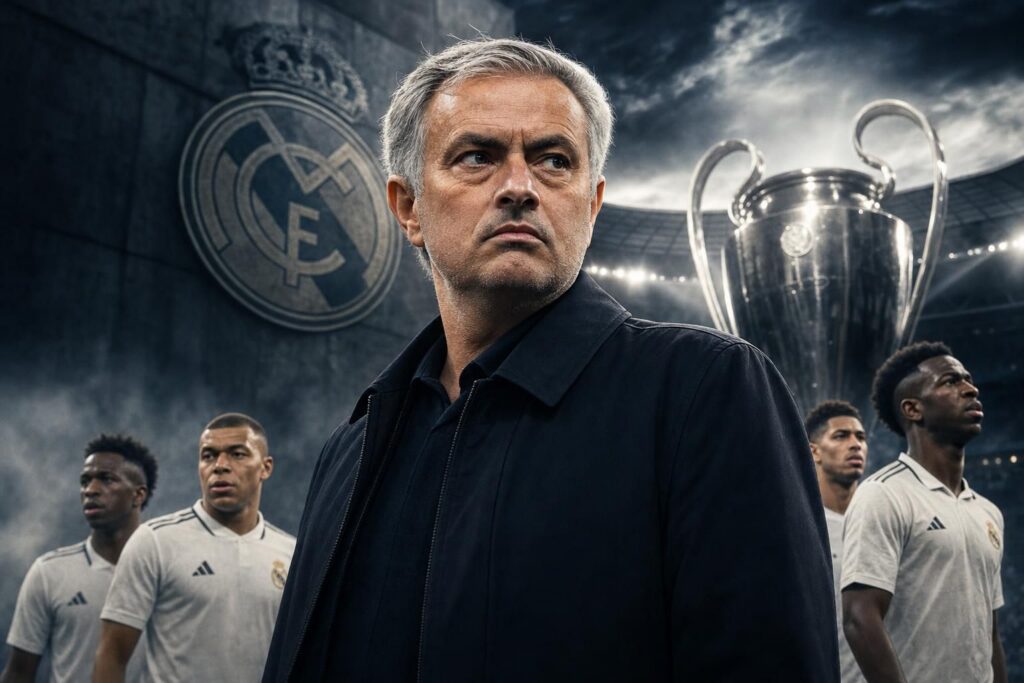
Mourinho returns to Real Madrid with tactical ingredients to win the Champions League, but must overcome his history of dressing room conflicts to succeed.
By Vaelin Lamorra
José Mourinho is back in the Champions League with Real Madrid, and ahead of Tuesday’s opener against Inter, one question towers over his second spell. Can Mourinho win the Champions League again?
Thirteen years after leaving the Bernabeu in acrimonious circumstances, the 63-year-old Portuguese coach is back with a realistic chance to compete at the highest level. His last Champions League triumph came in 2010 with Inter Milan. Sixteen years have passed. In that time, the coaching landscape has transformed entirely.
The Case Against
Let’s begin with the uncomfortable truth. Mourinho hasn’t won a Champions League title since 2010. That’s a sixteen-year gap. During that time, Pep Guardiola, Zinedine Zidane, Carlo Ancelotti, Jurgen Klopp and Luis Enrique redefined what modern elite football could look like. They proved, repeatedly, that you didn’t need Mourinho’s confrontational chaos to win at the highest level.
Worse still, Mourinho’s last decade has been mediocre. One Premier League title with Chelsea in 2014-15, a handful of minor European trophies, and a string of jobs that ended in spectacular acrimony. He’s been fired by Chelsea, Manchester United, Tottenham, Roma and Fenerbahce. Every single exit involved clashes with his star players.
Sergio Ramos, Iker Casillas and Cristiano Ronaldo couldn’t coexist with him in 2013. Ten years later, does anyone genuinely believe Mourinho has fundamentally changed the personality traits that created those conflicts? He’s 63. People don’t rewire their entire approach to management in their sixties, particularly not Mourinho.
And Madrid’s squad? It’s an ego-fueled collection of superstars who just sacked Xabi Alonso after six months. Alonso, a Real Madrid legend with impeccable credibility. If the players turned on him, why would they behave differently with Mourinho?
The Case For
But here’s where the analysis becomes more nuanced.
Real Madrid’s primary weakness isn’t attacking talent. It’s defensive solidity and organizational discipline. They have Kylian Mbappe, Vinicius Junior, Jude Bellingham and Yan Diomande in attack. They have Thibaut Courtois in goal, arguably the world’s best goalkeeper. What they don’t have is a manager who knows how to build a fortress.
This is where Mourinho’s specific genius becomes relevant. Every successful Mourinho team was constructed on a foundation of defensive mastery. Porto won the Champions League with a team that cost a fraction of what Barcelona were spending. Inter won it with defensive organization so suffocating that opponents couldn’t breathe. Even Chelsea’s best teams under him were defensively ruthless first, attacking second.
Madrid need that. They’ve been defensively fragile for years. Not incompetent, but vulnerable to sustained pressure from elite European sides. Mourinho’s appointment is less about trying to match Barcelona’s attacking philosophy and more about neutralizing Real Madrid’s actual structural problem.
Then there’s the Champions League field itself. PSG under Luis Enrique remains a threat, but everyone else? Manchester City won it after a twelve-year gap under Guardiola. Bayern Munich have struggled in European competition despite their domestic dominance. Liverpool, Barcelona, Inter and Juventus are in various states of transition. Among traditional Champions League contenders, only PSG has genuinely elite personnel to match Real Madrid’s.
For the first time in years, Mourinho isn’t facing a field of proven Champions League winners. He’s the second most decorated manager in the competition still actively working at a top club.
Can Mourinho Win the Champions League This Season?
The real question isn’t whether Mourinho has the tactical intelligence to succeed. He absolutely does. The question is whether he can manage the psychology of a Madrid dressing room without the conflicts that ended his first spell.
Zidane and Ancelotti succeeded because they walked into the room as living legends. Their authority wasn’t questioned because it was earned over decades. Mourinho has to earn it differently. He has to prove to players like Mbappe and Vinicius that his defensive philosophy enhances rather than suffocates their attacking brilliance.
That’s not impossible. It’s just unfamiliar territory for Mourinho, whose career has been built on confrontation and control rather than collaboration and compromise. The question is simple. Can Mourinho win the Champions League with this Real Madrid squad, or will dressing room tensions derail another project?
If he can navigate that psychological challenge, the tactical ingredients are genuinely there. A world-class goalkeeper, elite defenders, versatile midfielders who can press and defend, and attacking talent that doesn’t need instruction. Set them up to suffocate opponents, then unleash Mbappe and Vinicius on the counter. That’s a Champions League-winning template.
By June, Real Madrid will either have won their 16th Champions League title or have suffered another managerial collapse. There’s unlikely to be much middle ground.
Mourinho has one final chance to prove he’s still capable of delivering at the highest level. Real Madrid have the talent to make it happen. Whether he’s learned enough from a decade of underperformance to actually deliver it is the only question that matters.