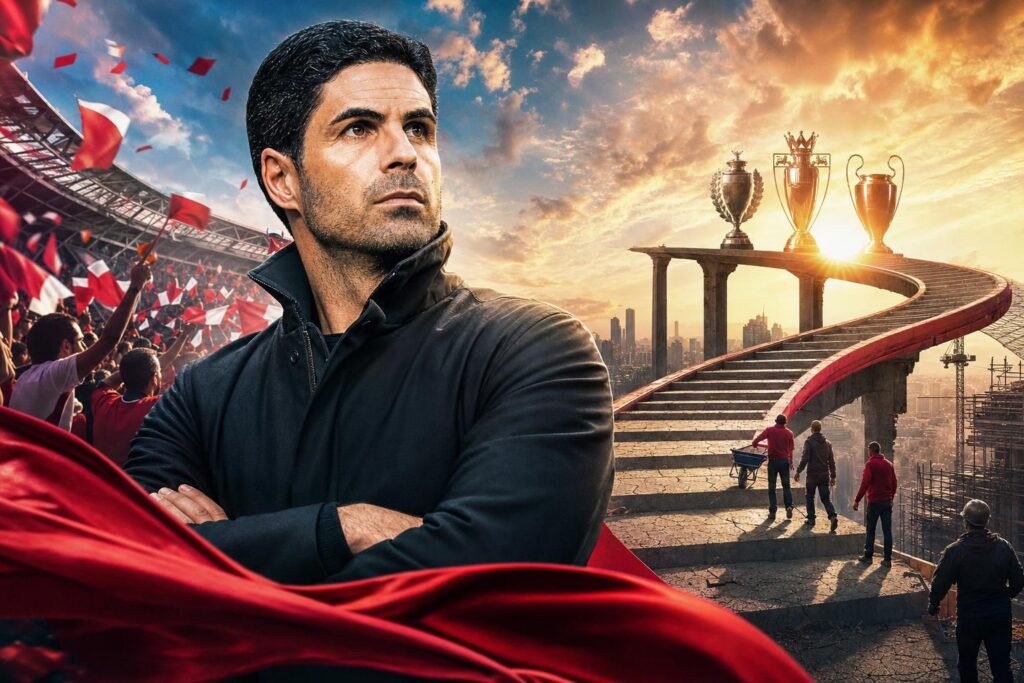
Arteta’s 2030 contract secures managerial continuity but cannot guarantee title defence or European success.
Mikel Arteta has signed a new Arsenal contract running until 2030, securing managerial continuity at the Emirates after a transformative 2025–26 season. The extension arrives as the reigning Premier League champions assess the challenge ahead: defending their first league title in 22 years while rebuilding from the disappointment of their Champions League final defeat.
In a statement reported by BBC Sport, Arteta said: “This is only the beginning of what we can achieve together.” Co-chairmen Stan and Josh Kroenke, in remarks also reported by the BBC, emphasised their pride in what has been achieved since Arteta’s December 2019 appointment and their commitment to continuing that trajectory.
The immediate practical consequence is straightforward: Arsenal avoid the distraction of managing a manager with an expiring deal as they enter crucial years for the club. Arteta’s previous contract was due to expire at the end of the 2026–27 season, meaning he would have entered next year facing either negotiation or departure. That uncertainty is now removed, and the club has publicly committed to building around their manager for the next four seasons.
What a Contract Actually Secures
But the extension is worth unpacking carefully, because it illustrates something fundamental about football’s architecture: a contract expressing intent is different from a contract guaranteeing results, and different again from a contract guaranteeing tenure.
Arsenal’s achievement in 2025–26 was genuine. The club won the Premier League title for the first time since 2004, ending a 22-year wait. That accomplishment, and Arteta’s management of it, provides the foundation for the owners’ commitment to build further. The Kroenkes have backed their manager with resources; now they are binding that backing with contract length.
Yet the club faces two distinct challenges that no extension can automatically resolve. The first is straightforward: defending the title. Repeating a Premier League triumph in consecutive seasons requires defensive sophistication and attacking consistency that few clubs manage. No manager enters the season guaranteed to deliver it. A new contract changes the conversation about uncertainty; it does not change the mathematics of competition.
The European Question That Remains
The second challenge is European. Arsenal reached the 2026 Champions League final in May, only to lose on penalties to Paris Saint-Germain after a 1–1 draw. That defeat marked the club’s exit from their most significant competition after reaching what may be their best opportunity in a decade. Arteta was hours away from winning European football’s greatest prize. Instead, he was minutes from victory and lost. The difference between transcendence and heartbreak in European football is often this thin.
The Kroenkes’ statement about “building on” what has been achieved since 2019 suggests an appetite for European success. The new contract is their public commitment to that ambition. But ambition is not outcome. A deal running to 2030 is not a guarantee that Arsenal will win the Champions League. It is a statement that the club believes Arteta is the manager to build toward it, and that they are willing to invest time and resources while he attempts it.
This distinction matters because Arsenal’s support will inevitably interpret the extension through the lens of their own expectations. Some will see a dynasty emerging; others will see the club making a long-term bet on a manager who, for all his domestic success, has yet to win Europe’s premier competition. Both interpretations are defensible. Neither is complete.
What Gets Locked In, and What Doesn’t
What the contract definitively secures is this: the club and manager have chosen continuity. Arteta will not enter a season managing his way toward a career-defining negotiation or exit. Arsenal’s ownership has committed to building around him over the medium term. That represents genuine stability.
What the contract cannot secure is the future itself. Arsenal won the league in 2025–26 but have not built a dynasty that transcends change. Contracts commit; they do not guarantee. They express aspiration; they do not mandate results.
The test now is whether Arsenal can sustain the intensity required to defend their title while continuing to compete in Europe. That test starts immediately. The contract simply ensures that, whatever the answer turns out to be, it will be answered with Arteta in place.