
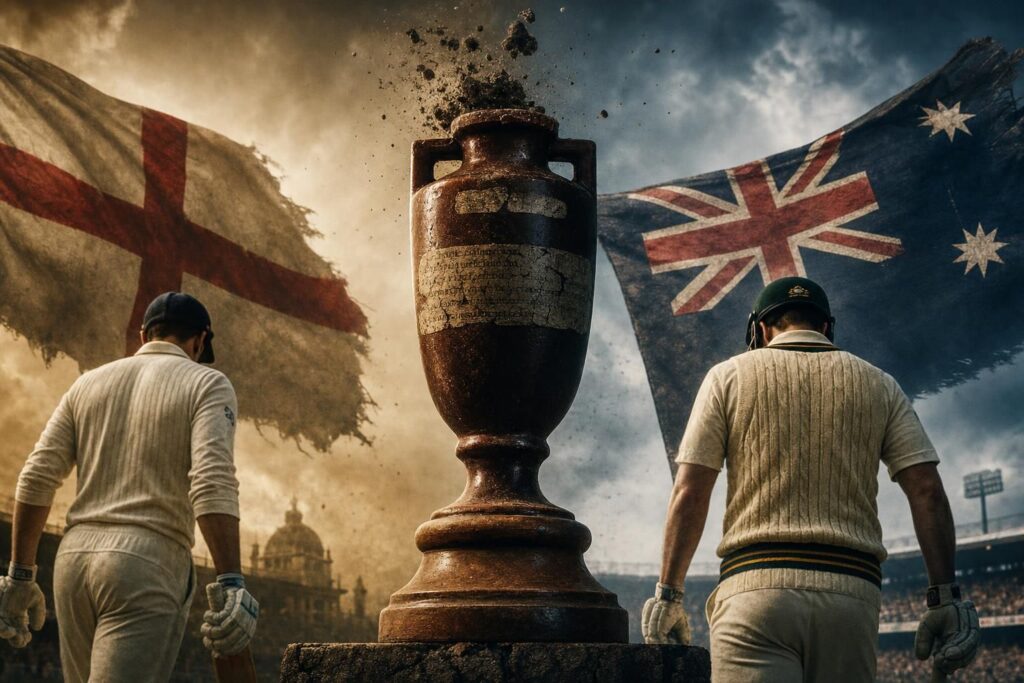
The Ashes grew from an 1882 newspaper joke into cricket’s defining rivalry through symbolism, controversy, national pride and sporting theatre.
The Ashes began with an English defeat, a sarcastic newspaper notice and the sort of extravagant national mourning usually reserved for monarchs or a disappointing summer. Australia’s victory at The Oval on 29 August 1882 inspired The Sporting Times to publish a mock obituary for English cricket, declaring it dead and imagining its ashes being taken to Australia.
That joke supplied cricket with its most durable story. What followed was not merely a sequence of Test series, but a sporting argument lasting more than 140 years. England and Australia have used it to debate courage, tactics, national character and, occasionally, whether bowling at somebody’s ribcage is legitimate strategy or an international incident requiring stern correspondence.
How the Ashes began
Australia’s 1882 victory at The Oval gave the rivalry its emotional spark. The result turned a cricket match into a piece of national theatre, with the press treating England’s defeat as evidence that English cricket had somehow died.
The Sporting Times obituary transformed that embarrassment into mythology. When England captain Ivo Bligh led a tour of Australia in 1882–83, his mission became associated with recovering the figurative ashes. During that tour, Bligh was presented with a small terracotta urn believed to contain the remains of a burnt cricket item. Its precise contents matter less than the story attached to them.
The urn later passed into the care of the Marylebone Cricket Club after being donated by Bligh’s widow, Florence. It became the physical symbol of the rivalry, although it was never designed as a conventional cup to be passed between victorious captains. The original remains associated with MCC at Lord’s.
The urn is not the Ashes trophy
This distinction causes regular confusion. Teams compete for the Ashes, but the tiny original urn is a historic artefact rather than the object routinely handed over after a series. A separate Ashes trophy represents the prize in modern presentation ceremonies.
That may sound unnecessarily complicated, but unnecessary complication is practically an organising principle of cricket. The urn matters because it connects every new contest to the original insult. Its value is symbolic: a modest terracotta container carrying the emotional weight of two entire cricket cultures.
What the Ashes record tells us
The series record is best understood as a story of changing eras rather than a permanent balance of power. Australia enjoyed long periods of superiority, including a dominant stretch from the late 1980s into the early 2000s, while England’s major modern revival began with the 2005 series.
That pattern is central to the rivalry’s appeal. One side establishes an era of control, the other spends years treating recovery as a national project, and eventually the balance shifts again. The Ashes is not a competition where history sits quietly in a table. It arrives at every new series wearing a very large coat.
Bodyline turned cricket into a diplomatic problem
The rivalry acquired its most poisonous edge during the 1932–33 series in Australia. England needed an answer to Don Bradman, whose batting dominance had made orthodox plans look like polite suggestions. Captain Douglas Jardine’s side adopted the strategy that became known as Bodyline: fast bowling directed towards the batter’s body, supported by a packed leg-side field waiting for deflections and hurried defensive shots.
It worked as a method of containment, but Australia regarded it as dangerous and contrary to the spirit of cricket. The dispute escaped the boundary rope and generated diplomatic tension between Britain and Australia. Cricket had managed the impressive feat of making field placement a matter of international relations.
Bodyline changed more than the temperature of one tour. Its consequences contributed to changes in cricket’s laws and fielding restrictions intended to prevent the tactic from being reproduced in the same form. It also established a permanent Ashes pattern: innovation by one side, outrage from the other, and decades of argument over whether ruthless cricket should be admired or prosecuted.
Botham’s Ashes made the impossible feel inevitable
By 1981 the rivalry needed no assistance from mythmakers, but Ian Botham supplied some anyway. England’s extraordinary turnaround at Headingley became the defining episode of a series so closely associated with him that it entered popular memory as Botham’s Ashes.
Botham’s intervention transformed a match Australia appeared to control. Bob Willis then delivered the bowling spell that completed England’s comeback. The wider series became a rolling drama of reversals and individual performances, restoring the idea that an Ashes contest could produce events too implausible for sensible fiction.
The importance of 1981 lies partly in how it is remembered. Earlier Ashes heroes belonged to photographs, scorebooks and radio recollections. Botham became a modern celebrity through televised sporting theatre, while Headingley offered a reusable template for English optimism: the situation is hopeless, the Australians are comfortable, and therefore something ridiculous may be about to happen.
Why the 2005 Ashes changed everything
The answer to Australia’s long dominance arrived in 2005. England defeated Australia in a series that combined elite fast bowling, tactical nerve and sustained tension. It revitalised public interest in the Ashes and introduced the rivalry to a generation that had known Australian control as a basic fact of life, like rain at a barbecue.
The series mattered because the cricket justified the surrounding noise. Momentum shifted repeatedly, pressure accumulated across matches and England demonstrated that Australia could be confronted rather than merely admired from a safe distance. Andrew Flintoff became its defining English personality, combining decisive performances with the emotional presence required by a contest that turns cricketers into national symbols without asking permission.
Since 2005, Ashes campaigns in the 2010s and 2020s have continued the cycle of dominance, resistance and reinvention. Stuart Broad and Ben Stokes joined a cast that includes Bradman, Jardine, Botham and Flintoff. They are not identical cricketers, but each became a way for one country to express its preferred version of itself.
Why the Ashes still matters
The Ashes endures because it combines history with renewal. Every series is self-contained, yet every confrontation carries memories of the ones before it. A hostile spell can evoke Bodyline, an improbable escape invites comparison with 1981, and any close English victory must endure the enormous historical shadow cast by 2005.
The rivalry also has a rich language of its own, from tactical disputes to the sledges that have become part of Ashes folklore. The Update’s guide to cricket sledges that deserve their own Ashes urn explores that verbal side of the contest.
There is also a Women’s Ashes, a separate competition with its own history and formats that has grown in prominence. It deserves treatment as more than a decorative paragraph attached to the men’s story, because its structure and development form a distinct historical narrative.
For the men’s contest, the essential ingredients remain remarkably close to those established in 1882: English anxiety, Australian delight in causing it, newspaper melodrama and a small urn that is not actually awarded to the winners. Most rivalries require marketing departments to explain why they matter. The Ashes has an obituary, a diplomatic crisis, Botham at Headingley and 2005. It can market itself.