Football refuses to broadcast live VAR audio to stadium supporters despite other sports doing it successfully, revealing institutional indifference to paying fans.
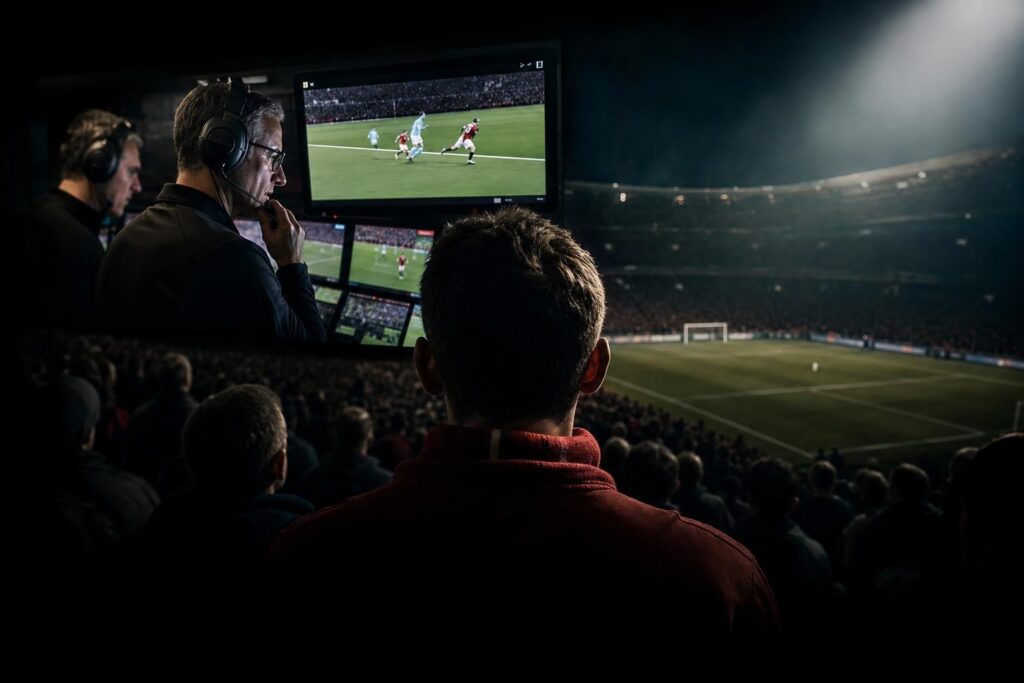
On Sunday, 74,161 supporters sat inside Old Trafford in complete darkness while millions watching at home learned exactly why Erling Haaland’s goal had been allowed to stand. The VAR had determined that it was Enzo Fernandez, not Haaland, in an offside position. That detail mattered. Television viewers heard the explanation. The stadium heard nothing. This is what football’s refusal to broadcast live VAR audio has created: a two-tier information system for paying supporters.
Almost a decade into VAR, and the sport has still not allowed live VAR audio to reach stadium supporters, despite the technology working, despite other sports managing it routinely, despite fans paying hundreds of pounds for the privilege of knowing less.
The absurdity is difficult to overstate. Supporters spend hundreds of pounds for matchday tickets. They abandon their sofas, their HD screens, their multiple camera angles. They accept worse views, no replays, no slow motion. And in return, football has decided they deserve to know less.
When a controversial decision arrives, stadium fans do not hear the VAR explanation. They do not understand the reasoning. They do not learn what the officials saw or discussed. They stand in silence while broadcasters explain the decision to the nation. On Saturday, Crystal Palace defender Axel Disasi was sent off for serious foul play in a match against Ipswich Town. The player stood on the sideline for over a minute while the VAR checked the decision. Selhurst Park remained in darkness. The paying customer knew nothing.
The Regulatory Theatre
The standard excuse is that broadcasting live VAR audio would be “chaotic.” That is what Lukus Brud, the Ifab secretary, told the BBC three years ago. Chaotic. As though adults cannot listen to professional discussion. As though football supporters are too emotionally fragile for context. As though other sports have somehow managed this impossible task without descending into anarchy.
Cricket does it. During DRS reviews, viewers hear the conversation, see the graphics, understand the decision. The commentary does not stop. The game continues. Cricket trusted its audience to handle information, and the sport did not collapse. Tennis does it. American football does it. Rugby does it. Even golf manages to broadcast official discussions without descending into the chaos that football apparently fears so greatly.
Football’s regulatory bodies, led by Fifa and Ifab, have created a mythology around live VAR audio as though releasing it would somehow delegitimise the referees. The opposite is true. Transparency legitimises decisions. Mystery creates suspicion. Silence breeds resentment.
The real objection appears to be different. It is not that audio would be chaotic. It is that audio would expose how frequently officials reason their way to highly subjective conclusions. It would reveal that reasonable people disagree on handball, contact, offside positioning and fouling. It might expose disagreement between the VAR and the referee. It might show officials struggling to justify decisions that seem unfair. That might embarrass the authorities. So they hide it.
The Howard Webb Puzzle
Here is where the story becomes genuinely baffling. Howard Webb, now Premier League referees’ chief, ran Major League Soccer before returning to England. In August 2020, during the MLS is Back Tournament, Webb’s league became the only competition ever to broadcast live VAR audio during matches. The experiment worked. The audio provided context. Supporters understood decisions. The system functioned without disaster.
Six years have passed. No other league has repeated the experiment. Webb himself, despite having led this successful trial, has not pushed to bring it to the Premier League. Instead, the Premier League offers Match Officials Mic’d Up, a monthly highlights show released weeks after matches have finished. That is not transparency. That is performance art masquerading as accountability.
La Liga publishes VAR audio within hours after each match. The German Bundesliga shares clips when relevant. Italy tried Open VAR but cancelled it because officials claimed the transparency created pressure. Football’s willingness to abandon transparency when officials complain about pressure tells you everything about who the sport actually serves. The answer is not the supporters.
The Problem Beneath the Problem
Live VAR audio will not happen soon because the authorities have decided it is not a priority. They have decided that protecting referees from scrutiny matters more than respecting supporters. They have decided that regulatory consistency and international agreement matter more than the paying customer in the stadium.
Some decisions would take time because checking happens during play. That is fair. But many decisions happen during stoppages, when there is no excuse for silence. When Haaland’s goal was being reviewed against Manchester United, the game was completely stopped. When Disasi was sent off, the game was completely stopped. There was nothing else to broadcast. No tactical complexity. No reason to preserve the radio commentary. Only a regulatory choice to keep fans uninformed.
The logistical obstacles are not real. The technical barriers do not exist. Webb proved in 2020 that live VAR audio could work. Other sports manage it routinely. Football refuses because the authorities have decided stadium supporters are not worth the administrative effort. They have decided that the inconvenience of transparency exceeds the value of the supporter experience.
What This Reveals
This is not really about VAR audio. It is about how football institutions view their supporters. They view them as revenue sources to extract money from, not as members of the football community deserving equal treatment. A supporter paying £150 for a matchday ticket knows less than someone streaming the match illegally for free. That is an institutional choice. That is deliberate.
The authorities tell themselves this is about protecting officials, maintaining authority, preserving the credibility of refereeing. What it actually demonstrates is contempt. Contempt for supporter intelligence. Contempt for stadium experience. Contempt for anyone not watching through a television screen or privileged enough to be working in a broadcast booth.
Football has spent nearly a decade integrating VAR into matches while treating it as a secret process. The wheels of progress have turned slowly because nobody particularly important was pushing for change. Webb could have. The Premier League could have. Fifa and Ifab could have. Instead, they have maintained a system that tells stadium supporters: your experience matters less than our comfort. Your understanding matters less than our convenience. Your money matters, but you do not.
The fans at Old Trafford paid to be there. They paid to watch football. They paid to be kept informed. Football took their money and decided that leaving them in darkness was an acceptable trade-off for regulatory caution. That may not be chaos. But it is something worse. It is institutional negligence dressed up as safety.