

Thirty-six clubs play eight league-phase matches before the top eight advance and teams placed ninth to 24th contest knockout play-offs.
The Champions League no longer has groups. It has one enormous table, eight matches per club and a knockout route influenced by where every team finishes. UEFA has essentially replaced eight tidy mini-leagues with something resembling an airport departures board, although the underlying system is more logical than its first appearance suggests.
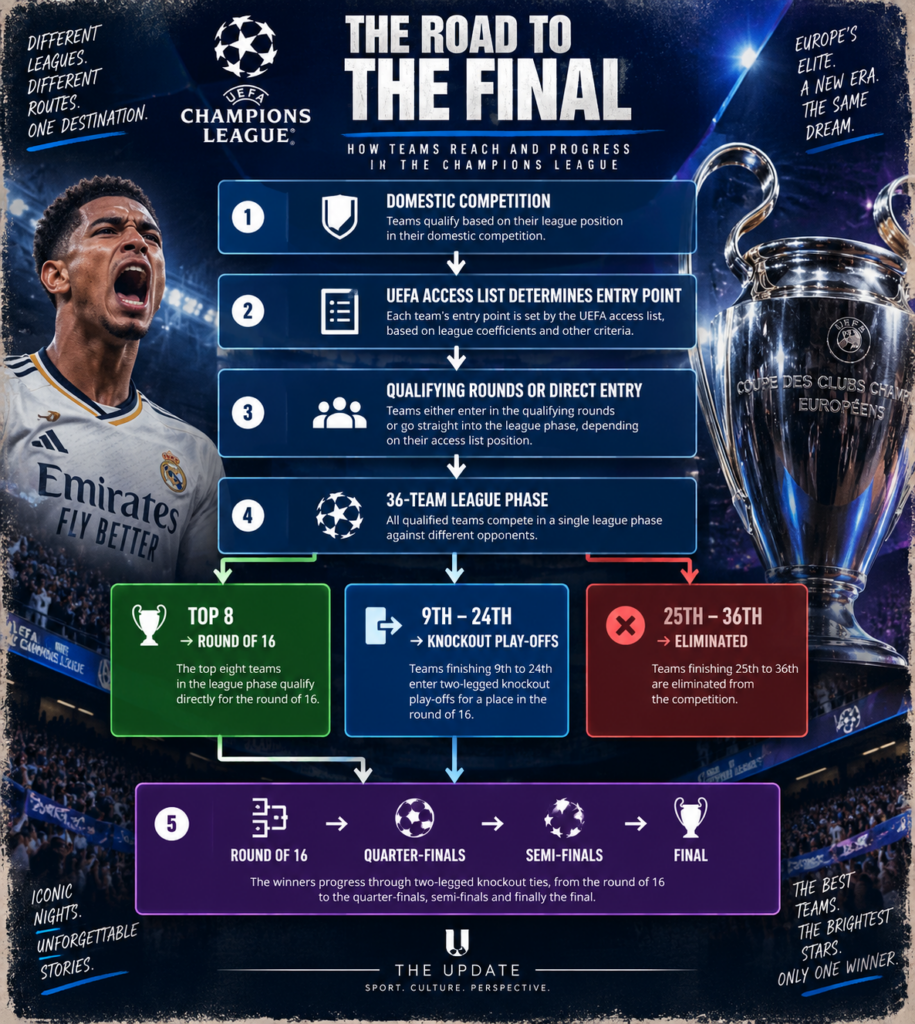
The simplest explanation is this: 36 clubs enter the league phase, each plays eight matches, and the resulting table decides who advances, who faces an additional play-off and who disappears from Europe altogether. From there, the competition becomes a seeded knockout bracket leading to the final.
How clubs qualify for the Champions League
A club’s route begins with its domestic performance, but there is no single finishing position that guarantees entry across Europe. UEFA maintains an access list based largely on association coefficients, which measure the results of clubs from each national association in European competition over several seasons.
That ranking determines how many Champions League places an association receives and where its clubs enter. Teams from the strongest associations can qualify directly for the league phase through their domestic leagues. Champions from lower-ranked associations may have to survive qualifying rounds first. In other words, winning a national title can produce either a velvet rope or an obstacle course, depending on the association involved.
Club coefficients serve a different purpose. These reflect an individual club’s European record and can affect seeding during qualification and the competition’s draw procedures. Association coefficients principally shape national access; club coefficients help organise the clubs once they arrive.
Entry is not purely a reward for results. Clubs must also satisfy UEFA’s licensing, integrity and financial sustainability requirements. A league position therefore creates sporting entitlement, not an unconditional boarding pass.
The reigning Champions League winner receives a place in the following season’s league phase if it has not qualified through its domestic competition. UEFA can rebalance the access list when a title-holder place is already covered or when licensing and admission decisions alter the expected field.
How the 36-team league phase works
Introduced in 2024/25, the league phase contains 36 teams in one standings table. Every club plays eight matches, rather than facing three group opponents home and away as it did under the former system.
This is often called a Swiss-style format, although it is not a complete round robin. Playing every other club would require 35 matches each and the immediate nationalisation of Tuesday evenings. Instead, each team receives a selection of eight opponents through UEFA’s draw system, with the results feeding into the same overall table.
Normal league principles apply: clubs earn points from their eight fixtures and are ranked in the common standings, with the competition regulations supplying tie-breakers when teams finish level. The crucial dividing lines are eighth, 24th and 25th.
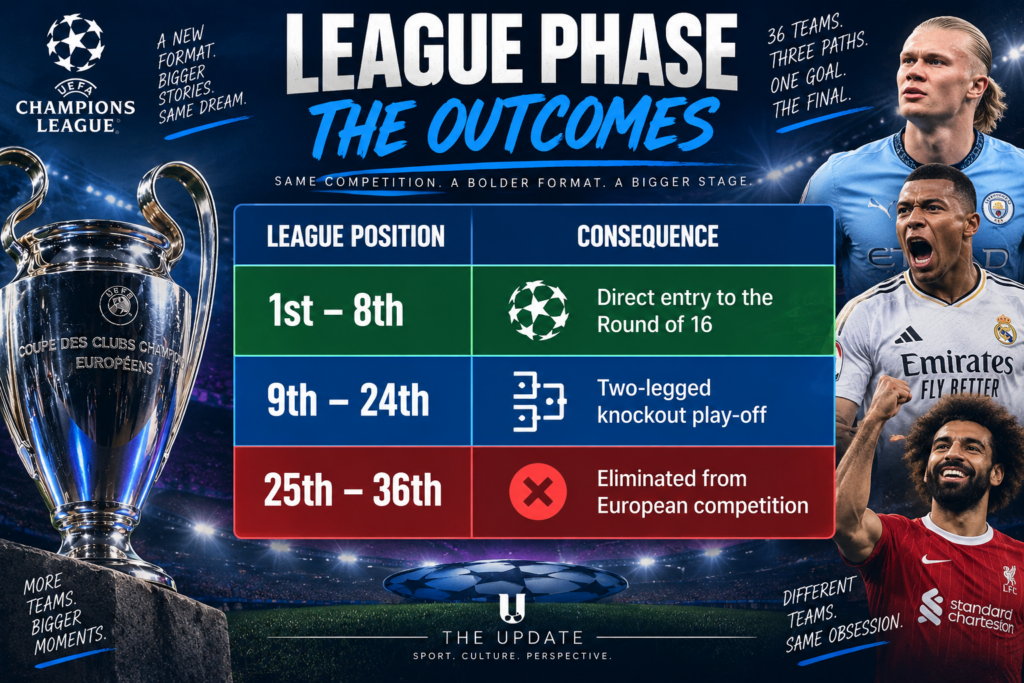
There is no drop into the Europa League for teams eliminated from this league phase. Once a club finishes 25th or lower, its European season is over. The old consolation chute has been removed.
Why finishing position matters
The top eight avoid the knockout play-offs and advance directly to the last 16. That means two fewer matches, a valuable rest period and no risk of being eliminated before the traditional knockout rounds have properly begun.
Teams placed ninth to 24th must play a two-legged tie for one of the eight remaining Round of 16 places. The league-phase ranking also informs seeding and the knockout path, so finishing higher is useful beyond merely crossing a qualification line.
Consider two hypothetical clubs. Albion finish eighth and proceed directly to the Round of 16. Borough finish ninth, only one place lower, but must negotiate an extra home-and-away play-off before joining them. If both eventually reach the final, Borough will have played two more matches. One position can therefore mean the difference between a free February and an urgent appointment with another European heavyweight.
How the knockout play-offs and seeding work
The 16 clubs finishing from ninth to 24th enter the knockout play-offs. Higher league-phase finishers are seeded against lower-ranked qualifiers, giving better-performing clubs a theoretically more favourable opponent. Each tie is played over two legs, and the eight winners advance.
The play-off draw is not an unrestricted raffle in which any of the 16 teams can receive any other. League positions narrow the possible opponents and feed clubs into designated parts of the knockout bracket. The precise draw possibilities can therefore be understood only after the final league table is complete.
The eight play-off winners then join the league phase’s top eight in the Round of 16. Again, league ranking influences the seeded route. UEFA maps the knockout path through the later rounds, meaning clubs can identify the section of the bracket from which future opponents will emerge rather than awaiting an entirely fresh, open draw at every stage.

Higher placement does not guarantee an easy life. Football remains stubbornly resistant to administrative promises, and a lower-ranked opponent may be recovering players, changing managers or simply becoming competent at an inconvenient moment. Seeding improves the route on paper; it does not play the tie.
What changed from the old group-stage format?
Under the previous system, 32 clubs were divided into eight groups of four. Each team played six matches, facing its three opponents home and away. The top two in every group reached the Round of 16.
The present format expands the field to 36 and gives each club eight league-phase fixtures against a broader range of opponents. All results contribute to one table, the top eight qualify directly, and another 16 teams contest play-offs.
The old format was easier to read locally because supporters needed to understand only four positions. The new one makes performance across the entire field matter. A late goal in a match hundreds of miles away can alter league positions, seeding and potential knockout routes. This creates a more connected final matchday, albeit one best approached with several screens and the expression of a provincial railway controller during signal failure.
The format in one sentence
A club qualifies through UEFA’s domestic access system, plays eight matches in a single 36-team league phase, and must either finish in the top eight or survive a two-legged play-off before entering the seeded knockout bracket that leads to the Champions League final.