By The Update
Watch the World Cup anywhere – secure it with Surfshark
TL;DR José Mourinho’s shock return to Real Madrid feels equal parts masterstroke and reality television. Once the world’s best manager, Mourinho struggled as football evolved towards pressing and possession football under Pep Guardiola and Jürgen Klopp. After disappointing spells at Spurs, Roma, Benfica and Fenerbahçe, many assumed his elite career was over. Florentino Pérez clearly disagrees. Now Mourinho inherits a squad packed with superstars and personalities. Whether he adapts or combusts, one thing is certain: it won’t be boring.
Football has spent the better part of a decade trying to convince itself that José Mourinho was done. Not merely diminished. Not merely past his peak. Finished. A relic. A museum piece. The tactical equivalent of a Blackberry. Every failed spell became fresh evidence. Every touchline scowl was treated like a pension application. Every press conference was less “master strategist” and more “man arguing with a self-checkout machine.”
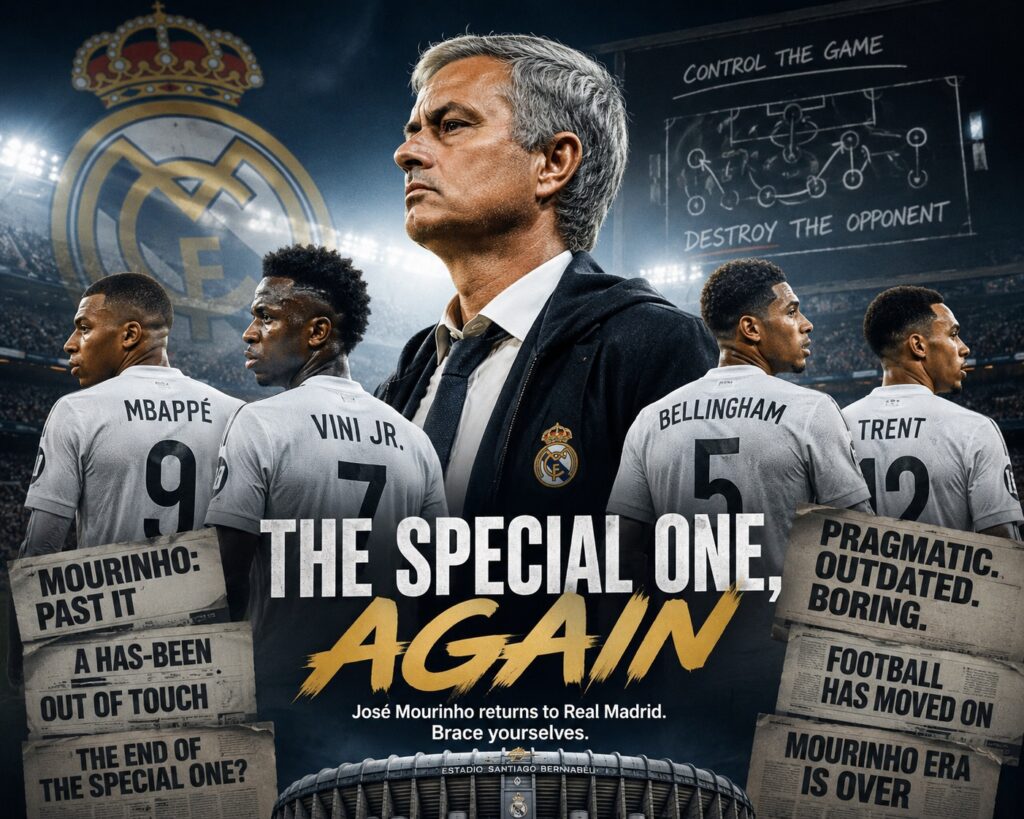
And yet here we are: José Mourinho returns to Real Madrid. Somewhere, Florentino Pérez has looked at a dressing room containing Kylian Mbappé, Vinícius Júnior, Jude Bellingham and Trent Alexander-Arnold, inhaled deeply, and concluded that what this collection of global superstars really needs is a Portuguese chaos merchant with a persecution complex and a grudge against modern football. It’s either a masterstroke or the most expensive reality television show ever commissioned. Probably both.
There was a time when Mourinho was unquestionably the best manager in the world. From Porto to Chelsea to Inter and then Real Madrid, he was football’s final boss. Between roughly 2003 and 2015, nobody bent elite football to their will as regularly as Jose. He won leagues in multiple countries. He conquered Europe twice. He turned defending into an art form and psychological warfare into a weekly hobby. While other managers sought beauty, Mourinho sought victory. Beauty, if it happened, was an acceptable side effect.
Then football changed.
Pep Guardiola didn’t just win, he evangelised a new ultra attacking style of football, propelled with high lines and Lionel Messi. Jürgen Klopp transformed pressing from a tactical concept into a religious movement. Mauricio Pochettino made intensity fashionable. Possession-heavy positional play became football’s dominant language. Full-backs started behaving like midfielders. Centre-backs began passing like quarterbacks. Goalkeepers were expected to launch attacks rather than merely prevent goals.
His football had always been pragmatic with a cynical lean. The difference was that pragmatism looks clever when you’re winning and prehistoric when you’re not. The more football lurched towards hyperactive pressing and intricate possession structures, the more Mourinho’s methods seemed trapped in amber. There were moments when it felt as though the game was physically passing him by.
One still imagines him standing on the touchline during those bleak final days at Manchester United, developing a permanent neck ache as Liverpool’s Andrew Robertson ran the left wing right in front of his dugout. Up. Down. Up. Down. Up. Down. Again. Again. Again. At some point Mourinho must have felt like a Victorian gentleman witnessing the invention of electricity.
The subsequent years only reinforced the narrative. Spurs ended badly. Roma contained moments of romance but ultimately confirmed the decline. Fenerbahçe passed in the blink of an eye. Benfica felt irritable. Rome, Lisbon and Istanbul are cities of staggering beauty, history and culture. They also happen to be a long way from the front line of Europe’s elite game. It is a résumé that looks magnificent in a photo album, if slightly less imposing when compared with the places where Mourinho forged his reputation at his peak.
The trajectory appeared obvious. A national team job. A few ceremonial appearances. Occasional television work. The gradual transformation from active participant to footballing elder statesman. Instead, football has once again remembered one of its oldest truths, never assume José Mourinho is gone.
Which brings us to the delicious absurdity of Real Madrid. Modern Madrid is less football club than collection of competing solar systems. Every player is a star. Every star has a brand. Every brand has a social media team. Managing this squad requires a split of 50% man management, 45% political dexterity and 5% tactical sophistication. A split Xabi Alonso never really got a grasp of. On top of all that, it will require the patience of a kindergarten teacher on double espresso.
How will Vinícius react to Mourinho’s public criticism? How will Mbappé respond when “constructive feedback” arrives wrapped inside a flamethrower? How long before a barbed comment becomes an international diplomatic incident? What happens when Jude Bellingham’s natural leadership collides with Mourinho’s lifelong belief that leadership should exclusively belong to well, José Mourinho?
These are not concerns. They are the attractions. And yet there is a genuine football question beneath the spectacle. Can Mourinho evolve? Can a manager forged in the era of compact blocks and lethal transitions thrive with perhaps the most attacking collection of talent on earth? Can he build a side that dominates possession rather than merely weaponises space?
Can he create a system that allows Mbappé and Vinícius to flourish simultaneously? More importantly, can he persuade two players who sometimes regard defensive tracking with the same enthusiasm teenagers reserve for tidying their bedrooms? For all the jokes, it would be foolish to dismiss him. Football has spent years treating Mourinho like an artefact from a bygone age. But elite sport has a habit of making fools of those who assume evolution is linear. Trends come and go. Tactical fashions rise and collapse. Every dominant idea eventually creates the conditions for its opposite.
Perhaps after years of positional orthodoxy, football is once again ready for a brilliant pragmatist. Or perhaps this will be a magnificent disaster. The most likely outcome, as with most Mourinho stories, is both.
Because Mourinho at Real Madrid was never going to be boring. Not in 2010. Not now. The football may be brilliant. The football may be dreadful. The trophies may arrive. The explosions almost certainly will.
Just don’t bet against him. Not yet.
And if you’re planning to watch, prepare accordingly. Prepare for the press conferences. Prepare for the mind games. Prepare for the feuds. Prepare for the headlines. Above all, prepare for fireworks.
With José Mourinho, you always should.
Stay secure and flexible while following the World Cup 2026 with Surfshark VPN – protect your privacy and access streaming services safely.
Some links in this article may be affiliate links. If you click through and make a purchase, we may earn a commission at no extra cost to you.