By The Update
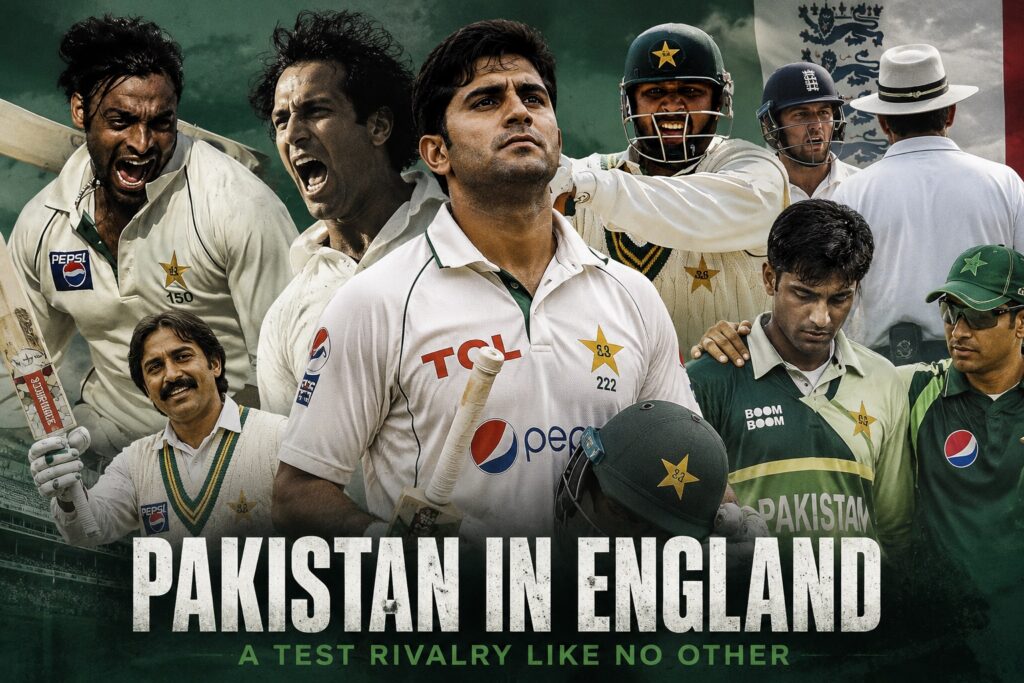
TL;DR Pakistan v England in Tests has given us Wasim, Waqar, reverse swing, scandals and some brilliant cricket. Now the rivalry enters another chapter with Pakistan back in England.
Watch on the go using tools like Surfshark
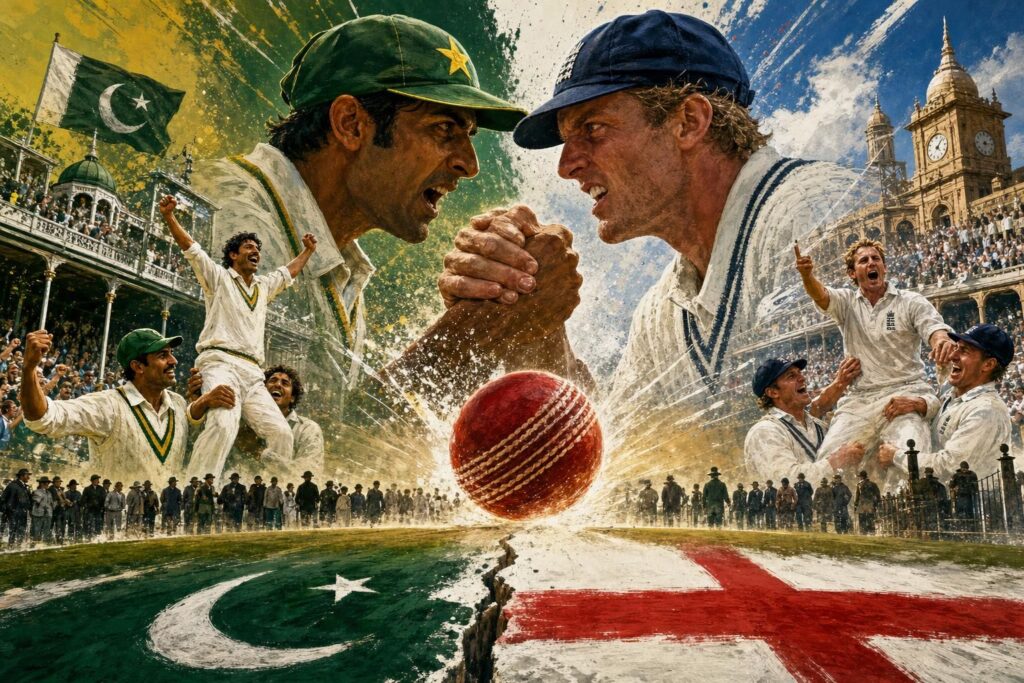
Pakistan are coming to England for three Test matches, which means Test cricket has once again decided to make itself interesting by inviting Pakistan.
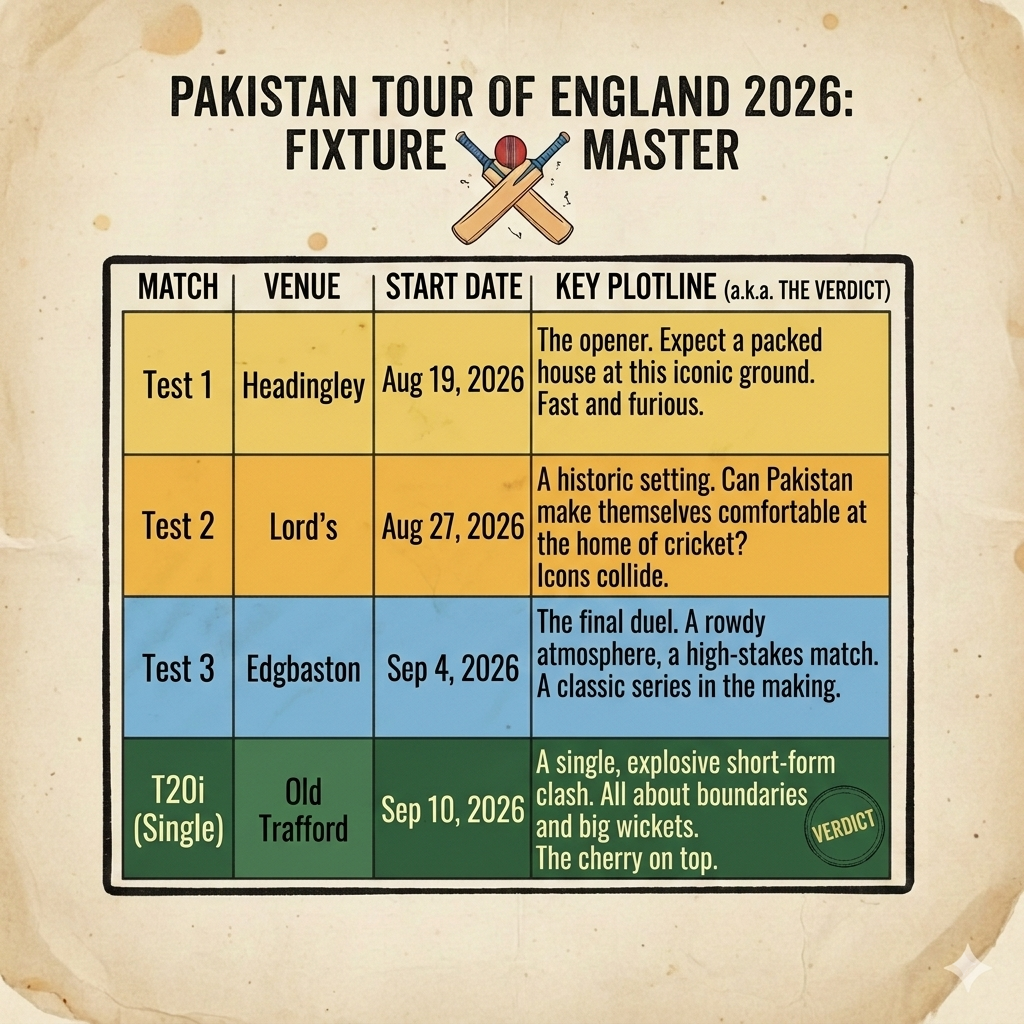
The first Test begins at Headingley on 19 August, followed by Lord’s and Edgbaston. On paper, this is simply another three-match series. In reality, Pakistan arriving in England has historically been less “three Test matches” and more “let’s see what happens, we may not even get to three”. There will be swing. There will be collapses. Someone will probably produce an innings of genius. An entire side will endure a batting collapse. Probably both. There may be an argument about the ball. There may be several. Test cricket is dying, apparently. Nobody told Pakistan.
The history is extraordinary. In the 1990s, Pakistan arrived in England with players who could genuinely frighten you. Wasim Akram and Waqar Younis were capable of making a cricket ball behave as though it had received different instructions from the laws of physics, while Javed Miandad, Saeed Anwar, Inzamam-ul-Haq and later Mohammad Yousuf and Younis Khan gave the batting enough class to punish England when the bowlers had finished making everyone uncomfortable.
Pakistan won the 1992 series 2-1 and then won again in 1996, 2-0 with one Test drawn. England simply did not have a comfortable answer to them. The 1996 side, led by Wasim, included Saeed Anwar, Mushtaq Ahmed and a collection of players who were rather better at Test cricket than their descendants have been in recent years.
And then there was the reverse swing. Oh, the reverse swing.
Pakistan didn’t merely use it. They seemed to have a PhD in it. Wasim and Waqar could make an old ball move late, quickly and violently, which was particularly unfortunate if you were an English batsman attempting to preserve your wicket. This was the era in which Pakistan’s ability to make the ball misbehave became part cricket, part folklore and part international diplomatic incident.
Which brings us neatly to 2006.
Bottlegate
The fourth Test at The Oval became one of the strangest matches in cricket history. Pakistan were penalised five runs after umpire Darrell Hair and Billy Doctrove concluded that the ball had been illegally altered. Pakistan refused to return to the field after tea in protest. The umpires eventually awarded the match to England, making it the first Test to be forfeited in the sport’s history. England won the series 3-0.
The argument over what actually happened has never really disappeared. Nor has the wider association between Pakistan and reverse swing, ball maintenance and the suspicion that perhaps someone, somewhere, was having a little too much fun with the cricket ball.
Pakistan’s history in England is like this. There is always something.
The 2000s produced a different Pakistan. The great 1990s generation gradually disappeared, but the talent did not. Inzamam-ul-Haq became the central figure, Mohammad Yousuf produced mountains of runs, Shoaib Akhtar occasionally appeared to bowl at approximately the speed of sound, and Pakistan remained capable of producing magnificent Test cricket even when the surrounding structure looked increasingly unstable.
Then came 2010. And this time the controversy was not about the ball. It was about the no-ball.
The Lord’s No-Balls
Pakistan’s 2010 tour contained enough drama for several cricketing careers. England won the four-Test series 3-1, but the defining story came at Lord’s, where Mohammad Amir and Mohammad Asif bowled deliberate no-balls at pre-arranged moments as part of a spot-fixing conspiracy involving captain Salman Butt.
Amir was only 18. He was also extraordinarily good.
That is what makes the story so miserable. The left-armer had already demonstrated frightening talent, and at The Oval earlier in the series he had taken six wickets in Pakistan’s four-wicket victory. The third Test would prove to be his final Test before the scandal consumed his career.
Butt, Amir and Asif were subsequently convicted in Britain and imprisoned. The scandal destroyed careers, damaged Pakistan’s reputation and turned what should have been remembered as another chapter in a remarkable cricketing rivalry into something much darker. Pakistan cricket has never entirely escaped the shadow of that period. And yet the cricket continued.
The Misbah Generation
The 2010s were not a golden age in the traditional sense, but Pakistan remained capable of being extremely difficult to beat.
Under Misbah-ul-Haq, they became disciplined, stubborn and occasionally infuriating. Younis Khan provided runs, Yasir Shah provided wickets, Sarfraz Ahmed eventually provided a new captaincy era, and Mohammad Amir returned from his ban to play against England again.
The 2016 series was particularly good.
Pakistan won the first Test at Lord’s by 75 runs, England responded by winning at Old Trafford by 330, then won again at Edgbaston before Pakistan levelled the series at The Oval. It finished 2-2, which felt about right for two teams that spent four matches repeatedly finding new ways to irritate one another. Remember the press ups?
Pakistan even reached No.1 in the ICC Test rankings that summer. That matters because the modern narrative sometimes suggests the decline happened much earlier. It didn’t. As recently as 2016, Pakistan were officially the best Test team in the world.
And then the foundations began to wobble.
From Greatness to Uncertainty
The reasons for Pakistan’s decline are complicated, and anyone offering one neat explanation is probably selling something. Political instability, changes in the Pakistan Cricket Board, inconsistent domestic structures, limited international cricket, coaching turnover and the rise of T20 cricket have all played a role. Pakistan have also struggled to produce the same depth of elite fast bowlers and technically reliable Test batsmen that once seemed to emerge almost by accident.
That last bit is particularly painful. Pakistan used to produce terrifying fast bowlers as though they were a seasonal crop.
Now every promising 19-year-old quick arrives with 14 different people asking whether he bowls too much T20 cricket.
The comparison with the Imran Khan era is instructive. Imran didn’t simply build a team capable of winning cricket matches. He helped establish an expectation of athleticism, fitness and professionalism. He was famously obsessive about his own physical condition and pushed standards that were unusual in Pakistan cricket at the time. The resulting generation became stronger, faster and more competitive, while his leadership helped turn extraordinary raw talent into a genuinely formidable side.
That culture produced Wasim. It produced Waqar. It produced a World Cup-winning side containing Miandad, Imran and Ramiz Raja, alongside younger players who would become stars themselves. The ICC has itself described that generation as containing genuine cricketing geniuses capable of mentoring the players around them.
Today’s Pakistan have their own great players. Babar Azam has already produced enough Test batting to sit among the country’s modern greats, while Shaheen Shah Afridi, Naseem Shah and others have shown flashes of the old fast-bowling tradition. Although neither are part of the fast bowling unit on this occasion.
Babar has now returned as Test captain for the England series, replacing Shan Masood trying to lift a Pakistan side currently sit ninth in the World Test Championship standings, which tells you rather more about their recent consistency than their potential.
And So We Return to England
This is why the Pakistan Tour of England in 2026 matters.
Not because Pakistan are favourites. They aren’t. Not because England are invincible. They aren’t that either. England have had their own problems and enter this series after a disastrous Ashes campaign, with Joe Root returning as captain following Ben Stokes’ retirement.
It matters because England v Pakistan in Test cricket has a history that refuses to behave normally.
There was the Wasim and Waqar era, when an old cricket ball became a weapon. There was 2006, when the match was forfeited. There was 2010, when a no-ball became evidence in a criminal investigation. There was 2016, when Pakistan climbed to No.1 in the world. There were the days of Miandad, Inzamam, Younis and Misbah, and now there is Babar, Rizwan and another generation trying to work out whether Pakistan cricket can become Pakistan cricket again.
That is the beauty of Test cricket.
It is supposed to be dying. It is too long. It is too complicated. Nobody has the attention span anymore. And yet give Pakistan five days at Lord’s, put England opposite them, add a red ball and a little bit of history, and suddenly everybody has an opinion about whether the ball is swinging. As it should be.
The rivalry survives because Pakistan have never really been predictable. And that, my learned reader, is precisely why we should be watching.
With fans flying in from Pakistan and beyond, staying safe on hotel Wi‑Fi becomes a real concern. Tools like Surfshark help travellers protect their data while they keep up with match highlights on the go.
Some links in this article may be affiliate links. If you click through and make a purchase, we may earn a commission at no extra cost to you.