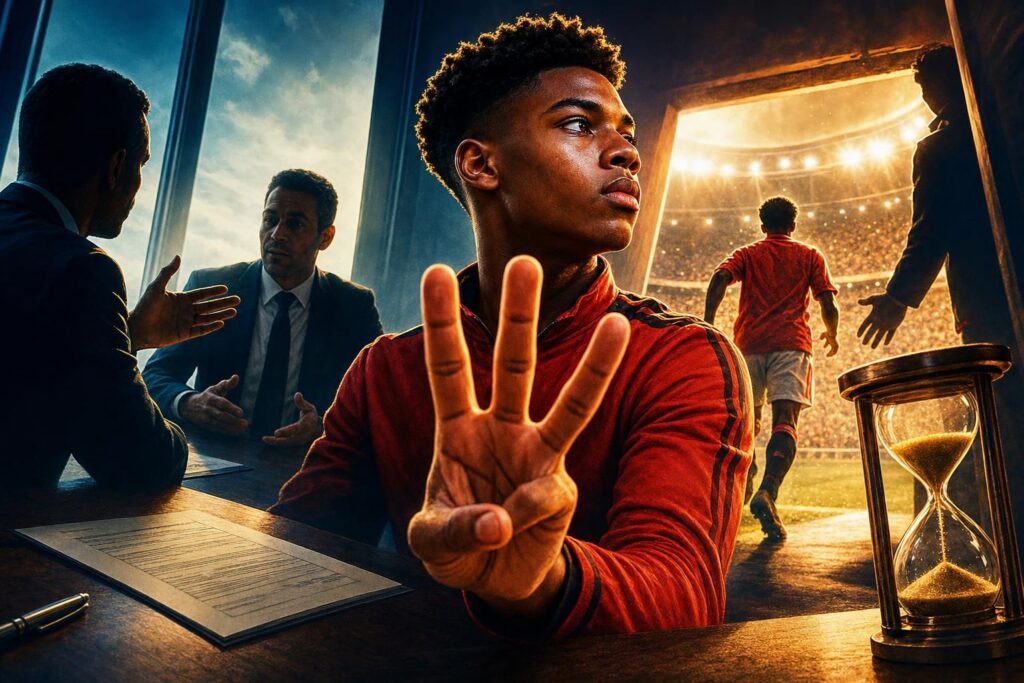
Gabriel’s representatives demanded 20 minutes in each of three games before scholarship negotiations, exposing tension between promised development and contractual reality.
Manchester United academy forward JJ Gabriel’s representatives demanded at least 20 minutes of playing time in each of three specified matches before entering scholarship negotiations with the club, according to reporting by ESPN. The condition reflects a fundamental disagreement about what Gabriel’s pathway at United should look like and when the club is obligated to deliver on its development promises.
The dispute matters precisely because it sits at the intersection of contractual negotiations and career progression. Gabriel, who turned 16 on 6 October 2026, is at the age when elite academy players typically transition from age-group football to scholarship terms. Those scholarships determine financial support, contractual status and, critically, access to first-team training and competition. His representatives appear to have used playing time in early-season fixtures as a condition for entering those talks. If the club wanted to proceed with a formal scholarship agreement, they would need to demonstrate commitment through actual competitive minutes.
The three matches in question were specific. ESPN reported that Gabriel’s representatives demanded 20 minutes in games against Sabah FK, Brighton (a Carabao Cup tie on 16 September) and Bournemouth (a Premier League fixture scheduled for 25 October). The condition was granular and non-negotiable: a minimum threshold in each game, not a vague promise of “opportunities to play.”
Gabriel had not trained with United since leaving ahead of the Brighton Carabao Cup match on 16 September, according to ESPN’s sources. He did appear in a pre-season friendly against Atlético Madrid, but a squad photograph released on 5 October, which some interpreted as evidence of reconciliation, was taken nearly a month earlier and cannot establish his current relationship with the club. The photograph is a relic of an earlier period, not proof that the dispute has resolved.
The disagreement reveals an uncomfortable tension in modern elite academy football. United, according to sources cited by ESPN, maintains it offered Gabriel a development pathway and wanted to check on his welfare. His representatives, though, appear sceptical of promises they believe the club has already broken. ESPN’s report does not establish the specific terms of those alleged promises or whether Gabriel or his family have publicly articulated their position on the matter.
This is where context becomes essential. Gabriel’s previous departure from United’s academy highlights the pressure that surrounds young academy players at elite clubs. The cycle is familiar: exceptional talent, accelerated progression, then a crisis point when the gap between expectation and actual opportunity becomes impossible to ignore. His representatives may be insisting on demonstrable action because words have proven insufficient in the past.
The fundamental issue is selectorial discretion versus contractual guarantees. A club like United cannot, and should not, be compelled to select a player regardless of form, fitness or tactical necessity. Selection must remain the manager’s prerogative. But when a club is negotiating a scholarship with a 16-year-old, effectively inviting him to commit his career trajectory to their system, the player’s representatives are entitled to ask for tangible evidence that the club will afford him meaningful opportunity to develop. The 20-minute threshold is one interpretation of what “meaningful” looks like. It is a condition, not entitlement.
What Remains Unresolved
What remains unresolved is substantial. The exact promises Gabriel’s representatives believe were broken are not established. Gabriel’s own view of his future at United is not publicly known. The substance of any private scholarship discussions is unknown. ESPN reports that representatives believed United had not kept its word, and that United countered with its own narrative of a development offer and welfare concerns, but neither party’s version has been independently verified. Neither has Gabriel himself spoken publicly about his position.
The threat of legal action, according to ESPN, is conditional. Sources told the outlet that Gabriel’s representatives might pursue litigation if evidence emerged of an improper approach by another club. United had not received a formal enquiry from any other club at the time of reporting. This is an important distinction: the legal threat is about external interference, not a dispute with United itself.
The Photograph Cannot Settle This
Sky Sports has separately reported that Gabriel is still expected to leave the club despite the squad photograph, though this reflects reporting rather than a confirmed outcome. Gabriel’s status remains uncertain: potentially signing elsewhere, potentially returning to negotiations with United, or potentially departing without any settled destination.
The photograph cannot settle this dispute because it was taken in the past and documents a moment before the crisis point. What matters now is whether United and Gabriel’s representatives can find a way forward, whether that involves first-team minutes as a condition of scholarship, or whether the gap between expectation and reality has become too wide to bridge.