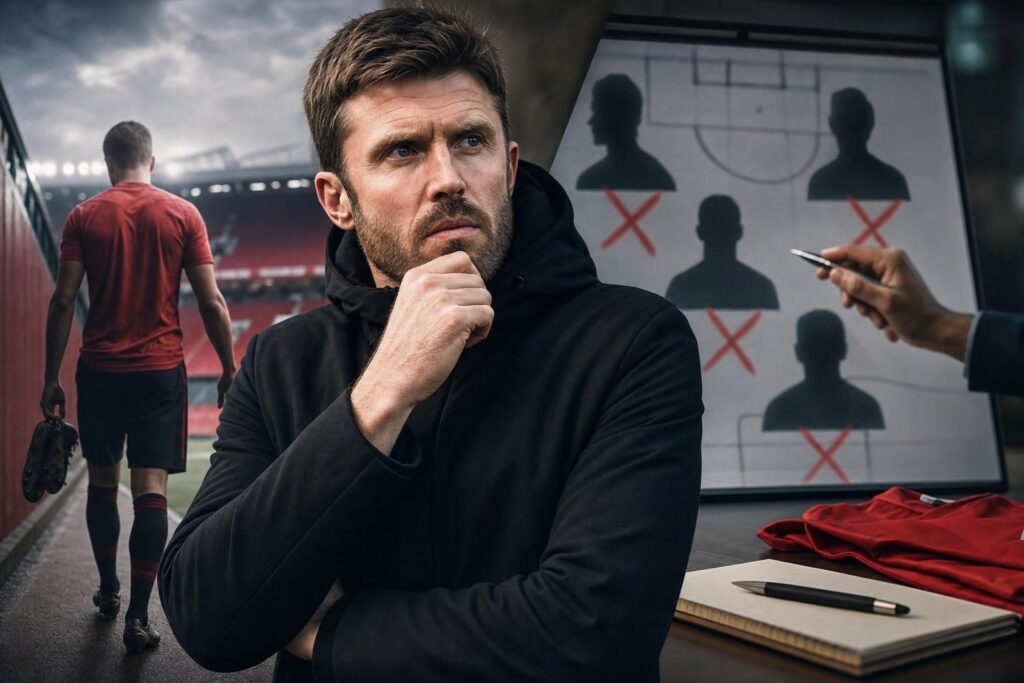
Manchester United chose not to sign a left-back despite expectations, backing Shaw and alternative options instead of overpaying for targets.
By ليث فيزاريان
The transfer deadline passed on the 1st September with Manchester United having made a calculated decision that will either look brilliantly pragmatic or catastrophically reckless by May. They did not sign a left-back, despite widespread expectation they would. Whether that proves wise depends entirely on Luke Shaw staying healthy and Michael Carrick’s experiment with alternative options working out. No pressure, then.
For months, the assumption was obvious. Shaw played all 38 Premier League games last season, extraordinary given his injury history, but he is 31 and cannot realistically be asked to play 60+ games across a compressed campaign. His only backup, Tyrell Malacia, left when his contract expired in June. A reinforcement was not just expected; it felt mandatory. The club identified targets. Newcastle’s Lewis Hall was clearly first choice. Barcelona’s Alejandro Balde was considered. Racing Santander’s Jorge Salinas was explored. Then came the late push for Rayan Ait-Nouri from Manchester City, which the Sky Blues predictably shut down. By 23:00, United had nobody and a blank space where a left-back should be.
The Lewis Hall Question
United genuinely wanted Lewis Hall. If a deal with Newcastle had been possible at a price they considered reasonable, they would have done it. But Newcastle, having been raided by other Premier League rivals for their best players, were not in a selling mood. Hall is 22, highly rated, and if the Magpies were going to sell him, the fee would be astronomical. United’s summer budget was finite. They had already committed £70m to midfield in the form of Brighton’s Carlos Baleba. The mathematics did not work.
So the club made a choice: maintain discipline on transfer fees, protect their budget for areas deemed more urgent, and wait until next summer when they hope to revisit Hall when Newcastle’s position might be different. It is a long-term decision masquerading as a short-term problem deferred.
The Alternatives and Why They Failed
United would have taken Balde on loan. Barcelona wanted to sell. Salinas had a relatively low release clause but Atletico Madrid were more interested. By the time United moved on to Nicolas Tagliafico, the window was closing and opportunities were vanishing. The brief, late attempt for Ait-Nouri, a player who has played left-back for Morocco, was an admission that the first-choice path had been blocked. City said no. Without an obligation to buy, United were not willing to proceed with a loan deal.
The subtext is clear. United were not willing to repeat the mistakes of recent years. Alex Telles, Matteo Darmian, Sergio Reguilon, all arrived as short-term fixes and fell short of the standard required. Carrick and the club decided that not signing a player was preferable to signing the wrong player.
What They Are Actually Doing Instead
The plan, apparently, is this: Shaw as first-choice left-back, Noussair Mazraoui as backup playing a position he has played for Morocco, Diogo Dalot available to switch flanks if required, and 19-year-old Harry Amass somewhere in the mix, though his exact role remains unclear. Oh, and Leny Yoro, the £52m signing from Lille, being used as a right-back in pre-season and introduced as a substitute in the right-back slot against Ipswich.
This is where the gamble becomes genuinely interesting. Yoro is 20, a centre-back by trade, and is being asked to adapt to a full-back role. If you need evidence this can work, Manchester City have done it with Josko Gvardiol. But it is not without risk. Yoro is physically capable – pace, strength, ball-playing ability are all there, but he is raw in a new position at a crucial moment of a season that could extend well beyond the traditional 38 games.
Amass is the puzzling piece. He impressed in pre-season, impressed observers during a loan at Sheffield Wednesday, got injured at Norwich, and yet United were willing to let him leave this summer despite the left-back shortage. That decision appears not to have happened, which raises questions about what his actual role will be. If he is genuinely going to be involved in the senior squad’s left-back rotation, the decision to not sign someone makes more sense. If he is simply another young player on the periphery, it does not.
The Risk Assessment
The risk is obvious: Shaw gets injured, Mazraoui struggles on the left, Yoro is not ready, Amass does not get a chance, and United are desperately weak in a position that has become increasingly important in modern football. Left-back has become an attacking position, a crucial outlet in transitions, often as important as centre-back. If it goes wrong, it goes very publicly wrong.
The rationale, though, is sound. United refused to be panicked into overpaying for Lewis Hall when they could wait a year. They refused to settle for a squad player they did not believe in. Carrick and the recruitment team have taken a hardline on transfer fees all summer and decided to maintain that discipline even when a gap existed. That requires confidence and, frankly, requires the squad to deliver when it matters.
It probably is the right call. It is definitely the call that makes sense analytically, away from the emotion of matches and the pressure of results. But results are what will decide whether this was pragmatism or folly. And those results, the ones that will determine whether Shaw stays healthy, whether Yoro adapts, whether the whole thing holds together, are coming whether United are ready or not.