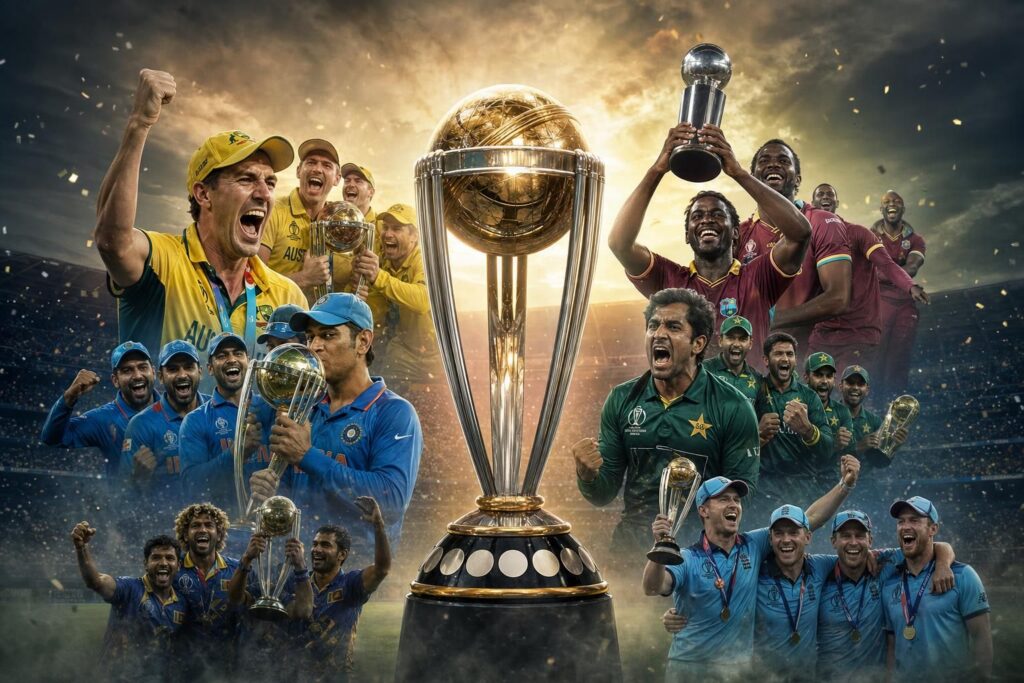
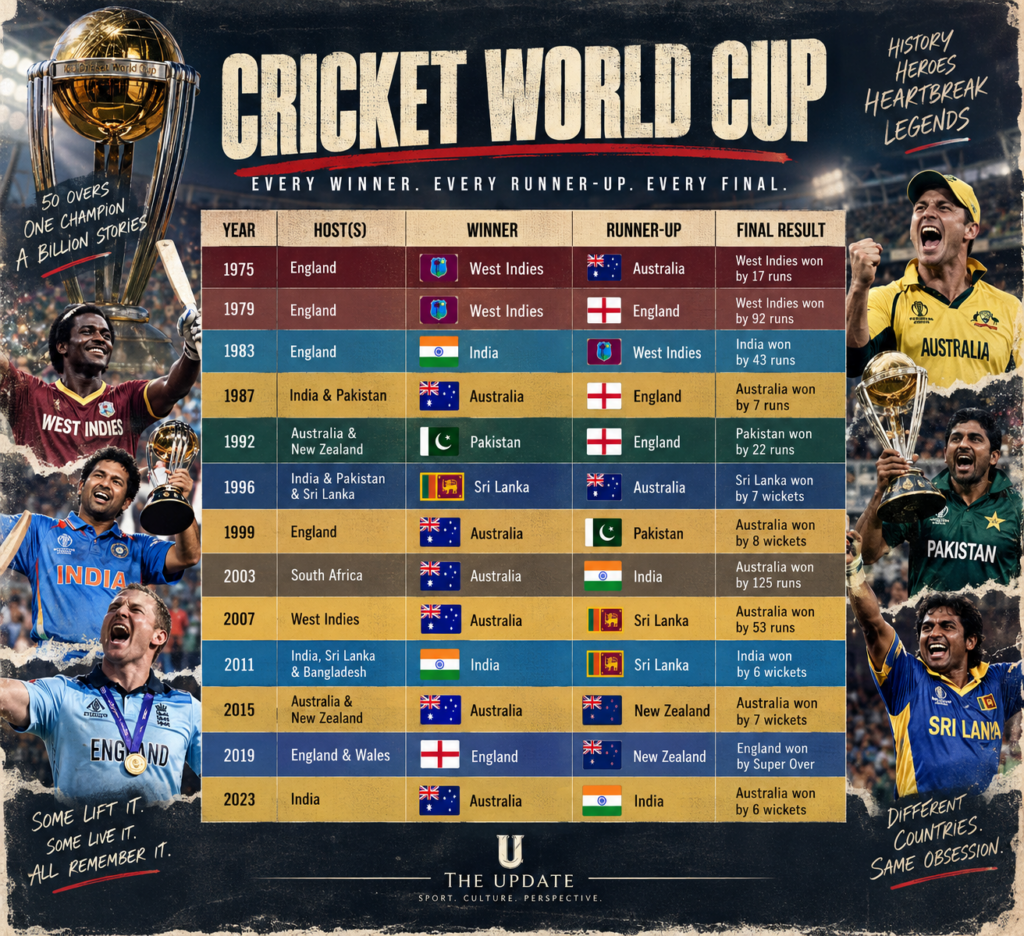
Australia lead the men’s ODI World Cup with six titles, followed by India and West Indies with two victories each.
Australia have won the men’s ODI Cricket World Cup six times, a level of sustained dominance usually associated with gravity, tax demands and television detectives who refuse to retire. India and West Indies have two titles each, while Pakistan, Sri Lanka and England have won once.
This is the complete history of the men’s ODI tournament from its 1975 beginning to Australia’s 2023 victory. It does not include the T20 World Cup, which is a separate competition with its own champions, history and capacity to make a carefully prepared tactical plan obsolete within six deliveries.
Every men’s Cricket World Cup winner and runner-up
1975 to 1983: West Indies rule, then India change everything
The inaugural 1975 competition featured eight teams and 60-over innings, all staged in England. West Indies beat Australia at Lord’s to become the first champions, before successfully defending the trophy against England at the same ground in 1979. Their blend of intimidating pace, athletic fielding and destructive batting established the tournament’s first great standard.
India’s victory over West Indies at Lord’s in 1983 broke that rule. It was India’s first title and prevented the defending champions from completing a hat-trick. More importantly, it altered the competition’s centre of gravity: the World Cup was no longer an English event dominated by a Caribbean superpower, but a prize capable of transforming cricket far beyond its original commercial base.
1987 to 1996: New hosts and three new champions
The 1987 World Cup moved outside England for the first time, with India and Pakistan sharing hosting duties. Australia defeated England at Eden Gardens to claim their first title. It was the opening entry in a trophy collection that would eventually require its own structural engineer.
Pakistan won in 1992 after a competition built around a round-robin format in Australia and New Zealand. The edition also marked South Africa’s return to the World Cup stage. Pakistan’s recovery became part of the tournament’s folklore, while England collected a third runners-up finish without a title, an achievement combining considerable excellence with the emotional texture of stepping on a plug.
Sri Lanka supplied the next great disruption in 1996. The co-hosts defeated Australia in the final, winning their first title and proving that the established powers did not own the trophy. Three successive tournaments had now produced three first-time champions, which remains a wonderfully untidy passage in a competition often ruled by dynasties.
1999 to 2007: Australia build the great World Cup dynasty
The 1999 tournament introduced the Super Six stage, one of several formats devised by administrators apparently concerned that groups followed by knockouts might be dangerously comprehensible. Australia emerged as champions after a campaign containing some of the competition’s tensest cricket, then defeated Pakistan in the final.
That title began the World Cup’s defining dynasty. Australia beat India in the 2003 final in Johannesburg and Sri Lanka in the 2007 final in Jamaica, completing three consecutive triumphs. Across those campaigns, Australia combined elite fast bowling, relentless batting and exceptional fielding with the unnerving confidence of a team that regarded pressure as something happening to everybody else.
The formats and staging around them kept changing, but the champion did not. Australia’s ability to dominate different conditions and tournament structures is what separates this run from an ordinary spell of success.
2011 and 2015: Home advantage becomes decisive
India won their second World Cup in Mumbai in 2011, defeating Sri Lanka in the final 28 years after the breakthrough at Lord’s. It was a landmark home triumph, delivered under a degree of expectation that would make carrying a piano up a spiral staircase seem pleasantly low-stakes.
Four years later, Australia won a fifth title by beating fellow co-hosts New Zealand in Melbourne. New Zealand had produced one of the tournament’s most compelling campaigns, but the final restored the familiar order. Australia remained the World Cup’s most reliable knockout machine.
2019: England win the final nobody could separate
The 2019 final at Lord’s is the strangest championship decider in World Cup history. England and New Zealand finished level, then could not be separated by the Super Over. England were awarded the trophy under the boundary-count regulation in force for the tournament.
The result gave England their first ODI World Cup, but the method immediately became the final’s defining controversy. New Zealand were not beaten by runs or wickets; they lost through a tie-breaking rule few spectators had expected to matter. It was exhilarating sport followed by the administrative equivalent of finding the winner in a spreadsheet.
England were legitimate champions under the rules, while New Zealand were entitled to feel uniquely aggrieved. Both statements can be true without turning the result into a morality play.
2023: Australia spoil India’s home procession
India hosted the 2023 competition and reached the final at the Narendra Modi Stadium, but Australia took the trophy. It was Australia’s sixth World Cup, extending their record and correcting any lingering impression that the post-2007 side belonged merely to history.
The victory reinforced Australia’s defining World Cup trait: tournament survival followed by knockout ruthlessness. Other nations have produced magnificent teams and memorable champions. Australia have repeatedly produced sides that arrive at the decisive stage looking as though the occasion has inconvenienced them rather than frightened them.
How the Cricket World Cup format has changed
The World Cup began with eight teams playing 60 overs per side. Later editions moved to the familiar 50-over game, while organisers experimented with round robins, separate groups, Super Sixes, quarter-finals and other multi-stage arrangements. The format has rarely remained untouched long enough to become furniture.
The official plan for the 2027 edition expands the field to 14 teams and introduces another three-stage competition. As with any future tournament, its eventual structure remains subject to subsequent ICC amendments, but the direction is clear: broader participation combined with multiple rounds intended to preserve competitive consequence.
Across all those revisions, the historical hierarchy is unmistakable. West Indies created the first dynasty, India delivered the first great disruption, Pakistan and Sri Lanka produced era-defining breakthroughs, and England won the closest final imaginable. Australia, with six titles across four different decades, remain the competition’s benchmark.