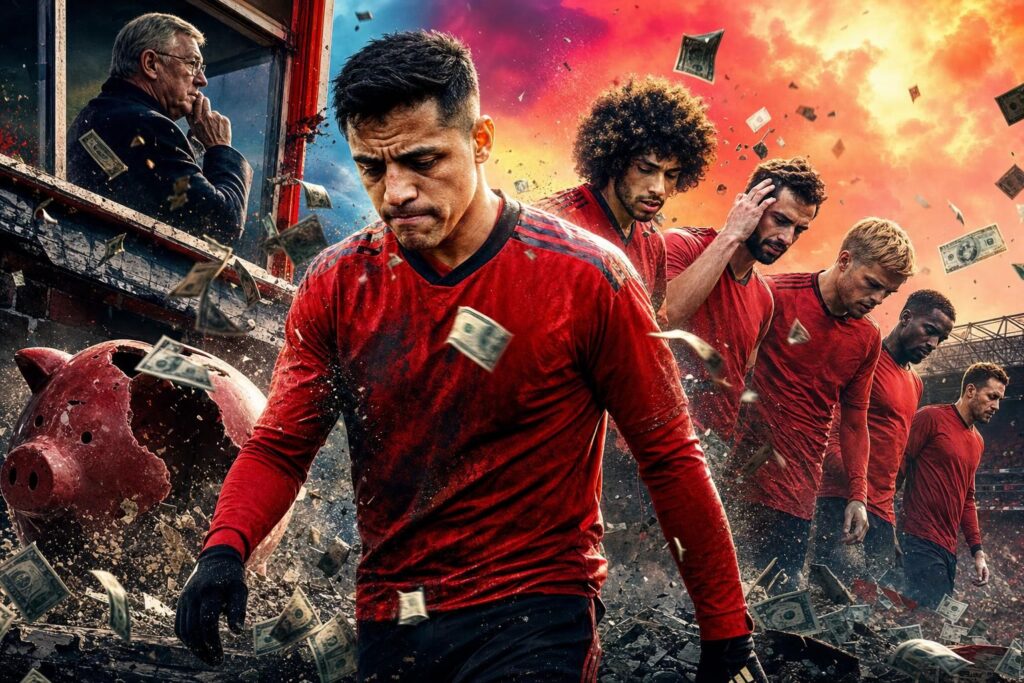

Manchester United repeatedly changed tactical principles and recruitment priorities, leaving each manager with expensive pieces from several incompatible teams.
There are signs that Michael Carrick may finally be pulling United in a more coherent direction. The early revival has already hit its first bump, but it is still far too soon to decide whether this is another short-term lift or the beginning of something more durable. Carrick’s United is therefore a story for another day. This piece is about how the club reached this point in the first place.
Manchester United did not lose their identity because nobody found the sacred formation hidden beneath Sir Alex Ferguson’s desk. They lost it because every attempted replacement arrived with a different idea of football, while the squad retained expensive evidence of the previous one.
David Moyes tried reluctant continuity. Louis van Gaal imposed possession and positional discipline. José Mourinho preferred compact control, Ole Gunnar Solskjær leaned into transitions, Ralf Rangnick prescribed pressing and Erik ten Hag pursued structured build-up. Each plan made sense in isolation. Together, they looked like six architects renovating the same house without consulting the drawings.
That is the defining story of Manchester United after Ferguson: not an absence of ideas, but a surplus of incompatible ones. Recruitment repeatedly followed the latest theory, only for the next manager to arrive with a new tactical vocabulary and a different shopping list.
Moyes inherited the champions, but not Ferguson’s authority
David Moyes took charge in May 2013 after Ferguson’s retirement and inherited the reigning Premier League champions. What he could not inherit was Ferguson’s authority, improvisational freedom or the accumulated understanding that allowed those teams to change shape without appearing lost.
The familiar ingredients remained: width, crosses, senior defenders, attacking forwards and the expectation that pressure would eventually tell. The rhythm changed, though. United’s build-up became more cautious, their attacking patterns less instinctive and the team’s direction harder to recognise. Rio Ferdinand later criticised elements of Moyes’s preparation and tactics, reflecting the broader sense that a new manager had not established command of a dressing room accustomed to Ferguson’s methods.
Marouane Fellaini was Moyes’s major addition and an instructive one. His physicality and aerial ability offered a direct route around midfield or near the penalty area, but the signing did not solve United’s need for a reliable controller. The club finished seventh in 2013/14, turning a failed title defence into something more serious – proof that continuity without a clear succession plan was wishful thinking wearing a club blazer.
Van Gaal gave United a system, then removed its pulse
Louis van Gaal represented the first decisive break. His United were meant to value possession, positional order and controlled build-up, with players occupying defined spaces and protecting the team’s structure rather than attacking every opening that appeared.
Recruitment reflected parts of that vision. Daley Blind offered intelligence and distribution from defence or midfield, while Ander Herrera added mobility and combination play. Marcos Rojo contributed to the reconstruction of the back line, and Juan Mata became part of a technically gifted but not always naturally balanced attacking group.
The theory was coherent. The visible football was frequently less persuasive. United could dominate possession and territory without consistently disorganising opponents, while safe circulation sometimes became an end rather than a means. The team returned to the Champions League via the play-offs in 2014/15, but the attack often felt like a heavily supervised school trip: everybody stayed together, nobody got lost and remarkably little happened.
Van Gaal proved that United could adopt a recognisable system. He also showed that identity is not simply having the ball. It is knowing how possession creates chances, where runners should appear and which risks are worth taking.
Mourinho built control around a contradictory squad
José Mourinho arrived in 2016 with a more pragmatic proposition. United would defend in a compact shape, manage matches and attack selectively through powerful or individually decisive players. There was nothing inherently outdated about that approach. Mourinho’s best teams understood space and game state with ruthless clarity.
The recruitment, however, contained competing impulses. Nemanja Matic was a disciplined midfielder trusted to secure the centre, while Romelu Lukaku provided strength, running power and a focal point. Paul Pogba brought passing range and ball-carrying, but needed a platform that did not always maximise his freedom. Alexis Sánchez added another high-profile attacker without resolving how United would create chances collectively.
United could defend compactly and counterattack effectively against opponents willing to advance. The greater difficulty came when they had to dictate play against a settled block. Attacking output could depend on isolated inspiration rather than repeatable combinations. The squad contained famous names, but celebrity is not a tactical principle, however enthusiastically the piano is unveiled.
Mourinho produced United’s clearest sustained defensive structure of the early post-Ferguson period. It did not become an institutional identity because the club’s next choice moved away from it.
Solskjær made transition football feel natural
Ole Gunnar Solskjær’s United were at their clearest when matches opened up. Quick forward passing, mobile attackers and aggressive transitions suited a squad carrying pace and individual threat. Against opponents who committed players, United could look exhilarating, and the football felt liberated after Mourinho’s final months.
But counterattacking fluency is easier to establish than control against deep opposition. United struggled to turn their transition threat into a complete attacking framework. Their pressing worked in phases rather than as a consistently connected mechanism, while build-up could become dependent on midfielders escaping pressure or creators manufacturing difficult passes.
Solskjær exposed the club’s central dilemma. United wanted the speed and romance associated with their past, but elite football also demanded detailed possession structures and coordinated pressing. Nostalgia could provide emotional direction. It could not tell the full-backs where to stand during first-phase build-up.
Rangnick diagnosed a club that could not take the medicine
Ralf Rangnick’s interim appointment in 2021 introduced the language of high-intensity pressing and structural reform. His approach was built around coordinated pressure and transitions, with the longer-term ambition of changing how the team recruited and played.
The problem was immediate. A pressing philosophy requires collective distances, physical commitment and players suited to the model, not merely a new formation on the television graphic. Rangnick’s short tenure offered too little time to rebuild the squad, and the intended transformation was never fully realised.
Michael Carrick’s interim spell sat between Solskjær and Rangnick, underlining the same instability. United were changing direction before any one direction had properly taken hold, a little like changing sat-navs halfway through a roundabout and blaming the road.
Ten Hag inherited every previous rebuild at once
Erik ten Hag arrived in 2022 with a clear modern brief: structured build-up, coordinated pressing and recognisable attacking patterns. Yet the same contradiction followed him. Detailed possession football requires defenders comfortable receiving under pressure, midfielders able to control space and attackers willing to press as a unit. Inherited squads rarely arrive as matching sets.
The important distinction is between intention and evidence. A team lining up in a 4-2-3-1 does not possess an identity merely because television graphics can arrange the shirts neatly. Identity appears in repeated actions: how the goalkeeper starts attacks, how midfield creates a spare player, where the defensive line sits, what triggers the press and how chances are generated.
Across the post-Ferguson era, United repeatedly displayed fragments of those behaviours without preserving them through managerial change. Players recruited for one interpretation of football became awkward inheritances under the next. The club kept commissioning rebuilds while declining to clear the building site.
The real failure happened above the dugout
No manager was tactically blameless. Moyes failed to command the transition, Van Gaal’s control became sterile, Mourinho’s attack relied too heavily on individuals, Solskjær never completed the move from transition team to dominant side, and Rangnick could not translate diagnosis into performance. Ten Hag’s structural ambitions also had to be judged by what appeared on the pitch, not by diagrams or reputation. The less said about Ruben Amorim’s increasingly dogmatic and by the end, completely unhinged reign, the better.
Managerial shortcomings alone, however, do not explain the repetition. A properly defined football structure recruits coaches and players around durable principles, allowing evolution without requiring ideological demolition. United instead changed those principles with the manager. Possession specialists met direct football, counter attackers met positional play and players signed for defensive security faced demands for sustained pressure.
Ferguson’s identity was never one formation. His teams evolved, but authority, recruitment and competitive expectations remained aligned around him. After his retirement, Manchester United repeatedly mistook appointing a manager for choosing a direction. The result was not an era without tactics. It was an era of tactical ideas continually cancelling one another out.
That helps explain why the club’s problems have felt structural rather than temporary. As Manchester United’s wider underachievement shows, the issue is not simply that individual managers made mistakes. The club kept asking each new regime to repair a squad built for somebody else’s football.