
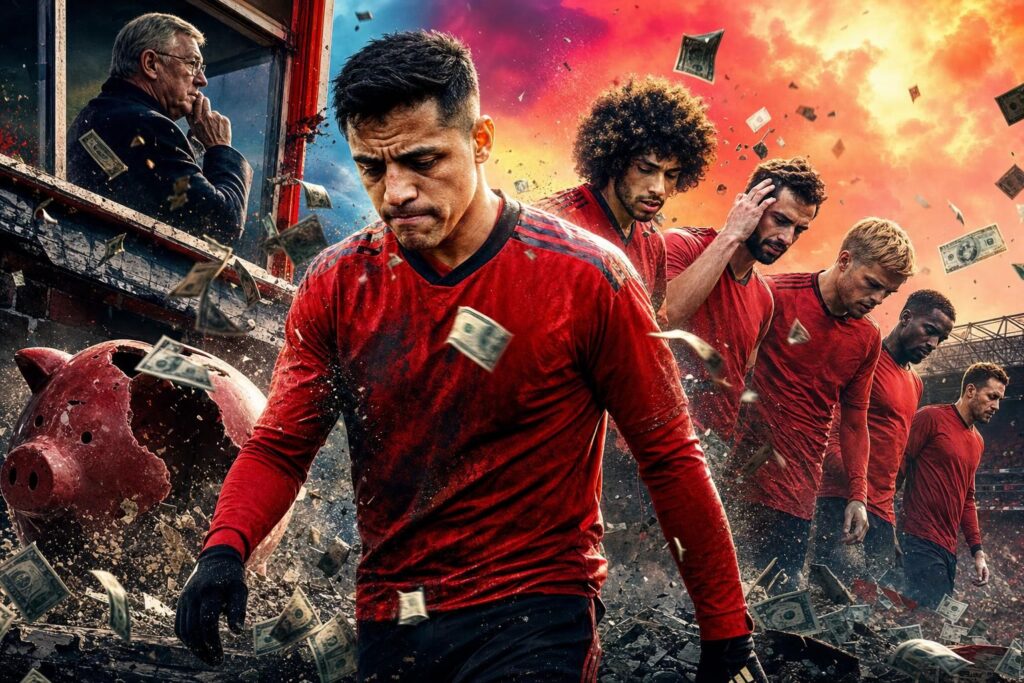
Sánchez tops this ranking of United’s post-Ferguson transfer failures, judged by cost, contribution and fit rather than treating every expensive signing as a flop.
Manchester United did not spend the years after Sir Alex Ferguson signing only bad footballers. They signed talented players to solve the wrong problem, at the wrong price, or for a team that kept changing its idea of what it wanted. That is a more damaging record than simply buying the occasional dud.
This ranking judges deals, not careers. The test is the gap between cost and contribution, alongside tactical fit, useful service and what the decision suggests about United’s planning. Reported fees offer context, not a pretend-precise bill for every pound spent. A player can have genuine talent, even good spells at United, and still represent poor recruitment. The order is an editorial judgement: it weighs the scale of the commitment against what United actually got back.
7. Romelu Lukaku: goals, but not a lasting answer
Signed in 2017 for a reported fee of around £75m, Lukaku offered an understandable answer to a straightforward question: where would United’s goals come from? He was an established Premier League scorer, not an obscure gamble discovered by a scout with an unusually persuasive PowerPoint.
The problem was less whether Lukaku could score than whether United were building an attack to get the best from him. His goals count in his favour, which keeps him below the costlier disappointments here, but he did not become the long-term focal point the investment implied. Calling him hopeless ignores his contribution; calling the deal a clear success ignores how soon United needed another answer up front. The signing addressed an immediate need, but did not settle it.
6. Ángel Di María: a statement without a supporting plan
Di María arrived from Real Madrid in 2014 for a reported fee in the £60m to £67m range. United had missed the Champions League, and signing a player of his standing sent an unmistakable message: the club could still attract stars. It was also an expensive way to reassure everyone that Manchester United remained Manchester United.
His stay lasted one season. Di María’s ability was never the central mystery; how to get sustained value from it was. A marquee arrival can lift expectations overnight, but it cannot provide a settled role or make a changing side coherent. This was an early warning that buying prestige and building a team are separate activities. The short tenure turns a big fee into a particularly poor return, whatever the player’s wider career says about his talent.
5. Paul Pogba: the talent was real, the project was muddled
United brought Pogba back in 2016 for a widely reported fee of around £89m. The attraction was obvious: an elite-profile midfielder who could make the side more dynamic and give a drifting club a new centrepiece. There were performances that justified the excitement. Anyone pretending his entire second United spell was useless has let disappointment edit the footage.
But a transfer of that size needed a clear, durable idea of the midfield around him and the job he was supposed to do. Too often, discussion of Pogba swung between asking him to fix the team and blaming him when he could not. He left in 2022, and the gap between what United bought, what they expected and what they built remains the point. He ranks below the outright failures because he contributed more than they did, but the club never made the expensive centrepiece feel like part of a settled project.
4. Jadon Sancho: buying a solution without securing the role
Sancho’s arrival in 2021, for a reported £73m, made sense on paper. United wanted greater attacking quality on the flank and signed a young player with a strong reputation. Unlike some deals on this list, this was not simply a famous name acquired to make a difficult summer look productive.
That makes the disappointing return more instructive. A winger’s output depends on role, combinations and a functioning attack, as well as individual form; United did not consistently turn Sancho’s qualities into reliable performances. Later uncertainty around his place at the club widened the distance between the fee and the benefit. The error was not believing he could play. It was paying for a dependable attacking answer without establishing how the team would get one from him. United bought potential, but the price and expectations left little room for a slow or uncertain fit.
3. Antony: familiarity did not remove the risk
Antony joined in 2022 for a reported fee of around £85m. The logic was visible: bring in a winger familiar with the football Erik ten Hag wanted to play. A manager’s knowledge of a player can reduce one kind of uncertainty. It does not guarantee that the player will justify an enormous fee in the Premier League.
Antony’s performances have not matched that price. His ranking reflects more than an unfavourable comparison between goals and pounds: it reflects how much United committed to one answer on the right wing. Recruitment should leave room for the possibility that an apparently good fit will not develop as hoped. At this cost, United left themselves very little. Familiarity may have made the choice feel safer, but it did not make the financial gamble small.
2. Harry Maguire: the right need, the wrong-sized bet
United needed defensive authority when they signed Maguire in 2019 for a reported £80m. That need was real, and so were his useful contributions. His inclusion is not an invitation to pretend he never played well, or to pin every defensive failure on the most recognisable centre-back in the photograph.
The issue is what the fee seemed to ask him to be: a near-complete fix for a back line whose problems went beyond one position. As tactical demands and managerial priorities changed, the premium paid for certainty looked harder to defend. Maguire ranks this high because the deal illustrates a recurring error neatly: identify a genuine weakness, spend as though one expensive purchase can settle it, then discover the rest of the system still needs work. The price magnified the expectations, while the signing alone could not guarantee the stability United wanted.
1. Alexis Sánchez: the exchange that solved nothing
Sánchez arrived from Arsenal in 2018 in a swap involving Henrikh Mkhitaryan. With no conventional headline transfer fee to argue over, it was easy to make the acquisition look ingenious. But the deal carried a substantial wage commitment, and Sánchez’s contribution at United fell far short of the expectations attached to his name and salary.
The thinking was understandable up to a point. United could acquire a proven Premier League attacker while preventing a rival from gaining the advantage. Yet that is the logic of winning a transfer contest, not necessarily of improving a football team. Sánchez takes first place because the gap between apparent opportunity and actual return was enormous. United treated availability and star power as if they answered the harder question: what, precisely, would he add to this side? The swap may have avoided a headline fee, but it did not make the commitment cost-free.
The costly habit behind the ranking
These deals failed in different ways. Lukaku’s goals make him a poor candidate for a simple “flop” label; Pogba’s best football makes any claim that he lacked ability look silly. Di María barely stayed, while Sánchez offered too little return for his commitment. Maguire, Sancho and Antony show how an identifiable squad need can still produce a questionable decision when price, role and longer-term planning do not line up.
That pattern fits into a wider problem: United’s difficulty in maintaining a consistent footballing identity after Ferguson. Their post-Ferguson tactical shifts help explain why individual arrivals so often seemed to be asked to repair more than one weakness. A transfer can be sensible in isolation and still become an awkward fit when the team’s priorities change around it.
There is an important distinction between spending badly and spending at all. Bruno Fernandes offered a counterexample: an ambitious signing who gave United an identifiable source of attacking creativity. The lesson is not that every expensive deal must fail. It is that a club needs a coherent role for the player, a clear idea of what he improves and a plan that lasts longer than the unveiling photos.
As the wider record of United’s transfer misfires suggests, the recurring trouble was asking an individual purchase to compensate for a team without a sufficiently consistent plan. After Ferguson, United kept shopping for the finished answer. Too often, they got an expensive new question instead.