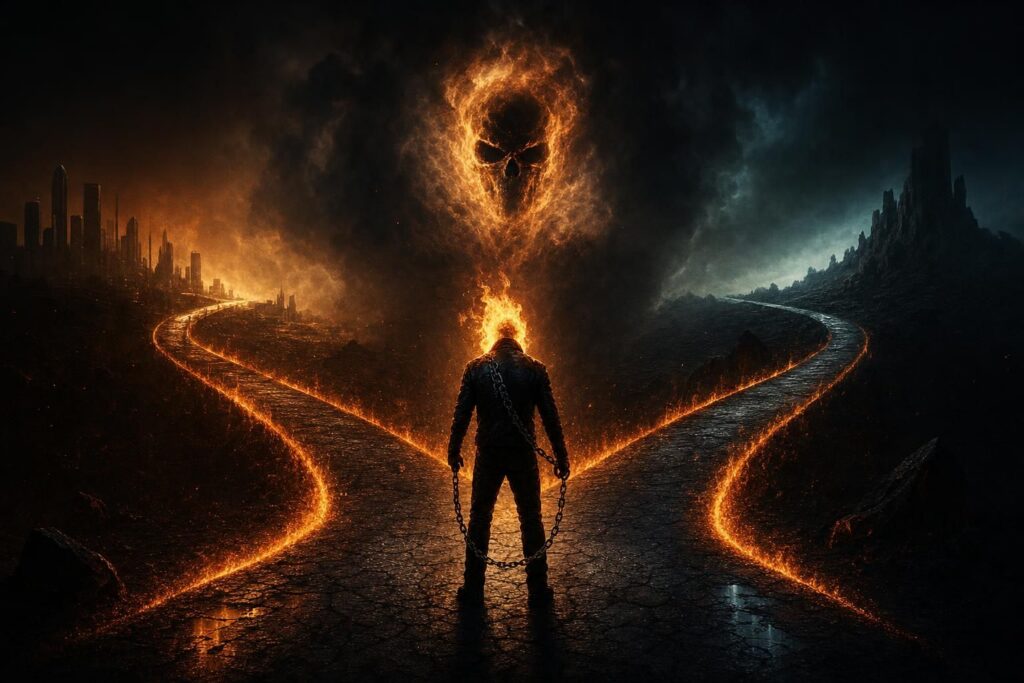
Ghost Rider is a supernatural Marvel mantle shared by several hosts, chiefly Johnny Blaze, Danny Ketch and Robbie Reyes, across comics and films.
Ghost Rider looks wonderfully simple from a distance: flaming skull, infernal vehicle, leather wardrobe and absolutely no interest in passing a standard driving test. Get closer, however, and Marvel’s supernatural antihero becomes considerably messier.
Ghost Rider is not one permanently fixed character. The name has been carried by multiple human hosts, most famously Johnny Blaze, Danny Ketch and Robbie Reyes, who draw their power from the wider mythology of the Spirits of Vengeance. Their origins, vehicles and relationships with those spirits differ, while decades of revisions have made the family tree resemble something Mephisto drafted after three bottles of red.
Reports of a possible new film have revived questions about Ghost Rider’s place on screen, but Marvel and Disney have not publicly confirmed a final release date, casting or precise MCU continuity. Until they do, here is the clean version of what Ghost Rider is, how the principal Riders differ and where the character has appeared.
What exactly is Ghost Rider?
Ghost Rider is best understood as a supernatural mantle rather than an ordinary superhero identity. A human host becomes connected to a Spirit of Vengeance, transforming into a skeletal, hellfire-wielding figure compelled to punish the guilty.
That broad definition is more reliable than insisting on one universal origin. Marvel has expanded and revised the mythology over time, connecting individual Riders to a much older lineage of vengeance spirits. Different stories place different emphasis on demonic possession, curses, mystical power and divine purpose. Consistency is not always the chief concern of a universe in which a motorbike can be on fire and still apparently pass its MOT.
Zarathos is particularly easy to misunderstand. The name is strongly associated with Johnny Blaze’s supernatural counterpart and has been used prominently in adaptations, but it should not simply be treated as another name for every Spirit of Vengeance. The wider concept extends beyond one entity and one host.
Johnny Blaze: the classic Ghost Rider
Johnny Blaze is the original modern Ghost Rider and remains the version most casual audiences recognise. A motorcycle stunt performer, Blaze makes a pact with Mephisto while trying to save someone he loves. As tends to happen when negotiating with Marvel’s resident infernal contracts department, the arrangement does not deliver a quiet and emotionally healthy life.
Blaze becomes bonded to a supernatural force and transforms into Ghost Rider. His visual template defines the character: burning skull, black leather, chains, hellfire and a motorcycle that treats conventional physics as an optional extra.
Johnny’s stories commonly revolve around control. The Spirit of Vengeance demands punishment, while the human host attempts to preserve some measure of judgement and compassion. That tension separates Ghost Rider from a simple monster who happens to own an excellent bike. Blaze is frightening because his power is overwhelming, but interesting because using it risks surrendering part of himself.
Danny Ketch: the successor who expanded the mythology
Danny Ketch became one of Marvel’s principal Ghost Riders after Johnny Blaze and was eventually established as Blaze’s brother. His history is tangled into the expanding Spirits of Vengeance mythology, including Blaze’s changing relationship with Ghost Rider power.
Ketch helped define the character for a later generation of comic readers. His era reinforced the darker visual language associated with Ghost Rider, including heavy chains and a formidable supernatural motorcycle. Readers who picture Ghost Rider as a particularly angry biker may be remembering elements that Danny’s stories helped cement.
Comics spoiler: Danny and Johnny’s family connection was not merely decorative trivia. It allowed Marvel to bind two apparently separate Ghost Riders into one supernatural lineage while opening the door to a much larger history of vengeance spirits.
Danny therefore matters for more than being “the other motorbike one”. He helped turn Ghost Rider from one cursed stuntman’s tragedy into a mantle capable of passing between characters and supporting a broader occult mythology.
Robbie Reyes: the Ghost Rider with four wheels
Robbie Reyes breaks the familiar formula immediately. Instead of arriving on a motorcycle, he is associated with a possessed muscle car, usually called the Hellcharger. This is sacrilege only if one believes eternal vengeance must arrive with exactly two wheels.
Robbie’s origin and relationship with his inhabiting spirit differ from Johnny’s traditional arrangement. That distinction gives him his own perspective within the mythology rather than reducing him to Blaze with a different driving licence. His stories also place greater emphasis on family responsibility and the pressures surrounding his human life.
Visually, Robbie’s skull-like transformation and blazing car preserve the essential Ghost Rider language while moving it somewhere new. He demonstrates why the character works as a mantle: the underlying idea is not simply “man with motorcycle”, but a human being forced to carry supernatural vengeance and decide what justice should look like.
Are Johnny, Danny and Robbie the only Ghost Riders?
No. Marvel has extended the Spirits of Vengeance concept to other hosts and different periods, making it a lineage rather than an exclusive club of three. Johnny, Danny and Robbie are the principal modern characters a newcomer needs to understand, but they do not represent every person ever given a flaming head and a grievance.
This distinction also explains why Ghost Rider’s origin has several versions. The essential idea remains stable, while the identity of the host, the supernatural entity involved and the method of transformation can change from one story to another.
What powers does Ghost Rider have?
Individual Riders vary, but several abilities recur. Hellfire is the signature weapon, manifesting through flames, chains and vehicles. Ghost Riders also possess enhanced supernatural durability and regenerative abilities, making ordinary attempts to stop them about as useful as issuing a parking ticket to an erupting volcano.
The most famous ability is the Penance Stare. By locking eyes with a victim, Ghost Rider forces that person to confront the suffering connected to their wrongdoing. Its effectiveness and limitations have shifted between stories, so it is better understood as mystical judgement than a perfectly measurable superpower. Comic continuity has supplied exceptions and complications, because no formidable ability survives long without a writer finding someone it cannot conveniently flatten.
The vehicles are supernatural extensions of the Rider’s power. Blaze and Ketch are associated with infernal motorcycles, while Reyes drives the Hellcharger. They are not merely transport. They are part of the visual language that makes each Rider distinct while preserving the central idea of a human host carrying supernatural vengeance.
Ghost Rider’s film history
Nicolas Cage played Johnny Blaze in Ghost Rider, released in 2007. The film adapted Blaze’s bargain, transformation and conflict with demonic forces into a gothic superhero blockbuster from the era when Marvel continuity was often handled with a leather coat, a special-effects budget and a hopeful expression.
Cage returned for Ghost Rider: Spirit of Vengeance, released in 2011. It again followed Johnny Blaze, but adopted a different creative style and pushed the Rider’s monstrous qualities further.
Neither film belongs to the Marvel Cinematic Universe. Both were Columbia Pictures releases made through the earlier system of separately licensed Marvel properties. They should therefore be treated as their own screen incarnation, not as hidden chapters between MCU films.
Is Ghost Rider joining the MCU?
No Ghost Rider film has been released as part of the core MCU. Reports surrounding Marvel’s future plans have linked the character with a possible 2028 project and Ryan Gosling, but Marvel and Disney have not publicly established those details through definitive official press materials. A reported target window is not the same thing as a locked release date, particularly in superhero cinema, where calendars move with the dignity of shopping trolleys on a hill.
The character would fit naturally beside Marvel’s supernatural material, but links to Blade, the Avengers or any prospective Midnight Sons line-up remain unconfirmed. It is also unknown which host a future adaptation would use.
That choice matters. Johnny Blaze offers the classic Faustian tragedy, Danny Ketch provides the bridge into the broader Spirits of Vengeance mythology, and Robbie Reyes supplies the most visibly modern reinvention. Whichever name eventually appears on a call sheet, Ghost Rider is bigger than one actor or one flaming vehicle. He is Marvel’s recurring argument that vengeance can be a power, a curse and a spectacularly irresponsible mode of transport all at once.