The Batman Part II continues Robert Pattinson’s separate continuity, while The Brave and the Bold is the Batman project announced for the shared DCU.
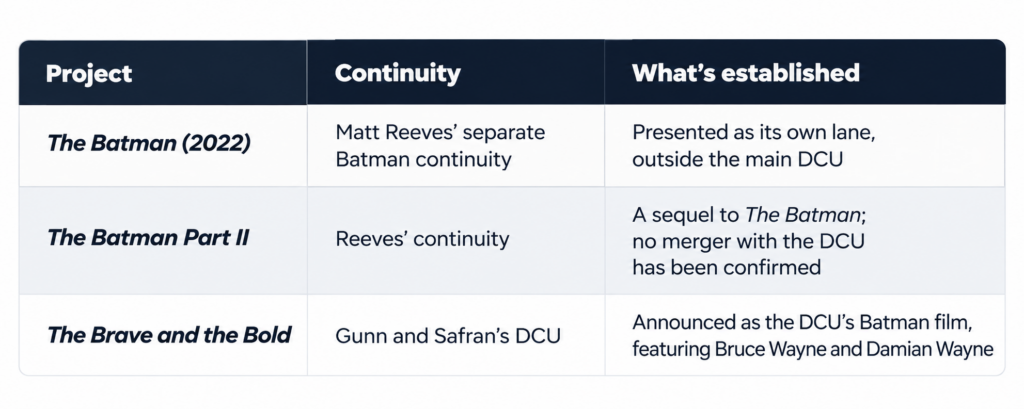
No. The Batman Part II has not been confirmed as part of James Gunn and Peter Safran’s shared DC Universe. It is the sequel to Matt Reeves’ The Batman, continuing Robert Pattinson’s story in that film’s separate continuity. The DCU’s announced Batman film is The Brave and the Bold, a different project.
The confusion is understandable: DC discussed Reeves’ sequel while unveiling plans for its new connected universe. But a studio slate is a list of projects, not a group photograph proving every character has met Superman. Here is the simple map.
Why The Batman Part II is separate from the DCU
Continuity is the fictional history shared by stories. If two films belong to the same continuity, events in one can be treated as having happened in the other. Reeves’ The Batman was presented as its own story, separate from the main DCU. Since Part II continues that film’s story, the clearest reading is that it belongs to Reeves’ lane, not Gunn and Safran’s shared universe.
DC’s January 2023 announcements set out a connected DCU slate while also discussing projects outside its main continuity, including Reeves’ sequel. That distinction matters more than the fact that the projects appeared in the same round of announcements. A company can plan several films about the same character without putting every Gotham in the same fictional postcode.
You may see Reeves’ films described as “Elseworlds”. The term is commonly used for DC stories outside the main shared continuity. It is a useful shorthand, but not evidence of a secret crossover or a promise that the films will eventually merge with the DCU. “Outside the DCU” does not mean “not a DC film”; it means Pattinson’s Bruce Wayne has not been established as the same Bruce Wayne who will appear in The Brave and the Bold.
Who is the DCU’s Batman?
The Brave and the Bold is the Batman film announced for Gunn and Safran’s connected DCU. DC’s slate announcement described a story involving Bruce Wayne and his son Damian Wayne. It is distinct from Reeves’ sequel, and its announcement did not turn Pattinson into the DCU’s Batman.
So DC has two Batman tracks to keep straight: Reeves’ version, continuing from The Batman, and the Batman being developed for the shared DCU. The arrangement is less unprecedented than it sounds. Batman has been reinterpreted repeatedly, and audiences can generally tell one version from another. The slightly less heroic task is following studio announcements when “a DC project” and “a project set in the DCU” are treated as if they mean the same thing.
The distinction also helps set expectations. Reeves’ first film was framed as a standalone Batman story, while Gunn and Safran’s DCU is intended to connect projects across film, television, animation and games. Those are different storytelling jobs. Bringing Reeves’ Gotham into the shared universe would be a substantial continuity decision, not a minor administrative tidy-up.
Why did DC announce both projects together?
Because “DC’s upcoming projects” and “projects set in the DCU” are not interchangeable categories. Gunn and Safran’s plans covered the new connected storytelling slate while also acknowledging other DC projects that would continue outside its main continuity. The Batman Part II being part of DC’s plans does not, by itself, make it part of the DCU’s canon.
This is where headlines can blur an important distinction. Saying Reeves’ sequel was included in a DC slate is not the same as saying Pattinson’s Batman will meet the DCU’s Superman. The first is about what the studio is making; the second is a claim about the fictional history those films share. One does not automatically prove the other.
DC could change its plans, and no announcement can rule out every possible future crossover. But possibility is not canon. Unless DC explicitly confirms that Reeves’ continuity has joined the DCU, treating Pattinson as the shared universe’s Bruce Wayne goes further than the established position.
What about dates and other Batman projects?
Release dates are no guide to continuity. When DC announced its plans in 2023, The Batman Part II had an October 2025 target. That date was subsequently overtaken by scheduling changes, so it should not be treated as the film’s current release date. The key point for this explainer is that a change to the schedule does not, on its own, move a film from one continuity to another.
The same caution applies to other DC projects that may involve familiar characters or creative partners. A shared character, producer or production company does not automatically establish a shared timeline. Continuity needs to be stated or made clear by the projects themselves; it cannot reliably be deduced from a slate, a rumour or a familiar name in the credits.
For now, the viewing rule is straightforward: watch The Batman Part II as a continuation of The Batman, and treat The Brave and the Bold as the DCU’s Batman project. There is no need for a multiverse diagram or Alfred with a laser pointer. Two Batman films can both belong to DC without telling the same story.
For more Batman related content please read our rundown of our favourite Top 5 Dark Knight quotes