By The Update
Watch the World Cup anywhere – secure it with Surfshark
TL;DR The England-Argentina rivalry has produced some of football’s most unforgettable moments, from Maradona’s brilliance in 1986 to Beckham’s redemption in 2002. But the real turning point came after England’s decline and failure to qualify for Euro 2008, which led to the Elite Player Performance Plan (EPPP). Fifteen years on, England are finally producing the technically gifted players needed to compete with Argentina on equal terms.
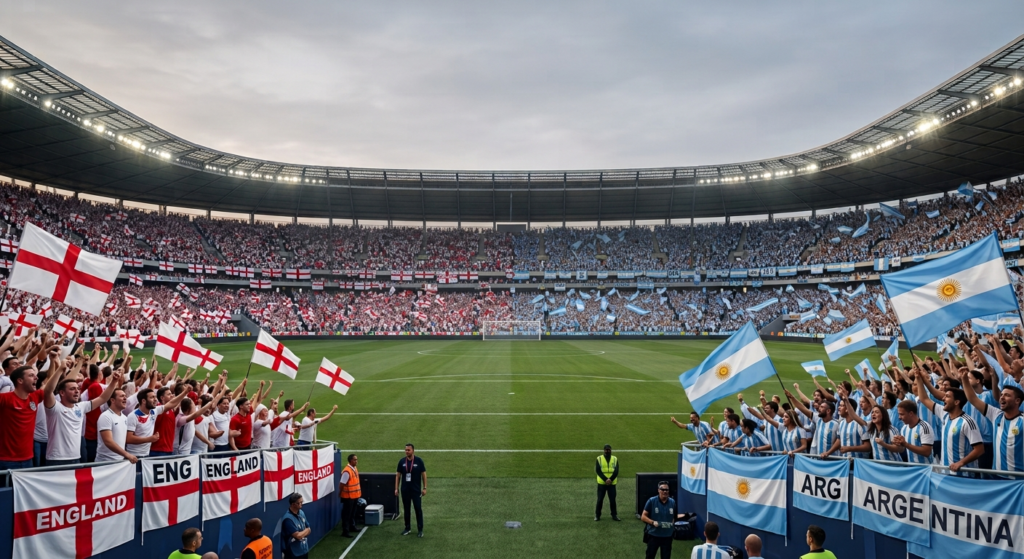
Some football rivalries are built on geography. Others are built on trophies. England vs Argentina was built on something altogether messier. Politics. Controversy. Genius. Heartbreak. Revenge. World Cup trauma. Sarongs and Posh Spice. Throw in a few red cards, a handball that still boils the blood and enough elite footballers to fill a Ballon d’Or shortlist, and you’ve got arguably international football’s greatest rivalry.
No fixture carries baggage quite like it. For England fans, the emotional rollercoaster really begins in Mexico 1986. Ah yes. Diego Maradona. Or, depending on your mood, football’s greatest genius…and football’s cheekiest burglar. All wrapped up in the same pocket sized package.
1986: Maradona, The Hand of God and England’s Greatest World Cup Robbery
First came the “Hand of God”, when Maradona quite literally punched the ball past Peter Shilton with enough subtlety to suggest he’d never heard of VAR. The officials, channelling their inner Arsene Wenger, somehow missed it, England were left fuming and generations of fans have spent the last forty years insisting Stevie Wonder would’ve given it.
As if that wasn’t painful enough, four minutes later Maradona collected the ball inside his own half, glided past half the England team as though they were traffic cones and scored what many still consider the greatest World Cup goal ever scored. Imagine being robbed by the same bloke who then paints the Mona Lisa in front of you. That’s 1986 in a nutshell.
1998: Michael Owen’s Wonder Goal and Beckham’s World Cup Nightmare
Then came France ’98. For about ten glorious seconds, Michael Owen produced one of the greatest goals England have ever scored at a World Cup. Seventeen touches? No. Just blistering pace, outrageous balance and enough composure to send the rock of Valencia, Roberto Ayala spinning before slotting past Carlos Roa.
It should have been remembered as the defining moment. Instead, England did what England seemed contractually obliged to do in major tournaments back then. Create unnecessary trauma. David Beckham’s petulant flick at Diego Simeone earned him a straight red. It was harsh, with Simeone producing the kind of dramatic collapse reserved for daytime soap operas, but the United midfielder had given the referee a decision to make and England were left to suffer the consequences. England somehow battled heroically with ten men for over an hour before, naturally, losing on penalties. Because of course we did.
By 2002, however, football finally decided England deserved a tiny slice of happiness. David Beckham, public enemy number one four years earlier, buried the winning penalty against Argentina in Sapporo. England defended magnificently, Sven-Göran Eriksson got his tactical approach spot on and Beckham completed one of football’s greatest redemption arcs. Finally. A World Cup win over Argentina. Job done. Except…it wasn’t.
2005: The Argentina Team That Made England Look Like They Were Playing Catch-Up
Because underneath the emotion, another reality was becoming increasingly obvious. Argentina simply produced footballers differently. I remember watching the friendly between the two nations in Geneva in 2005 from the comfort of my tiny living room. If I’m honest, I had one agenda. Lionel Messi. This teenage sensation everyone kept talking about was finally going to play against England and I couldn’t wait to see him. Except he didn’t. Suspended. Brilliant. Still, what Argentina brought instead wasn’t exactly a consolation prize.
Roberto Ayala marshalled the defence with effortless authority. Juan Román Riquelme drifted around the pitch conducting the game like an extremely chilled orchestra conductor who’d accidentally wandered onto a football pitch. Hernán Crespo’s movement was immaculate, while Carlos Tevez buzzed around making life miserable for England’s defenders.
The sophistication was staggering. Every pass had purpose. Every first touch created another angle. Every movement seemed choreographed. Watching it unfold, England didn’t look awful. They just looked….primitive. It honestly felt like Argentina had skipped several stages of football’s evolution while England were still enthusiastically inventing fire.
That wasn’t just one match. It reflected a much bigger problem.
Throughout the late 1990s and early 2000s, Argentina kept producing extraordinary technical footballers almost by default. England still had world class individuals – Beckham, Gerrard, Lampard, Rooney, Ferdinand, Terry, Owen, Gary Neville at a stretch…but the production line beneath them was beginning to dry up. As those players aged, the drop-off became increasingly obvious.
Then came the ultimate humiliation. Failure to qualify for Euro 2008.
For a nation with England’s resources, the Premier League, infrastructure and obsession with football, it was unforgivable. The warning signs could no longer be ignored. England weren’t consistently producing enough technically gifted, tactically intelligent players capable of dominating elite international football. The solution wasn’t another inspirational team talk. It was structural reform.
How the Elite Player Performance Plan Changed English Football Forever
In 2011, the Football Association and Premier League introduced the Elite Player Performance Plan (EPPP), completely redesigning how young players were identified, coached and developed. Greater investment. Better coaching. More contact hours. A stronger emphasis on technical ability and decision-making rather than simply producing the biggest, fastest teenager on the pitch.
The transformation took time, but today it’s impossible to ignore.
Jude Bellingham. Phil Foden. Bukayo Saka. Cole Palmer. Kobbie Mainoo. Adam Wharton. Trent. Ethan Nwaneri. Myles Lewis-Skelly. Over half of them aren’t even at the World Cup.
Players comfortable receiving the ball under pressure. Players capable of controlling matches rather than simply surviving them. Players who wouldn’t have looked remotely out of place alongside Riquelme and company back in 2005. That’s perhaps the biggest compliment you can pay England’s academy revolution.
The rivalry with Argentina will always be defined by 1986, scarred by 1998 and sweetened by 2002.
But perhaps its most important chapter happened away from the pitch.
Watching Ayala, Riquelme, Crespo and Tevez toy with England in 2005, followed by the embarrassment of missing Euro 2008, forced English football to ask some uncomfortable questions. The answers arrived with the Elite Player Performance Plan.
Fifteen years later, England no longer face Argentina hoping passion and commitment can bridge a technical gap. They face them believing they’re every bit as good. For decades, Argentina looked like they were playing 4D chess while England were still arguing over whose turn it was to roll the dice. These days?
They’re finally playing the same game.
Stay secure and flexible while following the World Cup 2026 with Surfshark VPN – protect your privacy and access streaming services safely.
Some links in this article may be affiliate links. If you click through and make a purchase, we may earn a commission at no extra cost to you.