
Fernandes’s reported commitment could ease Carrick’s selection problem against Chelsea, but neither a starting place nor a tactical recovery is confirmed.
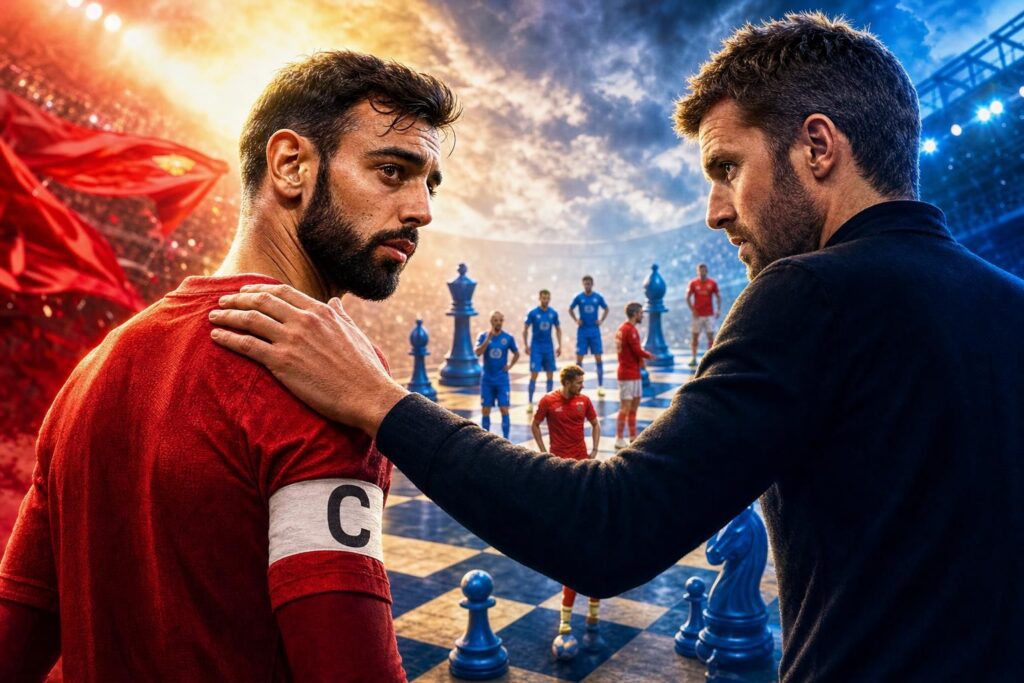
Bruno Fernandes could return against Chelsea after reportedly assuring Michael Carrick of his commitment to turning Manchester United’s season around. That would give Carrick another attacking option and spare us a further instalment of the captain-versus-coach debate. It would not, unfortunately, teach eleven players how to defend together.
According to the Guardian’s report on 28 October, Fernandes was expected to start against Chelsea after talks with Carrick before training on Tuesday. The newspaper says Carrick had dropped him against Bournemouth because of his public criticism following the defeat at Como.
Those are reported details, rather than a club-confirmed explanation of the omission or a confirmed Chelsea team. Still, the practical significance is clear: if Carrick can select his captain without their disagreement dominating everything, United have one fewer problem to carry onto the pitch. Given the current inventory, that qualifies as progress.
What Bruno actually questioned
Fernandes’s comment concerned a specific defensive choice. After the 4–1 defeat at Como, the Guardian quotes him saying: “It’s a decision from the staff to not press man-to-man”.
That matters because the distinction gets lost once a captain’s post-match interview enters football’s industrial-sized grievance machine. He questioned the choice not to press man-to-man. That does not establish that he rejected Carrick’s entire tactical approach, refused instructions or wanted a change of manager.
It was nevertheless a pointed thing to say publicly after a heavy defeat. Naming the staff’s decision directs attention towards the dugout, whether or not the player intended a wider confrontation. Carrick has a legitimate interest in keeping tactical disagreements from becoming the next opponent’s pre-match entertainment.
The football question deserves more attention than the etiquette, though. Man-to-man pressing gives players direct opponents to engage; other approaches can prioritise protecting spaces and blocking passing routes. Neither comes with a certificate guaranteeing competence. As our guide to how pressing works explains, the coordination matters: who goes, when they go and who covers behind them.
For us watching United, the useful test is whether the players act on the same instructions. One player charging forward while the next holds position can leave an opponent with precisely the gap the press was supposed to remove. Effort is welcome. Eleven separate interpretations of effort are rather less helpful.
Nothing in the reported talks confirms that Carrick has changed his approach or Fernandes has withdrawn his tactical view. They could agree to work together while still disagreeing about Como. Professional football ought to be able to accommodate that without requiring a commemorative handshake.
A return gives Carrick options, not a ready-made attack
The Guardian reports that Benjamin Sesko’s injury has left Carrick without another recognised senior centre-forward, with Fernandes and Bryan Mbeumo used as false nines. That makes the captain’s potential return a selection issue as well as a relationship story.
Bringing Fernandes back would allow Carrick to consider him either within that improvised forward arrangement or elsewhere in the attack. His next position has not been established. An expected start tells us who might play, not how United intend to make the team function.
There is a meaningful trade-off here. Use Fernandes as the highest attacker and someone else must provide the support and movement around him. Place him deeper and Carrick still needs an answer at the front. Restoring a name to the teamsheet does not fill every space that needs occupying.
United supporters know the temptation: put Bruno back in, then leave the complicated bits to Bruno. It is an excellent way to turn a team plan into one man’s increasingly urgent to-do list.
The Guardian also reports that Kobbie Mainoo returned to training on Wednesday after missing four games. That is potentially useful for Carrick’s midfield choices, but training does not establish match availability. Neither player should be treated as a complete solution before the Chelsea lineup is even confirmed.
Chelsea needs to show more than everyone getting along
The urgency comes from the results. Como’s 4–1 win was followed by a 3–0 home defeat by Bournemouth. At the Guardian’s 28 October reporting cut-off, United had two wins in 12 games and were 16th, one point above the relegation zone.
The newspaper reports a separate squad meeting at which players expressed support. That is preferable to open hostility, obviously. But nobody has ever climbed the table on minutes from a meeting, however encouraging the action points.
Against Chelsea, the evidence to look for is collective: whether United press together, offer the player on the ball usable passing options and retain enough cover when attacks break down. Fernandes playing would be a selection development. Those behaviours would tell us more about a possible recovery.
The Guardian identifies Roma and Aston Villa as the following fixtures. They provide further opportunities to assess a response, not a confirmed three-match ultimatum. As we explored in our piece on Carrick staying for Chelsea, taking charge of the next match leaves bigger questions unresolved.
The reported conversation is therefore welcome, within sensible limits. Carrick needs a captain he can use; Fernandes needs a role within a functioning side. Supporters would quite like to discuss an actual performance rather than conduct another forensic examination of who still believes in whom. Chelsea offers the first chance to change that conversation.