
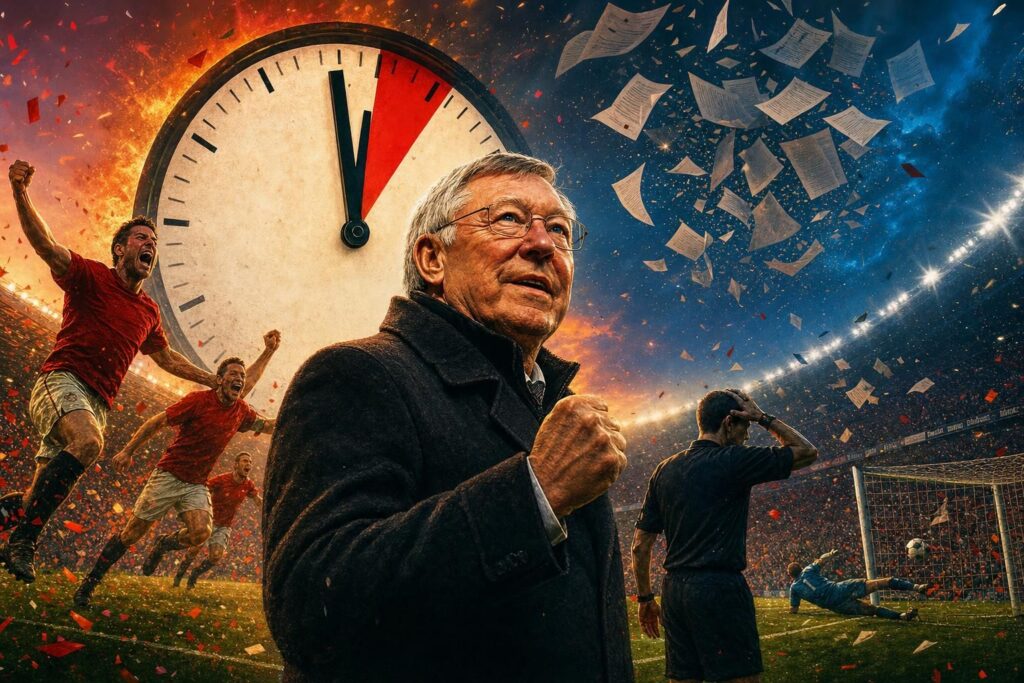
Fergie Time captures real late drama, but research covering 2009–2013 does not establish systematic favourable stoppage time for Manchester United.
The most convenient thing about Fergie Time is that everyone gets to win the argument. We get the late goal. Rival supporters get to explain that it was constitutionally impossible for Manchester United to lose while Alex Ferguson remained within pointing distance of a watch.
As a United supporter, I can appreciate the arrangement. As an explanation of refereeing, it needs rather more work.
“Fergie Time” carries two meanings: United’s knack for scoring late under Ferguson, and the allegation that officials awarded unusually generous stoppage time to help us do it. Those claims have spent years sharing a coat, which makes it remarkably easy to produce evidence for one and pretend you have proved the other.
The short verdict: the late drama was real; systematic preferential timekeeping is not established by the research discussed here. The strongest directly relevant study covers Premier League matches from 2009 to 2013, finds no evidence of home favouritism and only limited evidence of bias towards big clubs. That matters. So does the four-year window.
What Fergie Time actually meant
The Premier League’s own historical treatment places the phrase within the story of Ferguson’s United and their late goals. Steve Bruce’s famous late winner in 1993 is an early landmark in that history. The legend has roots earlier than the period eventually examined by the academic research.
There is no need to nominate a precisely documented first utterance to understand how the expression works. For us, it became shorthand for possibility: the match might be running out, but the result had not yet settled. For opponents, it could mean the horrible suspicion that surviving 90 minutes was merely the entrance examination.
That emotional difference explains much of the phrase’s durability. A late winner gives one set of supporters a memory worth polishing for decades and the other an immediate interest in clock calibration.
Our account of United’s 1999 treble explores the drama of that wider history. But a collection of glorious escapes, however enjoyable, cannot audit a referee’s timekeeping. The highlights tell you what happened with the available time. They do not establish whether that time was fairly awarded.
Added time is not a private extension
First, the terminology. Stoppage time, also called added or injury time, compensates for time lost during a half. Extra time is a separate period used in knockout football when the competition requires it. A Premier League match continuing beyond 90 minutes has entered stoppage time, not an additional knockout period hastily commissioned for Ferguson.
The official’s job is to allow for stoppages. The accusation of favouritism concerns whether that allowance was distorted to benefit a team. Those are separate questions, even when the television clock makes the whole business look suspiciously untidy.
Suppose United score after the 90th minute. That establishes the timing of the goal. To establish an improper advantage, we would also need evidence that the time allowed was unjustified or that United were treated differently from comparable teams in comparable circumstances.
More stoppage time can be legitimate if more time has been lost. Equally, the fact that officials have discretion does not make every decision beyond criticism. We should resist both the rival’s automatic conviction and the United supporter’s tempting defence that anyone questioning our winner simply hates joy.
The important distinction is between creating an opportunity and exploiting one. Even if extra seconds are awarded, somebody still has to score. Conversely, scoring does not retrospectively make those seconds an offence. The ball going in cannot rewrite the preceding stoppages.
What the Butler and Butler study found
Robbie Butler and David Butler’s 2017 paper, Fergie Time and the Allocation of Additional Time: Evidence from the English Premier League 2009 to 2013, examines the allocation of additional time rather than simply counting memorable goals.
Its reported conclusions are no evidence of home favouritism and limited evidence of bias towards “big” clubs. The relevant comparisons therefore concern home advantage and club size across Premier League matches, rather than United’s late winners considered in isolation.
Neither result should be casually translated into something else. A home-team effect would concern home sides generally. A big-club effect would concern a category of clubs. Neither automatically establishes a United-specific benefit, still less a personal service operated for Ferguson.
For those of us who have endured the accusation whenever a late goal comes up, this is useful evidence against the sweeping version of the story. It is not permission to announce that academia has reviewed every disputed second of our history and issued a commemorative certificate.
The dates impose a substantial limit. A study of 2009–2013 cannot settle every argument about the 1990s, nor can Premier League findings automatically answer questions about European or domestic cup matches. Bruce’s 1993 landmark and the study’s dataset belong to different periods. Joining them with a confident sentence would not close that gap.
There is another limit in the wording: “limited evidence” of big-club bias cannot honestly become “no evidence of any bias whatsoever”. Equally, it cannot bear the weight of a claim that United systematically received whatever time they needed.
A legend is allowed to be better than its prosecution case
The Economics of Sport discussion points towards the underlying difficulty: time-wasting, match circumstances and discretionary decisions complicate comparisons. An average alone cannot explain why time differed. A persuasive test must distinguish legitimate variation from preferential treatment.
That leaves room for further research without requiring us to treat every aggrieved recollection as counter-evidence. Supporter memory is excellent at preserving an injustice and rather less diligent about retaining the uneventful matches needed for a comparison group. Ours too. Especially ours when the winning goal is involved.
It also means the findings should be read at their proper scale. They test a defined Premier League period and specific comparisons; they do not reconstruct every referee’s decision, or prove that every allowance in that window was correct. The evidence pushes back against a broad allegation, but it cannot settle each individual match. Football arguments, inconveniently, remain capable of surviving a paper.
I would rather defend what United actually did than claim certainty the evidence cannot provide. The late goals deserve their place in our history. Their emotional force does not depend on proving that every referee was immaculate, and rival frustration does not establish that the clock was bent.
So was Fergie Time real? As a name for Ferguson-era late drama, absolutely. As a proven system of unusually favourable stoppage time for United, the available research does not establish it. Enjoy the winner. If you want to prosecute the timekeeping, bring something stronger than the replay.