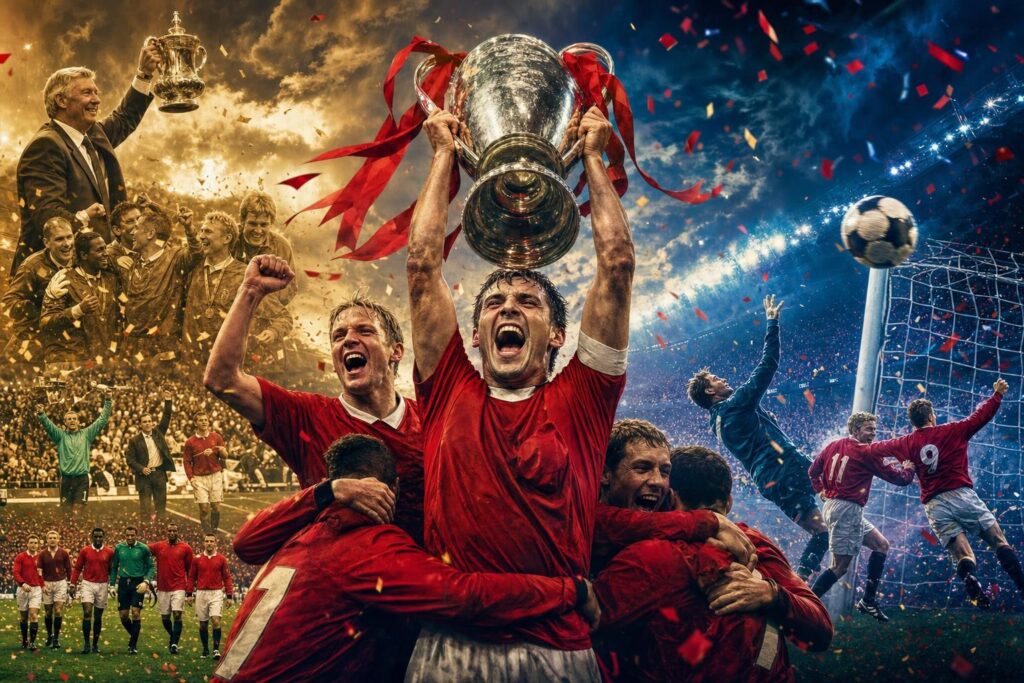
United clinched the league, beat Newcastle in the FA Cup final, then overturned Bayern’s lead with two stoppage-time goals to complete the Treble.
Manchester United’s 1999 Treble is often remembered as one long injury-time celebration. That skips the demanding business of winning the league and FA Cup first, and gives the Champions League final an air of inevitability that Bayern Munich’s lead at the Camp Nou would have made hard to swallow.
United won the Premier League on 16 May, the FA Cup on 22 May and the Champions League on 26 May. Three trophies in ten days sounds wonderfully tidy in retrospect. In reality, the league title was decided on the final day, and the European Cup was still in danger as the final entered stoppage time. The achievement was historic; it was never guaranteed.
The league went to the final day
United clinched the Premier League title on 16 May 1999 with a 2–1 home win over Tottenham Hotspur. Teddy Sheringham and Ole Gunnar Solskjær scored at Old Trafford, settling the league before the remaining two finals. The first part of the Treble was not a ceremonial opening act. It was a title decided by the last league match.
That matters because the neat version of the story can make the season sound like a procession: win one trophy, then collect the next two. The final-day title win instead shows how the competitions converged. United had to finish their league campaign before they could turn fully to the FA Cup final and the European final. There was no spare trophy tucked away while the team dealt with everything else.
The Premier League’s season overview captures the compressed finish. The title win began a ten-day run that also included Wembley and Barcelona. Looking back, the sequence is satisfying. At the time, each result still had to be earned.
Wembley did the job without the drama
Six days later, on 22 May, United beat Newcastle United 2–0 in the FA Cup final at Wembley. That made them domestic double winners and left the Champions League final as the last step towards the Treble. The logic is simple, if the sort of simple that is easy to overlook: without the win over Newcastle, even a victory in Barcelona could not have delivered all three trophies.
The FA Cup final gets less attention than the European final because it did not end with two stoppage-time goals. That is an odd penalty for winning a final by two goals. A clear result in the middle of a demanding ten-day stretch mattered precisely because it avoided turning every part of the campaign into a last-gasp rescue. United did not need a miracle at Wembley. They needed to win, and they did.
It also complicates the familiar idea that the Treble was simply a string of escapes. The Bayern final supplied the most dramatic near-miss, but the season also required a league title on the final day and a win in the FA Cup final. The trophies were connected, not interchangeable: each result kept the overall achievement possible.
Barcelona was the moment it nearly vanished
The Champions League final against Bayern Munich took place at the Camp Nou on 26 May. Bayern led 1–0 as the match reached stoppage time. United were one goal away from keeping the final alive, and two away from winning it. Teddy Sheringham equalised; Ole Gunnar Solskjær then scored the winner, completing a 2–1 comeback and the Treble.
The UEFA match record confirms the result and the decisive late goals. For United supporters, the final can make Bayern’s lead seem like a brief inconvenience on the way to a famous ending. It was not. Had the score stayed 1–0, United would have finished with the league and FA Cup, but without the European Cup.
Sheringham and Solskjær were substitutes, and their goals are the most visible evidence of the options Ferguson could call upon. That is a meaningful part of the explanation, but it is not a magic trick. Having attacking players available created possibilities; the players still had to take them. The comeback was both a product of United’s resources and a dramatic reversal that could easily have failed to arrive.
Calling the finish destiny makes for a good celebration and a poor explanation. Bayern were ahead, United were behind, and the result changed through two goals in stoppage time. The drama was not a decorative flourish added to an already-secured trophy. It was the difference between completing the Treble and falling short of it.
Why the three results belong together
The season’s final ten days show how the campaigns depended on one another. Tottenham’s defeat put the league title in United’s hands. The win over Newcastle completed the domestic double. Only then did the Champions League final decide whether the season would be a Treble or a two-trophy campaign. Each match changed what the next one could mean.
That chain is more convincing than treating Barcelona as the whole story. A famous ending can swallow everything that came before it, especially when two substitutes score late. But the final could only complete an achievement that remained alive after the league and FA Cup had been won. Wembley is not a footnote to the Camp Nou; it is one of the reasons the Camp Nou mattered.
The evidence here points most clearly to the sequence of results and the options that mattered in the final. It does not require a grand claim that one tactical masterplan explains every competition. United won the league on the final day, beat Newcastle in the FA Cup final, then overturned Bayern’s lead through Sheringham and Solskjær. That is already a substantial account of how the trophies came together.
United became the first English club to win the top-flight league title, FA Cup and European Cup in the same season. The feat is worth celebrating without pretending the outcome was written in advance. The league went to the final day; the FA Cup required a win at Wembley; and the biggest prize was still slipping away in Barcelona. United made history because they finished all three jobs, not because any of them was guaranteed.