
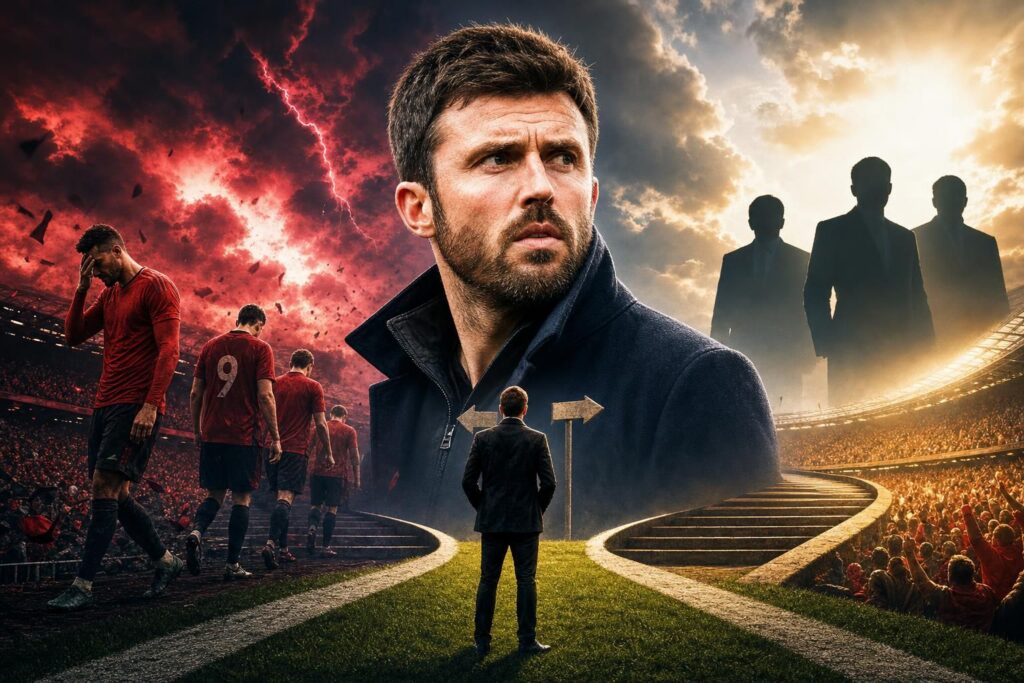
United’s results put Carrick under severe pressure, but reported successor contacts establish neither his dismissal nor a replacement appointment.
Michael Carrick’s Manchester United future remained unresolved in the Guardian’s Monday evening account, with executives discussing whether to sack him after Bournemouth’s 3–0 win at Old Trafford. United’s position after that defeat, according to the paper: 16th, one point above the relegation zone and two league wins all season. Even through red-tinted glasses, that is an appalling view.
In Jamie Jackson’s report of 26 October, director of football Jason Wilcox and chief executive Omar Berrada were deliberating over Carrick’s position. No dismissal, fresh backing or replacement appointment was established.
That leaves two questions which are easily bundled together when supporters are furiously refreshing their phones: should Carrick continue, and can United secure someone better equipped to arrest this decline? Answering the first does not automatically solve the second.
The table matters more than the Carrington entrance
The Guardian reports that United had gone eight matches without a win. Bournemouth’s victory on Sunday 25 October also followed a reported 4–1 Champions League defeat at Como in the preceding week.
That combination makes this considerably harder to explain away as one rotten afternoon. A heavy home defeat is damaging enough. When it sits inside a sustained winless run, with the relegation places a point away, the argument for patience needs something more substantial than an appeal to patience.
For those of us who admired Carrick as a player, there is an unpleasant emotional snag here. We remember how calmly he could improve a match without appearing to hurry. Unfortunately, the managerial job is assessed on the team he sends out now, not the midfield we would quite like to borrow from the past.
The league position does not establish that United will be relegated. It does establish how little protection their results had bought them at this point. Supporters should not need to calculate the distance from 18th before Halloween, but the badge does not add points to the table.
Against that backdrop, Carrick’s attendance at Carrington is a detail rather than a verdict. Jackson reports that he went there on Monday afternoon to watch an under-21s match. Being at the training ground proves he was at the training ground. We have reached an exhausting stage of United fandom when an academy fixture is expected to double as an employment tribunal.
There is contract context, too. United’s earlier announcement that Carrick would continue as head coach gave him a deal to 2028. That predates this crisis. It cannot be repackaged as a vote of confidence issued after Bournemouth.
A preferred successor is still not a successor
The Guardian reports that Eddie Howe is Wilcox’s preferred replacement, that contact has been made and that Howe is open to the role, subject to negotiations. Those are significant reported developments. None amounts to Howe accepting the job.
There is a substantial distance between identifying a preferred candidate and having someone ready to take training. Interest, negotiations and an appointment are separate stages, however quickly a supporters’ group chat can produce a proposed starting XI.
The paper also discusses Unai Emery, Julian Nagelsmann and Antonio Conte as possible options. Its estimate that Aston Villa would demand around £20m for Emery is a reported compensation figure, not an agreed fee. A list of recognisable managers gives United possibilities; it does not give them a completed succession plan.
The useful test for the executives is therefore tougher than whether another name sounds reassuring. They need to judge whether Carrick can recover results, then assess whether a realistic alternative offers a credible improvement. A new manager’s reputation cannot, by itself, explain how this team starts winning.
Our guide to who makes decisions at Manchester United provides the wider organisational context. In this case, the Guardian’s reporting places Wilcox and Berrada at the centre of the deliberations. Their judgement deserves scrutiny alongside Carrick’s coaching. The responsibility upstairs cannot end with choosing whose name goes on the next announcement.
Fernandes’s omission deserves scrutiny, not Instagram forensics
Carrick said dropping Bruno Fernandes against Bournemouth was for “pure football reasons”, according to the Guardian. After a 3–0 home defeat, that is plainly a selection decision he has to defend.
But assessing a selection is different from inventing a disciplinary explanation. As our coverage of Carrick’s comments about Fernandes explains, uncertainty around a player’s selection should not be promoted into a confirmed punishment.
The Guardian also reports that Fernandes subsequently liked an Instagram post about loyalty. It does not establish why. A thumb on a screen is doing an extraordinary amount of unpaid investigative work if we ask it to prove a dressing-room split.
There is already enough football evidence to demand serious answers: the results, the winless run and the league position. None needs embellishing with an imagined private feud.
The position established by the Guardian’s Monday evening report is stark enough. Carrick’s job was under discussion, the case for continuing was under severe strain, and reported alternatives remained unappointed. United need a defensible decision and a workable plan. Supporters have every reason to demand both, rather than treating the next managerial name as the plan itself.