United’s structural failures in defence and recruitment go beyond Carrick’s managerial problems. INEOS accountability required.
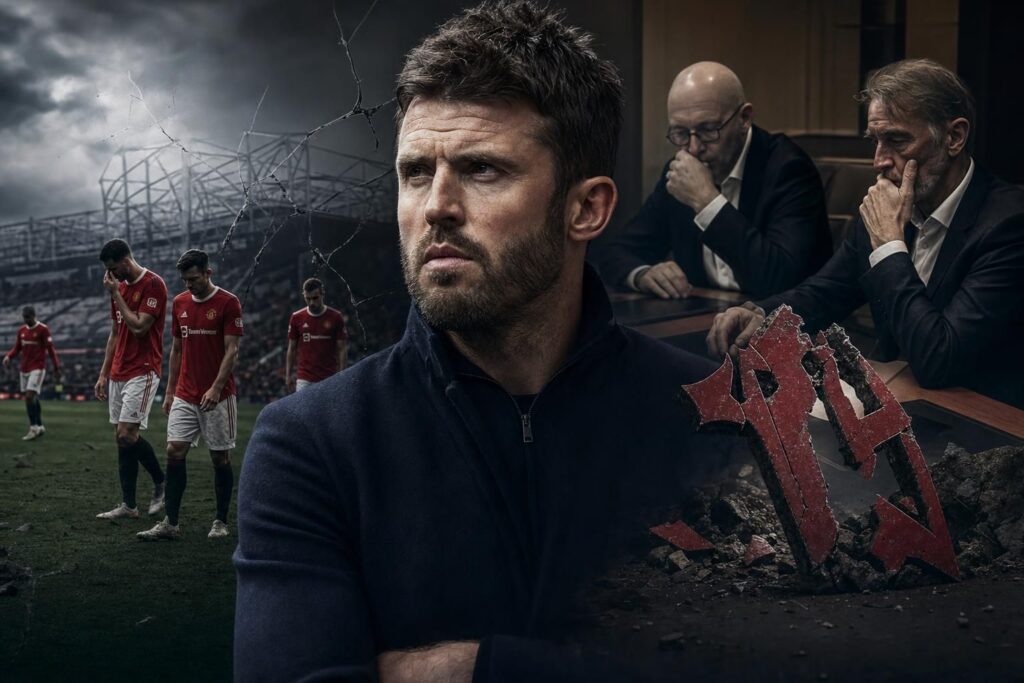
Michael Carrick is taking fire for Manchester United’s collapse, and rightly so. His eight changes against Brighton looked chaotic, his in-game management contributed to conceding three goals from a 2-0 lead (the first time Old Trafford has blown such a lead in 50 years), and his squad looked unfit enough to concern even Jamie Redknapp. Carrick deserves scrutiny.
But focusing exclusively on the manager misses the actual problem. Manchester United’s crisis is structural, and it predates Carrick’s six-game implosion. The real failures sit in recruitment strategy, squad construction, and INEOS decision-making, the kind of failures that no manager inherits without consequence.
A squad built backwards
Start with the arithmetic of incompetence. This summer, INEOS spent approximately £150 million on three midfielders: Baleba (£65-80m), Santos (€56-58m), and Tielemans (£35m). Meanwhile, the defence was left to fend for itself.
The numbers tell the story. They reflect a strategic choice. INEOS, operating under Jason Wilcox’s executive-led recruitment model, prioritised midfield security and attacking depth the previous summer, while leaving the back four underfunded and, crucially, inexperienced.
The Brighton match exposed exactly what that imbalance looks like. Yoro and Heaven, both teenagers playing their way into learning, faced a team that understood how to exploit young defenders. Vuskovic bullied Yoro for the second goal. Yoro’s positioning error gifted the third. Neither error was unpredictable; it was inevitable. You do not pair two 19-year-olds in a cup tie against a side hunting a comeback and expect them to hold firm, even if one of them cost £52m. Incredible really. That is not a tactical choice. That is a squad-construction failure.
Intensity problems that recruitment cannot solve
Here’s where Carrick’s accountability matters, because the intensity data suggests something beyond squad depth. United rank 18th in the Premier League for sprints and 19th for high-speed runs. More tellingly, when normalised for distance covered, they rank 18th for sprints per kilometre and 19th for high-speed runs per kilometre. In other words, United are not merely running less, they are moving without intensity even when they run.
That is partly coaching. It is partly squad capability and fitness profile. It is difficult to disentangle completely, but a manager who cannot impose physical intensity on his players bears responsibility for half of it. Carrick must answer for that.
What Carrick cannot answer for is inheriting a squad that lost shots on target for 50 minutes after going 2-0 up. That suggests either tactical paralysis, squad morale collapse, or a combination of both, all of which trace back to conditions the manager did not create.
The INEOS accountability question
INEOS shifted Manchester United away from a manager-led recruitment model towards executive-led decision-making. Wilcox holds “final say” on transfers. The theory: clarity, coherent strategy, reduced risk of managerial overreach distorting the plan.
The practice, at least in summer 2026, looks like a defensive department that was knowingly left short. Nobody at INEOS can claim surprise that a centre-back pairing of Yoro and Heaven creates fragility in September. That weakness was acknowledged before the window closed. The choice to prioritise three midfielders over defensive reinforcement was deliberate.
Whether that trade-off was strategically justified remains an open question. Did INEOS identify superior midfield targets and none as compelling for centre-back, or left back? Or did the executive structure simply prioritise depth in one area while accepting risk in another? Wilcox and INEOS owe supporters an explanation for that logic, particularly now that it is failing.
The managerial squeeze
This is where Carrick’s inheritance becomes significant. He arrived as interim manager with a squad already displaying the contradictions: talented young defenders alongside experienced but injury-prone alternatives, midfield depth that might become redundant if all three remain fit, and a training intensity that the data suggests requires serious recalibration.
His interim spell produced 11 wins from 16 league matches, a 68.75% win rate. This season, United have won just two of Carrick’s first six matches in all competitions, a 33.3% win rate.. That regression could mean several things: the permanent appointment changed his tactical approach, squad confidence collapsed the moment certainty arrived, or the team reverted to mean after an unsustainably successful run. The answer matters, because it affects whether the current crisis reflects Carrick’s stewardship or the squad’s true level.
Eight changes against Brighton suggested either tactical flexibility or panic rotation, quite possibly both. Comparing his approach directly against Brighton’s (six changes) invites the argument that Carrick overthought it. Equally, it might suggest that his squad depth is so uneven that rotation disrupts coherence more than it maintains freshness.
What happens now
The immediate pressure on Carrick is justified. His in-game management requires improvement, and his squad’s intensity cannot remain 18th and 19th in any meaningful metric. Those are managerial accountability issues.
The larger question sits with INEOS. Does the executive structure recognise that defensive recruitment was inadequate? Will Wilcox’s model adjust, or will it double down on the current strategy? January transfer activity will provide the answer. If INEOS remains committed to the midfield-first approach, Carrick is managing a squad architecture he did not design and potentially cannot overcome.
For now, Carrick must improve intensity, sharpen in-game decision-making, and find a defensive setup that does not rely on two teenagers absorbing pressure. Those are within his control. INEOS must answer for a recruitment strategy that left the defence underfunded while spending £150m on midfielders, half of whom may not even start regularly. That remains their failure, regardless of what happens next.