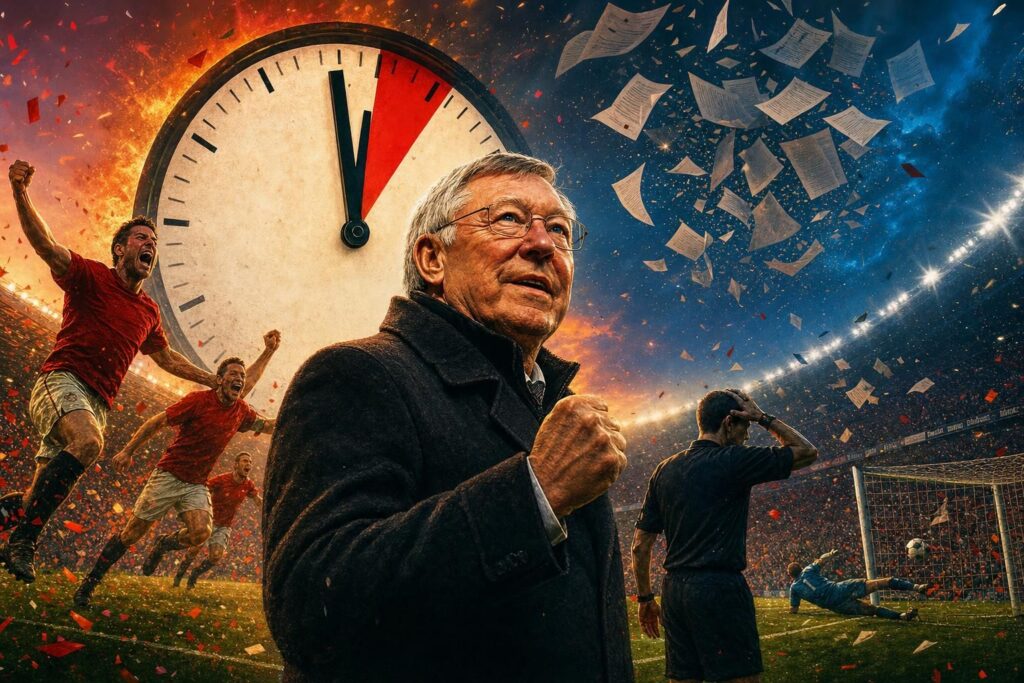

Chelsea led before Martínez’s dismissal, making United’s red card only part of a defeat that increases scrutiny of Carrick without confirming managerial action.
Chelsea beat Manchester United 2–0 at Stamford Bridge, leaving Michael Carrick facing further scrutiny and United with an explanation that only stretches so far: they were already behind before Lisandro Martínez was sent off.
The dismissal made a recovery harder. It did not put Chelsea ahead. Football’s post-match arguments have a habit of allowing the most dramatic incident to swallow everything that preceded it, particularly when a struggling manager could use somewhere to shelter.
According to Sky Sports’ match report, Morgan Rogers scored Chelsea’s opener before Martínez’s dismissal, with Cole Palmer also scoring from the penalty spot. Chelsea finished with the win and a clean sheet; United finished goalless and a player down. Carrick gets the questions.
Chelsea had the lead before United lost a man
The fairest assessment separates the match into two distinct problems for United. First, they conceded with the sides still level in numbers. Then, having fallen behind, they lost Martínez and had to pursue a response with ten men.
Those situations require different judgements. Chelsea’s opening goal belongs to the contest before the numerical advantage. United’s subsequent difficulty has to be considered in light of the dismissal. Neither fact cancels the other.
Being reduced to ten changes the practical demands of chasing a game. A side needs to find attacking support without leaving itself exposed, while fewer players must cover the spaces left behind. That is a genuine handicap, not an excuse invented in the interview area.
But it cannot travel backwards through the match and defend the opening goal. Carrick deserves allowance for the more difficult task after the sending-off, not an exemption from examining what happened before it.
Equally, conceding first does not establish that United would inevitably have lost with eleven. The dismissal removed that version of the contest. Anyone confidently supplying its final score is reporting from an imaginary Stamford Bridge.
Chelsea deserve more than a supporting role
There is a familiar indignity awaiting any team that beats Manchester United: winning the match, then discovering the entire discussion concerns the occupants of the other dugout. Chelsea did not spend their afternoon merely providing scenery for Carrick’s employment debate.
Rogers’ opener gave them the advantage before the dismissal. Palmer’s penalty also counted towards a two-goal winning margin. They took three points without conceding. Those are meaningful achievements even without attaching a grand declaration about where their season is heading.
The numerical advantage qualifies an assessment of the victory; it does not make the victory disappear. Chelsea still had a result to secure. United’s failure to score meant there was no equaliser to puncture it.
For Chelsea supporters, there is uncomplicated satisfaction available here: a home win over United, two goals and no concession. They are entitled to enjoy that without first submitting a written assessment of Carrick’s future.
The sensible limit is equally important. This scoreline alone cannot establish complete tactical superiority or prove that every Chelsea problem has been solved. A good result deserves appreciation without immediately being promoted into a manifesto.
More scrutiny for Carrick, no confirmed decision
BBC Sport describes Carrick as “under-fire” and frames the defeat as increasing the pressure on him. That is an editorial assessment of his position, not evidence that United have decided to change their manager.
The distinction can feel almost quaint in football, where “pressure” is routinely treated as an official stage in a dismissal procedure. There is no league table for it, however enthusiastically the debate awards points.
What Carrick faces is a result that offers little reassurance. United lost, failed to score and were trailing before the red card complicated their response. That is enough to sustain uncomfortable questions without inventing a boardroom verdict.
For the institutional context, our guide to who makes decisions at Manchester United examines the club’s structure. Public criticism alone does not tell us what those decision-makers will do.
The football verdict is firmer. Chelsea earned their lead against eleven and finished the job against ten. United’s dismissal belongs in the explanation of the defeat. Giving it the whole explanation would let too much else off the hook.