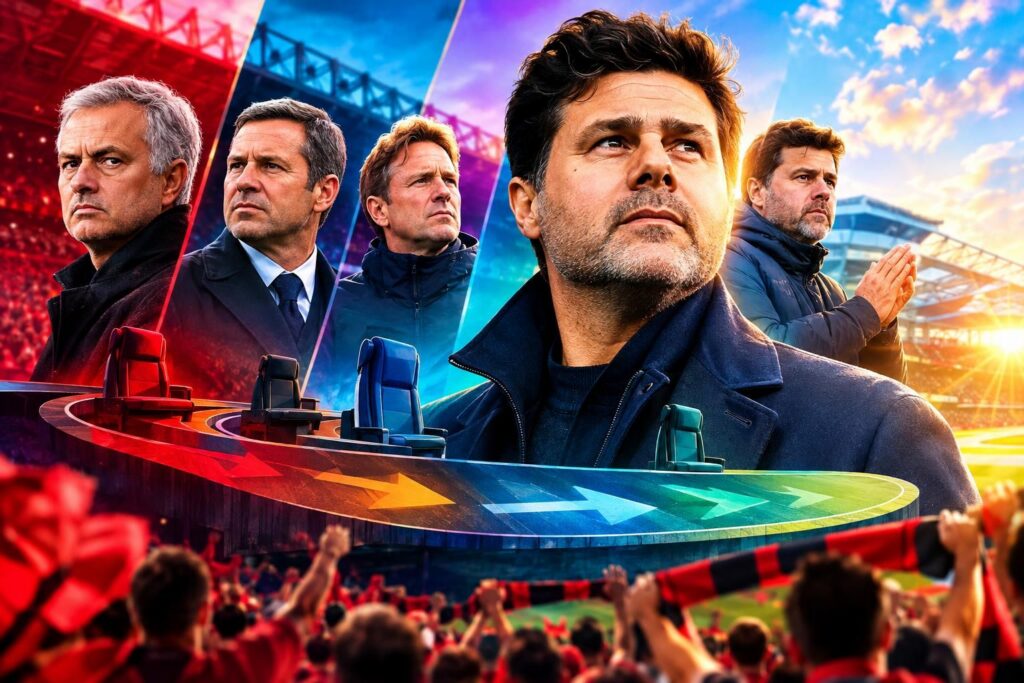
Mourinho’s reset delivered most, but no post-Ferguson project built a lasting answer; Pochettino’s has only just begun.
Being a Manchester United supporter since 2013 is like buying a new kettle every time the electricity goes off. The packaging promises a better morning; the kitchen remains dark. I have admired the packaging, too. Give me one convincing appointment announcement and I am mentally arranging the open-top bus parade before the new manager has found the training ground.
So let us rate the resets, not simply the men. As of 24 November 2026, this covers permanent appointments from David Moyes to Michael Carrick. Ralf Rangnick and other caretakers were handovers, not equivalent long-term projects; Mauricio Pochettino has only just started and cannot fairly be scored. My marks out of ten weigh results, the fit between the playing idea and the squad, and what survived the coach’s departure. They are supporter judgements, not measurements taken with an expensive clipboard. For a straight ranking of the managers themselves, we have done that elsewhere.
The succession we mistook for a plan
David Moyes, 2013–14: 2/10
Moyes inherited the league champions. That sounds like receiving the keys to a Ferrari, until you remember the owner also took the mechanic, the map and the peculiar ability to make every passenger believe they would get there on time. Ferguson’s retirement was always going to hurt. It did not require United to fall to seventh by the time Moyes left in April 2014, without a cup to soften the landing.
The promise was continuity: the successful manager’s chosen successor, given room to grow. What the season established instead was that appointing a successor is not the same as building a succession. I have sympathy for the scale of the inheritance. I cannot award marks for how frightening the exam paper looked.
Louis van Gaal, 2014–16: 5/10
Van Gaal offered the opposite comfort: an unmistakable playing idea and the air of a man who would correct your positioning in the queue for a pasty. Fourth place restored Champions League qualification in his first season. Fifth followed in his second, though United won the FA Cup in his final match. Two days later, he was gone. Even our trophy presentations could apparently double as exit interviews.
That cup matters, and so does having a recognisable method after the Moyes year. But an idea is only a reset if the club can live with where it leads. Van Gaal made us more deliberate on the ball; he did not leave a direction United chose to keep. Watching us search for a goal could feel like watching somebody try every password except the correct one.
The trophies, the affection and the bill afterwards
José Mourinho, 2016–18: 7/10
Mourinho’s case is the one that should interrupt a comfortable rant. The League Cup and Europa League arrived in his first season; second place in the Premier League followed in 2017/18. Those are achievements, not consolation stickers. If the point of a reset is to make United competitive again, his came closer than most, even if admitting it makes my teeth itch.
The cost was that the winning formula did not become a lasting one. His pragmatic football could get results without answering what United should look like once its chief organiser left. We had silverware in the cabinet and no convincing instructions for the next shift. That is still better than a beautiful set of instructions and an empty cabinet, which is why he tops these marks.
Ole Gunnar Solskjær, 2019–21: 6/10
Ole arrived as caretaker in December 2018, then became permanent manager in March 2019. For a while, the place felt like United again. Third place in 2019/20 and second in 2020/21 were genuine progress; the counterattacking threat gave us nights when hope did not feel like a medical condition. He left in November 2021 without a major trophy.
Here is the awkward distinction: reviving the mood was an achievement, but a mood cannot tell you how to break down a stubborn defence or carry a team through every sort of match. His reset made supporting us fun again before it proved it could make us consistently formidable. I would not swap those good nights for a tidy diagram. I also cannot put them in the trophy cabinet.
Erik ten Hag, 2022–24: 6/10
After Rangnick’s interim spell, Ten Hag brought the appeal of a modern playing identity. His first season delivered third place and the League Cup. His second brought eighth, United’s lowest Premier League finish at that point, and an FA Cup final victory over Manchester City. Only this club could make a derby cup triumph feel like both a glorious answer and an increasingly urgent follow-up question.
Two trophies demand credit; the league decline demands more than a shrug. The reset’s best moments suggested authority and direction, but its results stopped supporting a stable build. United parted with him in October 2024. Our changing tactics since Ferguson tell part of that story: recognising a manager’s intended football is not the same as seeing a squad perform it reliably.
The revolving door discovers another gear
Rúben Amorim, 2024–26: 3/10
Amorim’s arrival offered a distinct new direction. I can understand the attraction: when every previous recipe has disappointed, a different formation starts to look like a secret ingredient. Yet a strong playing idea only helps if the players and the club can make it work. His tenure ended in January 2026, leaving another abandoned attempt to change what United are, rather than a settled answer.
That is a verdict on the project, not a claim that Amorim alone chose every ingredient in the cupboard. United appointed a head coach with a clear approach and did not turn that approach into something durable. The distinction matters whenever we pretend a new face at the press conference can reorganise the entire building before the biscuits arrive.
Michael Carrick, 2026: 4/10
Carrick became permanent head coach on a contract running to 2028, but United have already moved to Pochettino. That makes his reset assessable in one narrow, rather damning respect: it did not last. A permanent appointment ending before its contracted horizon tells us something about the club’s capacity to stick with a direction. It does not, by itself, tell us Carrick was incapable of delivering one.
We should resist stuffing his short spell with imagined explanations. He was neither merely a caretaker nor given the time the word “permanent” invited supporters to expect. At United, that word now has roughly the reassuring force of a railway announcement saying the service is only slightly delayed.
Mauricio Pochettino, from November 2026: not yet rated
United announced that Pochettino had started work on 18 November. Six days is enough time for us to approve the training photographs and argue about the first team sheet, not to judge a reset. His test will be whether the playing idea, recruitment and results reinforce one another long enough to matter. Until then, hope is permitted; a score is not.
The verdict: Mourinho’s reset achieved the most, Ole’s restored the most joy, and Van Gaal’s at least knew what it wanted the team to do. None left United with a solution the next appointment could simply carry forward. The circumstances differed, and decisions at United involve more than the head coach. That is precisely why hiring another one cannot, on its own, constitute a fresh start. I will still talk myself into Pochettino by the weekend. I just hope this time someone checks the fuse box before selling us the kettle.