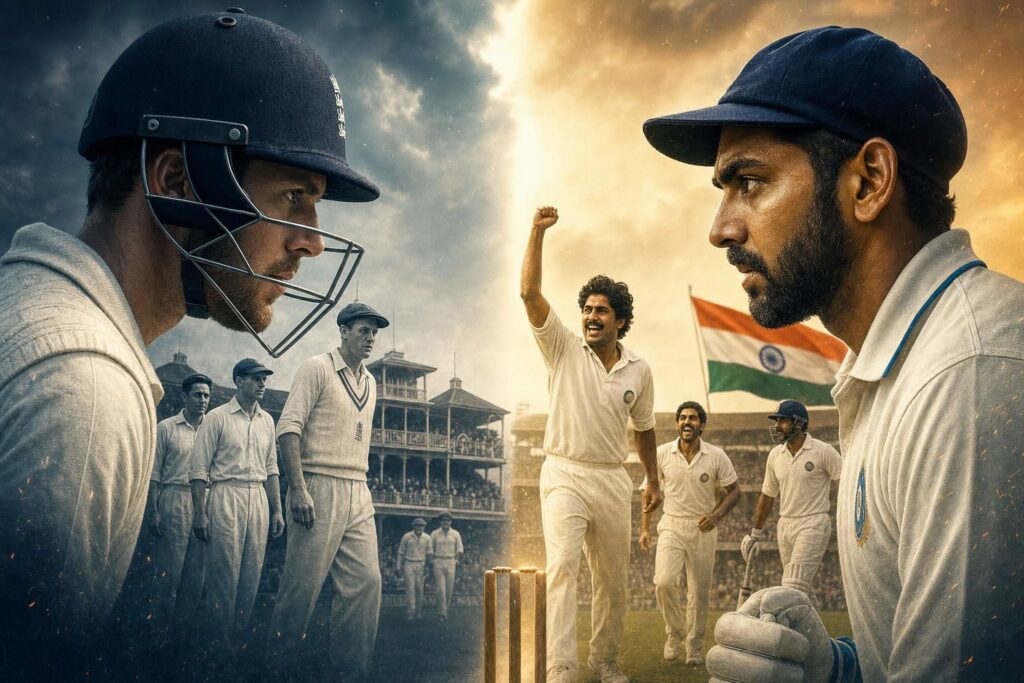
England dominated early, but India’s 1952 breakthrough and 1971 series win transformed a one-sided contest into a modern Test heavyweight rivalry.
England versus India is one of Test cricket’s longest-running rivalries, although it did not begin as a balanced contest. When India arrived at Lord’s in 1932 for its first Test, England represented the established power and India was still taking its first serious steps into international cricket. Nearly a century later, the fixture has become a major sporting and commercial event, shaped by changing teams, changing audiences and the stubborn demands of playing Test cricket away from home.
The story is not simply one of England declining and India rising. It is a history of India learning how to compete in English conditions, England repeatedly discovering that home advantage is helpful rather than magical, and both countries turning a bilateral series into one of cricket’s biggest shared stages.
1932: India enters Test cricket at Lord’s
The formal beginning came at Lord’s between 25 and 28 June 1932. England won the Only Test, but the result mattered less historically than the appearance itself. India had entered Test cricket, and England became the opponent against which much of its early progress would be measured.
That first match established the basic shape of the rivalry. England possessed the deeper Test tradition and greater familiarity with its own conditions, while India was building the structures, experience and confidence required to compete internationally. The early decades therefore carried a clear imbalance, with England holding the stronger record in the head-to-head contest.
1952: India discovers the feeling of winning
India’s first Test victory came in February 1952 in the Fifth Test at Madras, now Chennai. It was a landmark result because it gave India its first win in Test cricket and demonstrated that the team could overcome England in a long-form contest rather than merely make the occasional nuisance of itself.
The significance of the match extended beyond the scorecard. Test cricket rewards teams that can survive difficult passages, adapt across several days and find more than one route to victory. India’s breakthrough suggested that its future against England would not be limited to respectable defeats. The old hierarchy had acquired its first proper crack.
One point needs clearing up, because the history is often muddled. India’s first Test win against England came in India in 1952. Its first Test series win in England came later, in 1971. Those are separate milestones, and treating them as the same achievement turns a useful piece of cricket history into a rather confused scrapbook.
The 1960s and 1970s: the underdog starts travelling well
The next important shift came through the 1960s and 1970s, when India became a more credible opponent away from home. The change was gradual rather than theatrical. India’s progress was built through experience in unfamiliar conditions, greater belief in its own methods and a growing ability to challenge established teams on their territory.
The 1971 series win in England was the clearest statement of that progress. India was no longer merely visiting English cricket to learn from it. It had won a Test series there, changing the psychological balance of the rivalry even if England remained capable of dominating individual encounters.
This period also made the rivalry more than a contest between a traditional host and a developing visitor. India’s results abroad gave its supporters a stronger stake in overseas series, while England’s meetings with India increasingly carried the pressure of defending status as well as winning matches. A tour could now become a referendum on which cricketing culture was moving forwards.
The conditions battle: England, India and the away problem
England and India have often asked different questions of a Test team. In England, movement through the air and off the pitch can punish uncertain technique, while weather and changing surfaces make patience essential. In India, heat, longer periods of spin and different rhythms of batting and bowling demand another kind of adjustment.
That contrast is one reason the rivalry has never been explained properly by a simple list of series results. Teams have had to build different tour strategies for each country, and captains have had to decide whether to attack the conditions or merely survive them. The side that adapts quickest can look dominant; the side that misreads the challenge can look as if it has forgotten how cricket works.
The 1990s and 2000s: India becomes a sustained challenger
India’s improvement became more consistent in the 1990s and 2000s. The rivalry moved beyond isolated breakthroughs towards repeated, high-level competition, with India increasingly capable of winning outside Asia and England facing a team that expected to belong in the argument.
This was also when the contest grew in visibility. Better international broadcasting and the expansion of cricket’s global audience made England versus India more accessible to supporters in both countries. The series was no longer followed only by people sitting in a ground or waiting for the next newspaper report. It was watched, debated and dissected across two large cricket audiences, with every captaincy decision liable to become a national talking point.
That wider audience changed the feel of the rivalry. England supplied the historic setting and the language of tradition; India brought an enormous and increasingly influential supporter base. The result was a contest with sporting importance and commercial weight, without needing a manufactured feud pasted over the top.
2011 onwards: a mature, volatile rivalry
From 2011 onwards, England and India entered a more balanced era in which series could swing sharply and neither side could assume that history would do the work for it. Results across the period included emphatic performances as well as closely contested matches, underlining how quickly the balance can move in Test cricket.
India’s growth into a consistent challenger changed the stakes for England at home and away. England could still exploit familiar conditions, but India arrived with greater belief and a clearer expectation of competing. In India, England faced the reverse problem: technical preparation, tactical discipline and the need to withstand pressure from a highly engaged home audience.
The modern rivalry is therefore powered by more than old results. It combines the prestige of Lord’s and other historic English grounds with India’s central place in the global cricket economy. It combines contrasting conditions with increasingly sophisticated tour planning. Most importantly, it has moved from a one-sided origin story to a contest in which both teams can plausibly seize control.
Why England versus India still matters
The defining moments of this rivalry are the 1932 Lord’s debut, India’s first win in Chennai in 1952, the 1971 series victory in England and the sustained competitiveness that followed from the 1990s onwards. Each turning point changed what the next series meant.
England versus India began with India entering a world largely shaped by England. It developed as India learned to win, especially away from home, and became a modern heavyweight contest as broadcasting, captaincy and supporter culture widened its reach. The rivalry’s appeal lies in that long argument over power: who has adapted, who has prepared better and who can remain composed when five days of cricket begin to feel like a national personality test.